
Why AI Changes the Coaching and Course Business in 2026 — and What Does Not
From the course AI for Coaches and Course Creators
In every lesson
The AI Professor starts from the lesson you have open
You ask it in writing or by voice, right from the lesson, and you can listen to the answer on request. Where needed, it fills in from general knowledge. When you select a passage, a bar appears with “Explain this to me”, “Give me an example”, “Why does it matter?” and “My own question”.
Its panel has four tabs:
- Conversation: you ask, it answers starting from the lesson
- Summary: the key ideas of the lesson, point by point
- AI Quiz: 3, 5 or 10 new questions from the lesson, with explanations
- Review: flashcards made from the lesson
Included in every subscription and in single-course access, within a fair-use limit.
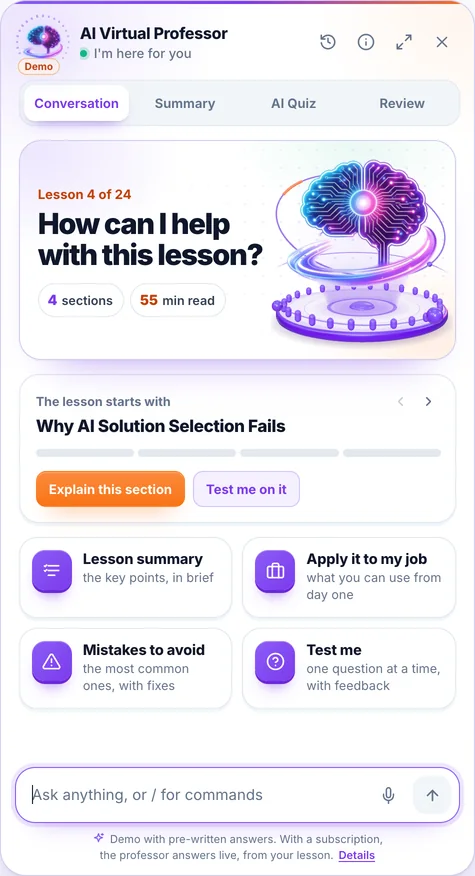
The demo opens on a lesson from the course “AI for Business Leaders”, with prepared answers; voice is off in the demo.
It is an artificial intelligence system, not a human teacher; its answers may contain errors. Details in the Terms & Conditions.
If you coach people or teach what you know, 2026 is a strange and exciting moment. Artificial intelligence can draft a lesson outline in seconds, rewrite a sales email in your tone, summarize a messy brain-dump into a clean curriculum, and answer the same student question for the hundredth time so you do not have to. Used well, AI gives a solo coach or course creator the leverage that used to require a small team. Used badly, it produces bland, dishonest content that quietly destroys the one thing your business runs on: trust.
This course is about using AI the first way. Think of it as a co-creator, not an author. You bring the expertise, the lived experience, the judgment, and the relationship with real human beings. AI brings speed, structure, and a tireless first draft. The magic — and the money — is in the combination.
What genuinely changes
Let us be concrete about where AI actually helps a coaching or course business.
- The blank page disappears. Curriculum outlines, lesson scripts, workbook prompts, email sequences, landing-page drafts — AI turns "I do not know where to start" into "here is a draft I can shape." For a creator who has ideas but freezes at execution, this alone is transformational.
- Repurposing becomes cheap. One workshop can become a lesson, a lead magnet, five social posts, a newsletter, and an FAQ entry. AI does the mechanical reshaping so you can focus on the ideas.
- Delivery gets more consistent. Session-prep summaries, intake questionnaires, follow-up templates, and support answers can be systematized, so every client gets your best thinking, not just the ones you saw when you were fresh.
- You reclaim hours. The admin that eats a solo practice — writing, formatting, answering, organizing — shrinks. Those hours go back into coaching, teaching, and rest.
A week in two practices — same coach, different leverage
To make this concrete, follow Maria, a career coach with eight one-to-one clients and a small group program, through a typical week — first without AI, then with it.
Without AI. Monday morning disappears into writing the weekly newsletter from scratch — ninety minutes of staring, drafting, and second-guessing. Before each session she re-reads old notes for fifteen minutes to remember where the client left off. After sessions she writes follow-up summaries by hand, which she often skips when tired, so clients get inconsistent follow-through. Wednesday she wants to turn last month's workshop into a lead magnet but never finds the three free hours it needs. Friday she answers the same four questions about her group program in four separately written emails. Total output: one newsletter, eight sessions delivered with variable preparation, no new lead magnet, and a nagging feeling of being behind.
With AI. Monday she records a five-minute voice note with her real opinion about a hiring trend she saw this week, and her assistant drafts the newsletter in her documented voice; she edits for fifteen minutes and ships it. Before each session, a prepared summary of her own notes gives her the client's goals, last commitments, and open threads in ninety seconds. After each session she dictates three bullet points and AI turns them into a warm, structured follow-up email she reviews and sends. Wednesday she pastes the workshop transcript into a repurposing prompt and gets a workbook draft she refines over one focused hour. Friday, her FAQ document — assembled once with AI from all past answers — lets her reply to program questions in two minutes each. Total output: everything the first week produced, plus a lead magnet, plus consistent client follow-through, in roughly six fewer working hours.
Pick up exactly where you left off
Pick the option that fits you; your account is created at checkout in under a minute:
What's next in this lesson
- What does not change — and never will
- A decision table you will use all course long
- The principle that runs through this whole course
- A note on scope — read this twice
- A first prompt you can use today
- What to do with the interview output
- Common mistakes in your first AI week
- How this course is organized
Everything you'll learn in this course
1 Module 0 — AI as a Co-Creator: Mindset, Tools, and Your Authentic Voice 3 lessons
- Why AI Changes the Coaching and Course Business in 2026 — and What Does Not Reading now 50 min
- Choosing Your AI Tools and Writing Prompts That Sound Like You 50 min
- Protecting Your Authentic Voice, Expertise, and Trust 50 min
2 Module 1 — Niche, Positioning, and Your Signature Offer 3 lessons
- Finding and Sharpening Your Niche with AI 50 min
- Designing Your Signature Offer and Program Ladder 50 min
- Understanding Your Ideal Client — Ethically and Accurately 50 min
3 Module 2 — Designing Curricula and Learning Outcomes 4 lessons
- From Expertise to a Learning Journey: Outcomes First 50 min
- Structuring Modules, Lessons, and Assessments 50 min
- Writing Lesson Scripts, Workbooks, and Slides 50 min
- Accessible, Inclusive, and Readable Course Materials 50 min
4 Module 3 — Client Delivery: Intake, Sessions, and Staying in Your Lane 3 lessons
- Client Intake and Session-Prep Workflows 50 min
- Coaching Session Support Without Losing the Human 50 min
- Scope of Practice: Staying in Your Lane 50 min
5 Module 4 — Honest Content Marketing 4 lessons
- Your Content Engine: Emails, Posts, and Newsletters 50 min
- Landing Page and Sales Copy That Tells the Truth 50 min
- Repurposing One Idea Across Formats 50 min
- Discovery Calls and Selling Without Manipulation 50 min
6 Module 5 — Lead Magnets, Audience Building, and Community 4 lessons
- Building Lead Magnets and Freebies That Deliver Real Value 50 min
- Growing an Email List and Nurturing It Honestly 50 min
- Cohorts and Communities: Structure and Facilitation 50 min
- Workshops and Webinars That Teach Before They Sell 50 min
7 Module 6 — Pricing, Packaging, and Ethical Launches 2 lessons
- Pricing and Packaging: Using AI as a Sounding Board 50 min
- Launch Planning and Ethical Promotion 50 min
8 Module 7 — Support, Systems, and Scaling Your Time 3 lessons
- Customer Support and FAQ Automation 50 min
- Repeatable Systems, SOPs, and Templates 50 min
- Measuring Outcomes and Iterating Your Program 50 min
9 Module 8 — Trust, Privacy, Ethics, and a Sustainable Practice 3 lessons
- Data Privacy and Client Confidentiality 50 min
- Truthful Marketing, Intellectual Property, and Disclosure 50 min
- A Sustainable Practice and Your 90-Day AI Plan 50 min
10 Final Quiz — AI for Coaches and Course Creators 1 lessons
- Final Assessment: AI for Coaches and Course Creators 45 min
Everything you need to learn effectively
Interactive quizzes
Check your knowledge at the end of every lesson with scored quizzes and feedback.
Personal notes
Save notes on every lesson, accessible anytime from your dashboard.
Scheduled reviews
Revisit lessons exactly when it matters, at the right intervals — so you remember for the long term.
Progress & Achievements
Track your progress, unlock achievements, and visualize what you've learned.
Bookmarks
Save the lessons that matter and find them instantly when you need them.
Questions & Answers
Ask questions right on the lesson and get answers from our team.
Good to know before you start
How do I get access to the course?
You can read the beginning of the first lesson for free, right on this page. For the course you create an account, pick the subscription that fits — a single course or a bundle — and get access immediately after your payment is confirmed. Everything happens 100% online.
Can I cancel my subscription anytime?
Yes. Cancel anytime, straight from your account, in just a few clicks. Your access stays active until the end of the period you have already paid for.
What does the subscription for this course include?
All 30 lessons in the course, interactive quizzes, the AI Professor built into every lesson (select a passage and choose “Explain this to me”), within a fair-use limit, personal notes, automatically saved progress, and content updates included.
Is there a fixed learning schedule?
No. You learn at your own pace, on any device. Lessons are structured step by step, and the platform saves your progress automatically, so you can pick up right where you left off — anytime.
Ready to unlock all the content?
Just this course — €99 / month, VAT included — or every Business course, with smart quizzes and the AI Professor included, in the bundle at €299 / month, VAT included.