
Why AI Is the Solo Operator's Unfair Advantage in 2026
From the course AI for Consultants and Freelancers: Build a Solo AI-Powered Business
In every lesson
The AI Professor starts from the lesson you have open
You ask it in writing or by voice, right from the lesson, and you can listen to the answer on request. Where needed, it fills in from general knowledge. When you select a passage, a bar appears with “Explain this to me”, “Give me an example”, “Why does it matter?” and “My own question”.
Its panel has four tabs:
- Conversation: you ask, it answers starting from the lesson
- Summary: the key ideas of the lesson, point by point
- AI Quiz: 3, 5 or 10 new questions from the lesson, with explanations
- Review: flashcards made from the lesson
Included in every subscription and in single-course access, within a fair-use limit.
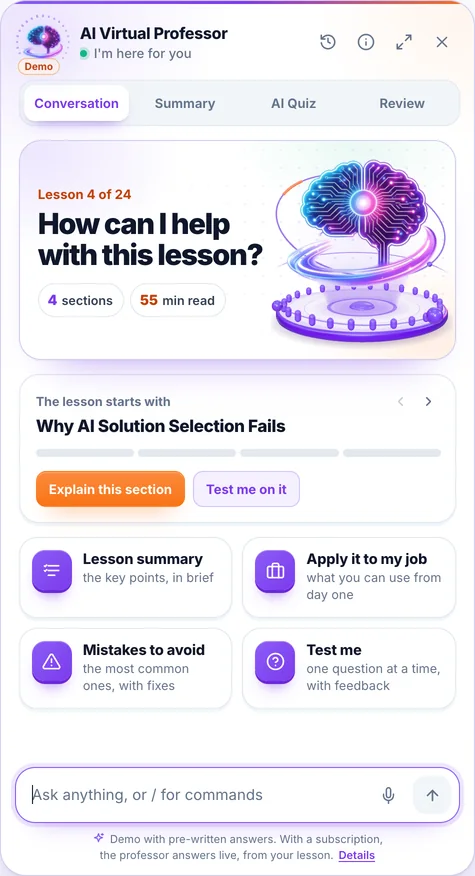
The demo opens on a lesson from the course “AI for Business Leaders”, with prepared answers; voice is off in the demo.
It is an artificial intelligence system, not a human teacher; its answers may contain errors. Details in the Terms & Conditions.
For most of business history, scale required people. To take on more clients, deliver bigger projects, or offer more services, you hired. Headcount was the growth engine — and the ceiling. In 2026, that equation has changed for one specific group more than any other: the solo consultant and the freelancer.
This course is about turning artificial intelligence into the leverage that used to require a team. Not to cut corners, and not to pretend a machine is doing expert work it cannot do — but to remove the friction, the admin, the blank-page problem, and the ten unpaid hours a week that keep solo operators stuck. Used well, AI lets one skilled person deliver like a small agency, at a fraction of the cost and stress.
The one-sentence thesis of this course
AI does the leverage; you do the judgment.
Everything that follows — prospecting, proposals, delivery, automation, pricing — hangs off that sentence. AI is extraordinary at drafts, structure, research synthesis, repetition and speed. It is unreliable at final judgment, taste, accountability and truth. Your value as a professional was never the typing. It was the thinking, the trust, and the responsibility. AI amplifies the first; it can never take on the last.
Why solo operators benefit more than big firms
Large firms have layers: analysts to do research, associates to draft, coordinators to chase follow-ups. When AI arrives, it compresses those layers — which is disruptive and political inside a big organization. For you, the solo operator, there are no layers to disrupt. You are the analyst, the associate, the coordinator and the partner. So when AI can draft the first version of a deliverable, synthesize twenty pages of research into a brief, or turn a messy call recording into a clean summary, the entire benefit lands on your desk instantly.
The result is a genuine structural shift. In 2026 a single capable consultant can:
- Respond to more opportunities because proposals take an hour, not a day.
- Deliver faster because first drafts of reports, decks and analyses appear in minutes.
- Look bigger than they are with polished, consistent output and responsive communication.
- Keep margins high because the "team" is a subscription, not a payroll.
- Reclaim time by automating onboarding, invoicing and follow-ups.
Where AI genuinely helps a solo business
Be precise about this, because vague enthusiasm leads to sloppy work. Across a typical solo practice, AI delivers real value in these zones:
- Finding clients: researching prospects, drafting personalized outreach, spotting leads in your inbox and network.
- Winning work: structuring proposals, tailoring case studies, preparing for discovery calls.
- Delivering work: research synthesis, first drafts of documents and decks, reformatting, data cleanup, brainstorming options.
- Running the business: drafting contracts and invoices from templates, follow-up sequences, scheduling, a searchable knowledge base of your own past work.
- Marketing yourself: turning one idea into a week of content, repurposing a client win into a case study, writing newsletters.
Pick up exactly where you left off
Pick the option that fits you; your account is created at checkout in under a minute:
What's next in this lesson
- Where AI must not be trusted — and why it matters for *you*
- The 2026 tool landscape, briefly
- A first prompt you can use today
- The four-question filter: should AI touch this task?
- The three eras of solo leverage
- A map of where the leverage lands
- A worked scenario: the Monday-morning proposal
- Common mistakes that erase the advantage
Everything you'll learn in this course
1 Module 0 — The Solo AI Advantage in 2026 3 lessons
- Why AI Is the Solo Operator's Unfair Advantage in 2026 Reading now 50 min
- Your Solo AI Toolkit: Models, Tools and How to Choose 50 min
- Guardrails First: Confidentiality, Liability and the Rules That Protect You 50 min
2 Module 1 — Positioning and Personal Brand 3 lessons
- Finding Your Niche and Sharpening Your Positioning with AI 50 min
- Building a Magnetic Personal Brand as a Solo Expert 50 min
- Your Portfolio, Website and Proof of Expertise 50 min
3 Module 2 — Finding and Winning Clients 5 lessons
- Lead Generation and Prospecting with AI 50 min
- Referrals and Repeat Business: Your Cheapest Growth Channel 50 min
- Cold Outreach That Gets Replies 50 min
- Writing Proposals That Close 50 min
- Discovery Calls and Qualifying Clients 50 min
4 Module 3 — Pricing and Packaging Your Services 3 lessons
- Value-Based Pricing with AI as Your Thinking Partner 50 min
- Negotiating Scope and Price with Confidence 50 min
- Productizing Your Services for Leverage 50 min
5 Module 4 — Delivering Work Faster with AI 4 lessons
- AI-Powered Research and Analysis 50 min
- Turning Data into Client-Ready Analysis and Visuals with AI 50 min
- Drafting Deliverables at Speed 50 min
- Quality Control: Verifying AI Output and Protecting Your Reputation 50 min
6 Module 5 — No-Code Automations for a Solo Business 3 lessons
- No-Code Automation Foundations with Make and Zapier 50 min
- Automating Client Onboarding and Communication 50 min
- Building Your AI Second Brain with Notion 50 min
7 Module 6 — Admin, Operations and Finance 3 lessons
- Contracts, Invoicing and Getting Paid 50 min
- Know Your Numbers: Profitability, Metrics and Pricing Reviews 50 min
- Follow-ups, CRM and Never Dropping a Ball 50 min
8 Module 7 — Content Marketing and Inbound Lead Generation 2 lessons
- A Content Engine That Runs Itself 50 min
- Turning Content into Clients: Lead Magnets and Nurture 50 min
9 Module 8 — Scaling Without Employees 3 lessons
- AI as Your Virtual Team 50 min
- Managing Multiple Clients and Your Time 50 min
- Guardrails at Scale: Confidentiality, Disclosure and Professional Liability 50 min
10 Final Quiz — Build a Solo AI-Powered Business 1 lessons
- Final Assessment: AI for Consultants and Freelancers 45 min
Everything you need to learn effectively
Interactive quizzes
Check your knowledge at the end of every lesson with scored quizzes and feedback.
Personal notes
Save notes on every lesson, accessible anytime from your dashboard.
Scheduled reviews
Revisit lessons exactly when it matters, at the right intervals — so you remember for the long term.
Progress & Achievements
Track your progress, unlock achievements, and visualize what you've learned.
Bookmarks
Save the lessons that matter and find them instantly when you need them.
Questions & Answers
Ask questions right on the lesson and get answers from our team.
Good to know before you start
How do I get access to the course?
You can read the beginning of the first lesson for free, right on this page. For the course you create an account, pick the subscription that fits — a single course or a bundle — and get access immediately after your payment is confirmed. Everything happens 100% online.
Can I cancel my subscription anytime?
Yes. Cancel anytime, straight from your account, in just a few clicks. Your access stays active until the end of the period you have already paid for.
What does the subscription for this course include?
All 30 lessons in the course, interactive quizzes, the AI Professor built into every lesson (select a passage and choose “Explain this to me”), within a fair-use limit, personal notes, automatically saved progress, and content updates included.
Is there a fixed learning schedule?
No. You learn at your own pace, on any device. Lessons are structured step by step, and the platform saves your progress automatically, so you can pick up right where you left off — anytime.
Ready to unlock all the content?
Just this course — €99 / month, VAT included — or every Business course, with smart quizzes and the AI Professor included, in the bundle at €299 / month, VAT included.