
What AIOps Actually Means in 2026
From the course AI for DevOps and SRE: AIOps in Practice
In every lesson
The AI Professor starts from the lesson you have open
You ask it in writing or by voice, right from the lesson, and you can listen to the answer on request. Where needed, it fills in from general knowledge. When you select a passage, a bar appears with “Explain this to me”, “Give me an example”, “Why does it matter?” and “My own question”.
Its panel has four tabs:
- Conversation: you ask, it answers starting from the lesson
- Summary: the key ideas of the lesson, point by point
- AI Quiz: 3, 5 or 10 new questions from the lesson, with explanations
- Review: flashcards made from the lesson
Included in every subscription and in single-course access, within a fair-use limit.
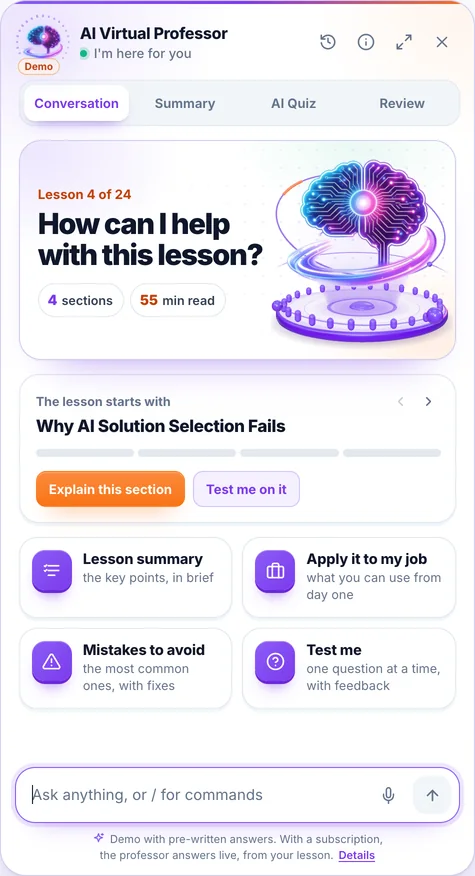
The demo opens on a lesson from the course “AI for Business Leaders”, with prepared answers; voice is off in the demo.
It is an artificial intelligence system, not a human teacher; its answers may contain errors. Details in the Terms & Conditions.
AIOps — Artificial Intelligence for IT Operations — is one of the most abused terms in the industry. Vendors slap it on every dashboard with a threshold rule and call it AI. This course takes a precise, engineering-first view. AIOps in 2026 means using statistical methods, classical machine learning, and large language models to help operations and reliability teams detect problems earlier, understand them faster, and respond more safely — without replacing human judgment on production systems. The goal is not autonomy for its own sake; it is leverage. A good AIOps setup lets a small on-call rotation run a large, complex platform with fewer 3 a.m. pages and shorter incidents.
From reactive operations to AI-augmented reliability
Traditional operations were reactive. You wrote static threshold alerts (CPU over 80 percent, error rate over 5 percent), waited for something to breach them, and then a human paged through dashboards trying to correlate signals by hand. This worked when systems were small and monolithic. It falls apart in a world of hundreds of microservices, ephemeral containers, multi-region deployments, and dozens of daily releases. The signal-to-noise ratio collapses: static thresholds either fire constantly (alert fatigue) or miss the subtle, correlated degradations that actually cause outages.
AI-augmented reliability changes the workflow at three points. First, detection shifts from fixed thresholds to models that learn normal behavior and flag deviations, including seasonal and multi-dimensional patterns a human would never tune by hand. Second, understanding shifts from manual dashboard-surfing to AI that correlates metrics, logs, and traces and drafts a plausible explanation with supporting evidence. Third, response shifts from tribal knowledge to AI-assisted runbooks that surface the right next action while keeping a human firmly in control of anything that mutates production.
The four pillars of AIOps
It helps to organize AIOps into four capabilities, each of which we will develop across this course:
- Observe — collect high-quality telemetry (metrics, logs, traces, events, profiles) with consistent metadata. AI is only as good as the signals it reasons over. Garbage telemetry produces confident, wrong conclusions.
- Detect — find anomalies and predict incidents before users feel them, using forecasting, outlier detection, and correlation rather than brittle static rules.
- Diagnose — accelerate root cause analysis by correlating signals across services and summarizing what changed, so the mean time to understanding drops.
- Act — recommend and, where truly safe, help execute remediation, always with human oversight, audit trails, and a fast rollback path.
A mature team does not adopt all four at once. Most start with better observability and detection, then add AI-assisted diagnosis, and only much later automate narrow, well-understood remediations behind guardrails.
Where LLMs fit — and where they do not
Large language models such as Claude Opus 5.5, Claude Sonnet 5, GPT-6 Sol, and Gemini 3.1 Pro are extraordinary at a specific class of operations tasks: summarizing long, messy logs; explaining an unfamiliar stack trace; drafting a PromQL query from a plain-English question; proposing hypotheses during an incident; writing a first-draft postmortem; and generating or reviewing Infrastructure as Code. They are pattern engines that compress human operational knowledge into fast, on-demand assistance.
Pick up exactly where you left off
Pick the option that fits you; your account is created at checkout in under a minute:
What's next in this lesson
- The non-negotiable guardrails
- What success looks like
- The AIOps maturity model
- A quick test: real AIOps or an AI sticker?
- Worked scenario: one incident, three maturity levels
- Common misconceptions to unlearn
- A pragmatic first-90-days plan
- In practice: the sentence that keeps you honest
Everything you'll learn in this course
1 AIOps in 2026: Foundations and the Modern Stack 3 lessons
- What AIOps Actually Means in 2026 Reading now 48 min
- The Modern Observability and AIOps Stack 48 min
- LLMs in the SRE Workflow: Capabilities, Limits, and Oversight 48 min
2 Intelligent Observability: OpenTelemetry, Prometheus, Grafana 3 lessons
- OpenTelemetry Deep Dive: Signals, Collector, Conventions 48 min
- Prometheus and PromQL for AI-Driven Alerting 48 min
- Grafana and LLM-Assisted Querying and Dashboards 48 min
3 Anomaly Detection and Intelligent Alerting 4 lessons
- Anomaly Detection Fundamentals for Operations 48 min
- Cutting Alert Fatigue: Correlation, Grouping, Deduplication 48 min
- Predictive Alerting and Building Intelligent Pipelines 48 min
- SLOs, Error Budgets, and AI-Assisted Reliability Targets 48 min
4 AI-Assisted Log and Trace Analysis 3 lessons
- LLM-Powered Log Analysis: Patterns, Summaries, Search 48 min
- Distributed Trace Analysis with AI 48 min
- Data Privacy and PII in Telemetry: The GDPR Guardrail 48 min
5 AI-Assisted Incident Response and On-Call 3 lessons
- The Incident Lifecycle and Where AI Augments It 48 min
- AI Copilots for On-Call: Triage, Context, and Comms 48 min
- Blameless Postmortems and AI-Assisted RCA 48 min
6 Root Cause Analysis Assisted by AI 3 lessons
- RCA Methodologies and Causal Reasoning with AI 48 min
- Correlating Signals Across Telemetry for RCA 48 min
- Change-Based RCA: What Changed and Why It Matters 48 min
7 AI in CI/CD Pipelines and Infrastructure as Code 3 lessons
- AI in CI/CD Pipelines: Tests, Builds, and PR Review 48 min
- Infrastructure as Code with AI: Terraform and Pulumi 48 min
- Progressive Delivery and Deployment Safety with AI 48 min
8 ChatOps, Runbook Automation, and Kubernetes Operations 3 lessons
- ChatOps and Runbook Automation with AI 48 min
- Agentic Automation and the Guardrails of Human Oversight 48 min
- Kubernetes Operations with AI 48 min
9 Capacity, Cost Optimization, DevSecOps, and Case Studies 4 lessons
- Capacity Planning and Forecasting with AI 48 min
- Cloud Cost Optimization (FinOps) with AI 48 min
- DevSecOps: AI in Security, Supply Chain, and Secrets 48 min
- Case Studies and an AIOps Adoption Roadmap 48 min
10 Final Quiz — AI for DevOps and SRE 1 lessons
- Final Assessment — AI for DevOps and SRE: AIOps in Practice 58 min
Everything you need to learn effectively
Interactive quizzes
Check your knowledge at the end of every lesson with scored quizzes and feedback.
Personal notes
Save notes on every lesson, accessible anytime from your dashboard.
Scheduled reviews
Revisit lessons exactly when it matters, at the right intervals — so you remember for the long term.
Progress & Achievements
Track your progress, unlock achievements, and visualize what you've learned.
Bookmarks
Save the lessons that matter and find them instantly when you need them.
Questions & Answers
Ask questions right on the lesson and get answers from our team.
Good to know before you start
How do I get access to the course?
You can read the beginning of the first lesson for free, right on this page. For the course you create an account, pick the subscription that fits — a single course or a bundle — and get access immediately after your payment is confirmed. Everything happens 100% online.
Can I cancel my subscription anytime?
Yes. Cancel anytime, straight from your account, in just a few clicks. Your access stays active until the end of the period you have already paid for.
What does the subscription for this course include?
All 30 lessons in the course, interactive quizzes, the AI Professor built into every lesson (select a passage and choose “Explain this to me”), within a fair-use limit, personal notes, automatically saved progress, and content updates included.
Is there a fixed learning schedule?
No. You learn at your own pace, on any device. Lessons are structured step by step, and the platform saves your progress automatically, so you can pick up right where you left off — anytime.
Ready to unlock all the content?
Just this course — €99 / month, VAT included — or every IT Pro course, with smart quizzes and the AI Professor included, in the bundle at €399 / month, VAT included.