
Why AI Changes the Job Search in 2026 — and What Stays the Same
From the course AI for Your Job Search and Career Growth
In every lesson
The AI Professor starts from the lesson you have open
You ask it in writing or by voice, right from the lesson, and you can listen to the answer on request. Where needed, it fills in from general knowledge. When you select a passage, a bar appears with “Explain this to me”, “Give me an example”, “Why does it matter?” and “My own question”.
Its panel has four tabs:
- Conversation: you ask, it answers starting from the lesson
- Summary: the key ideas of the lesson, point by point
- AI Quiz: 3, 5 or 10 new questions from the lesson, with explanations
- Review: flashcards made from the lesson
Included in every subscription and in single-course access, within a fair-use limit.
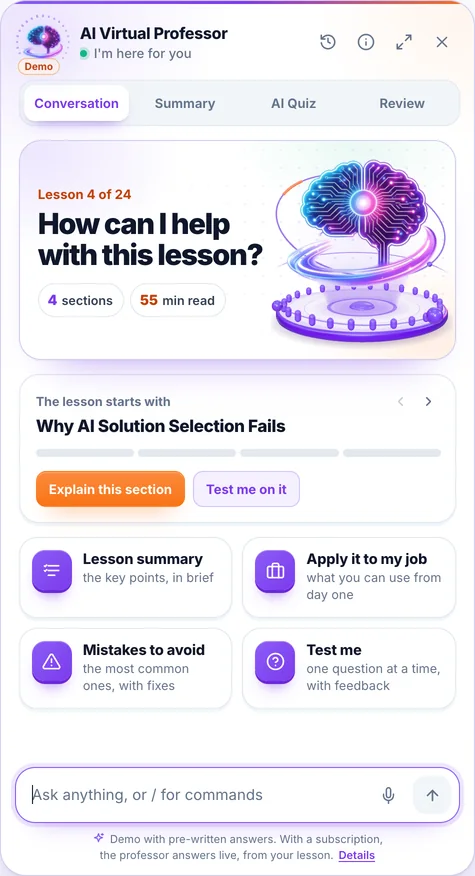
The demo opens on a lesson from the course “AI for Business Leaders”, with prepared answers; voice is off in the demo.
It is an artificial intelligence system, not a human teacher; its answers may contain errors. Details in the Terms & Conditions.
In 2026, artificial intelligence is part of almost every job search — often on both sides of the table. Candidates use it to write resumes, prepare for interviews, and research companies. Employers use it to filter applications, screen candidates, schedule interviews, and even draft interview questions. If you understand how AI works in this process, you have a real advantage. If you ignore it, you are competing with one hand tied behind your back.
This course teaches you to use AI as a career co-pilot — a tool that helps you prepare harder, write more clearly, and think more strategically. It is not a magic button that finds you a job while you sleep, and it is absolutely not a way to fake your way into a role you are not ready for. The goal is simple: use AI to express the truth about you better, not to invent a person who does not exist.
The 2026 landscape in one honest paragraph
The current generation of AI assistants — Claude (with models like Sonnet 5 and Opus 5.5), OpenAI's GPT-6 Sol in ChatGPT, and Google's Gemini 3.1 Pro — can hold long, coherent conversations and work with entire documents at once, and the models of recent years have shown remarkable skill at adapting tone and structure. That is genuinely useful for a job seeker: your resume, a job description, and your notes all fit in one conversation, and the assistant can cross-reference them. What these models still cannot do is know your life. They know nothing about your real projects, your actual numbers, or the way your last manager would describe you — unless you tell them, accurately. Every impressive output is built from what you put in. That single fact shapes everything in this course: the quality of your inputs (real facts, real stories, real numbers) determines whether AI makes you sharper or just makes you sound like everyone else.
What actually changes with AI
Let us be precise about where AI genuinely helps a job seeker in 2026.
- Speed of the first draft. A blank page is the enemy of momentum. AI turns "I do not know how to start" into "here is a draft I can improve" — for resumes, cover letters, LinkedIn summaries, and outreach messages. What used to take an evening of staring now takes twenty minutes of editing.
- Tailoring at scale. Adapting your resume to each job used to take an hour. With a good workflow, AI helps you do it in minutes, so you can apply thoughtfully instead of blasting the same generic CV everywhere. Ten tailored applications beat fifty identical ones.
- Preparation and practice. You can run realistic mock interviews, get feedback on your answers, and rehearse difficult conversations like salary negotiation — as many times as you want, without judgment, at midnight in your kitchen if that is when you have time.
- Research and clarity. AI helps you digest long company pages, understand an industry, decode a confusing job description, and clarify what you actually want from your next role. It compresses hours of scattered reading into a structured briefing you then verify.
- Feedback you would not otherwise get. Most rejected candidates never learn why. An AI assistant can critique your resume against a job description, point out vague bullets, and flag jargon — imperfectly, but instantly and endlessly patiently.
Pick up exactly where you left off
Pick the option that fits you; your account is created at checkout in under a minute:
What's next in this lesson
- What does not change — and never will
- The other side of the table: how employers use AI
- The one principle to carry through the whole course
- A first prompt you can use today
- Common mistakes to avoid from day one
- How this course is organized
Everything you'll learn in this course
1 Module 0 — AI for Your Career in 2026: Mindset and Integrity 3 lessons
- Why AI Changes the Job Search in 2026 — and What Stays the Same Reading now 50 min
- Your AI Job-Search Toolkit: Real Tools and a Safe Setup 50 min
- The Integrity Rule: Using AI Honestly (and Verifying Its Output) 50 min
2 Module 1 — Career Clarity and Honest Self-Assessment 3 lessons
- Clarify What You Actually Want with AI-Assisted Reflection 50 min
- Build an Honest Skills Inventory and Spot Transferable Strengths 50 min
- Set Realistic Targets: Roles, Companies, and a Timeline 50 min
3 Module 2 — Your Resume, Optimized with AI and ATS-Friendly 4 lessons
- Anatomy of a Modern, ATS-Friendly Resume 50 min
- Writing Powerful, Honest Achievement Bullets with AI 50 min
- Tailoring Your Resume to Each Job Description with AI 50 min
- Inside the Employer's AI Stack: Screening, Background Checks, and Your Data Rights 50 min
4 Module 3 — Cover Letters and Written Applications 3 lessons
- Writing a Personalized Cover Letter with AI 50 min
- Application Questions and Outreach Emails, Done Well 50 min
- Addressing Career Gaps and Career Changes Honestly 50 min
5 Module 4 — LinkedIn and Personal Branding 2 lessons
- Optimizing Your LinkedIn Profile with AI 50 min
- Personal Branding and Content That Builds Credibility 50 min
6 Module 5 — Company Research and Interview Preparation 4 lessons
- Researching Companies, Roles, and Industries with AI 50 min
- Common Interview Questions and Structured Answers (STAR) 50 min
- Running Realistic Mock Interviews with AI 50 min
- One-Way Video Interviews and AI-Led Screens: Performing Well, Staying Yourself 50 min
7 Module 6 — Salary Negotiation 2 lessons
- Researching Your Market Value with AI 50 min
- Negotiating the Offer with AI Help 50 min
8 Module 7 — Networking, Follow-Up, and Managing Your Search 4 lessons
- Networking and Informational Interviews with AI 50 min
- Follow-Up and Application Tracking with AI 50 min
- Managing Rejection and Staying Motivated 50 min
- Job Scams, Fake Postings, and Protecting Yourself During the Search 50 min
9 Module 8 — Upskilling, Portfolio, and Long-Term Career Growth 4 lessons
- Building a Development Plan and Upskilling with AI 50 min
- Building a Portfolio and Personal Projects 50 min
- Growing Your Career Over the Long Term 50 min
- Your New Job: The First 90 Days, Workplace AI Rules, and Early Momentum 50 min
10 Final Quiz — AI for Your Job Search and Career Growth 1 lessons
- Final Assessment: AI for Your Job Search and Career Growth 55 min
Everything you need to learn effectively
Interactive quizzes
Check your knowledge at the end of every lesson with scored quizzes and feedback.
Personal notes
Save notes on every lesson, accessible anytime from your dashboard.
Scheduled reviews
Revisit lessons exactly when it matters, at the right intervals — so you remember for the long term.
Progress & Achievements
Track your progress, unlock achievements, and visualize what you've learned.
Bookmarks
Save the lessons that matter and find them instantly when you need them.
Questions & Answers
Ask questions right on the lesson and get answers from our team.
Good to know before you start
How do I get access to the course?
You can read the beginning of the first lesson for free, right on this page. For the course you create an account, pick the subscription that fits — a single course or a bundle — and get access immediately after your payment is confirmed. Everything happens 100% online.
Can I cancel my subscription anytime?
Yes. Cancel anytime, straight from your account, in just a few clicks. Your access stays active until the end of the period you have already paid for.
What does the subscription for this course include?
All 30 lessons in the course, interactive quizzes, the AI Professor built into every lesson (select a passage and choose “Explain this to me”), within a fair-use limit, personal notes, automatically saved progress, and content updates included.
Is there a fixed learning schedule?
No. You learn at your own pace, on any device. Lessons are structured step by step, and the platform saves your progress automatically, so you can pick up right where you left off — anytime.
Ready to unlock all the content?
Just this course — €99 / month, VAT included — or every Business course, with smart quizzes and the AI Professor included, in the bundle at €299 / month, VAT included.