
AI in Operations and Supply Chain in 2026: What Is Real
From the course AI for Operations and Supply Chain
In every lesson
The AI Professor starts from the lesson you have open
You ask it in writing or by voice, right from the lesson, and you can listen to the answer on request. Where needed, it fills in from general knowledge. When you select a passage, a bar appears with “Explain this to me”, “Give me an example”, “Why does it matter?” and “My own question”.
Its panel has four tabs:
- Conversation: you ask, it answers starting from the lesson
- Summary: the key ideas of the lesson, point by point
- AI Quiz: 3, 5 or 10 new questions from the lesson, with explanations
- Review: flashcards made from the lesson
Included in every subscription and in single-course access, within a fair-use limit.
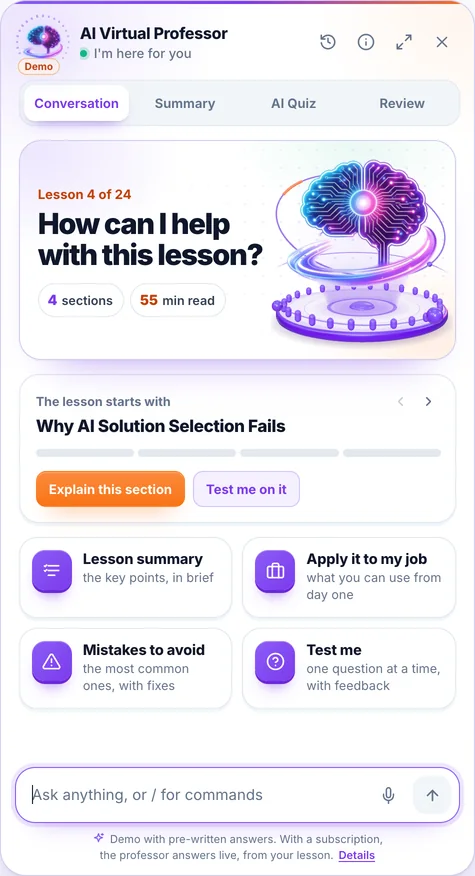
The demo opens on a lesson from the course “AI for Business Leaders”, with prepared answers; voice is off in the demo.
It is an artificial intelligence system, not a human teacher; its answers may contain errors. Details in the Terms & Conditions.
By 2026, artificial intelligence has moved from pilot slides into the daily rhythm of operations and supply chain work. Planners run forecasts that a model has already pre-adjusted for seasonality and promotions. Buyers open a supplier review with a risk summary drafted overnight. Warehouse managers get a shift plan that already accounts for the order profile coming down the pipe. But there is a wide gap between teams that use AI as a disciplined tool and teams that treat it as an oracle. This course closes that gap. It teaches you to use AI to assist operations professionals, not to replace the judgment that keeps a supply chain safe, legal, and profitable.
This first lesson is your map: where AI genuinely helps across the end-to-end chain, where it does not, why the technology matured when it did, and the single principle that keeps you out of trouble.
The one-sentence summary of this whole course
AI assists. Humans decide.
Everything else — the prompts, the planning workflows, the tooling — hangs off that sentence. Supply chains move money, materials, and people. A bad automated call can strand a container, starve a production line, or send a driver down an unsafe route. AI is superb at the first draft and the pattern across thousands of SKUs; it is weak at the final judgment and the exception that matters most. Keep that asymmetry in mind and you will deploy it well.
The asymmetry has a structural cause worth understanding. Machine learning models — whether a gradient-boosted forecasting engine or a large language model — learn regularities from historical data. They excel exactly where the future resembles the past at scale: thousands of item-location combinations, millions of tracking events, years of sensor readings. They fail exactly where the situation is novel, political, or morally loaded: the strategic customer whose order you protect at a loss, the supplier you keep through a bad quarter because of a twenty-year relationship, the safety call where "probably fine" is not acceptable. No model has that context unless a human supplies it, and even then, accountability cannot be delegated to software.
Why 2026 is different from 2020
Three shifts converged to make AI a daily operations tool rather than a data-science side project.
First, the planning and execution vendors embedded it. You no longer need a data-science team to get machine-learning forecasting: SAP Integrated Business Planning, Kinaxis, Blue Yonder, o9 Solutions, and Oracle Fusion Cloud SCM ship it inside the product, alongside conversational assistants (SAP's is called Joule). The barrier to entry collapsed from "hire ML engineers" to "switch on a feature and govern it."
Second, general-purpose language models became genuinely useful for operations language work. Models such as Claude (Opus 5.5, Sonnet 5, Fable 5.1), GPT-6 Sol, and Gemini 3.1 Pro, plus Microsoft 365 Copilot inside Office documents, can summarize a 40-page supplier contract, draft an S&OP narrative, classify free-text spend descriptions, or explain a forecast exception in plain language. The huge volume of text work in supply chain — emails, contracts, specs, claims, reports — finally got a power tool.
Third, the data got better. Real-time visibility platforms (project44, FourKites), cheap IoT sensors on machines and trailers, and cloud data platforms that join ERP, WMS and TMS data mean models finally have something worth learning from. This matters because data quality — not model quality — is the ceiling on AI value in a supply chain.
Pick up exactly where you left off
Pick the option that fits you; your account is created at checkout in under a minute:
What's next in this lesson
- Where AI genuinely helps across the chain
- Plan
- Source
- Make
- Deliver
- A realistic day with AI: three roles
- What AI cannot (and must not) do in operations
- The regulatory frame you will meet in this course
Everything you'll learn in this course
1 Module 0 — AI in Operations and Supply Chain in 2026 4 lessons
- AI in Operations and Supply Chain in 2026: What Is Real Reading now 50 min
- The Ops and Supply Chain Tech Stack: ERP, SCM and the AI Layer 50 min
- Data Foundations: Master Data, Integration and the Digital Thread 50 min
- The Golden Rule and Guardrails: AI Assists, Humans Decide 50 min
2 Module 1 — Demand Forecasting and Planning 4 lessons
- Demand Forecasting Fundamentals with AI 50 min
- Demand Sensing, External Signals and New Product Forecasting 50 min
- Building and Improving a Forecast: A Practical Workflow 50 min
- Forecast Accuracy, Bias and Human Review 50 min
3 Module 2 — Inventory Optimization 3 lessons
- Inventory Optimization with AI: Safety Stock and Reorder Points 50 min
- Multi-Echelon Inventory, Perishables and Slow Movers 50 min
- Inventory Health: ABC/XYZ Segmentation, Service Levels and Excess Stock 50 min
4 Module 3 — Procurement and Supplier Management 3 lessons
- AI-Assisted Procurement and Spend Analysis 50 min
- Supplier Selection, Risk and Performance Management 50 min
- Contract and Negotiation Support with AI 50 min
5 Module 4 — Logistics, Route Optimization and Fulfillment 4 lessons
- Route and Transportation Optimization with AI 50 min
- Freight, Carrier Selection and Last-Mile Delivery 50 min
- Warehouse Operations and Fulfillment Automation 50 min
- Network Design, Simulation and Supply Chain Digital Twins 50 min
6 Module 5 — Production, Quality and Maintenance 4 lessons
- Production and Manufacturing Planning with AI 50 min
- Quality Control and Computer Vision 50 min
- Predictive Maintenance and Asset Reliability 50 min
- Generative AI on the Shop Floor: Work Instructions and Frontline Copilots 50 min
7 Module 6 — Supply Chain Visibility and Risk Management 2 lessons
- End-to-End Visibility and Control Towers 50 min
- Risk Management, Disruptions and Resilience 50 min
8 Module 7 — Process Automation and Integrated Planning 2 lessons
- Intelligent Process Automation: RPA plus AI 50 min
- S&OP and Integrated Business Planning with AI 50 min
9 Module 8 — Sustainability, Cost and Governance 3 lessons
- Sustainability and Cost Optimization with AI 50 min
- Building the Business Case: ROI, Pilots and Scaling AI in Operations 50 min
- Governance, Guardrails and an AI-Ready Operations Team 50 min
10 Final Quiz — AI for Operations and Supply Chain 1 lessons
- Final Assessment: AI Across Operations and the Supply Chain 55 min
Everything you need to learn effectively
Interactive quizzes
Check your knowledge at the end of every lesson with scored quizzes and feedback.
Personal notes
Save notes on every lesson, accessible anytime from your dashboard.
Scheduled reviews
Revisit lessons exactly when it matters, at the right intervals — so you remember for the long term.
Progress & Achievements
Track your progress, unlock achievements, and visualize what you've learned.
Bookmarks
Save the lessons that matter and find them instantly when you need them.
Questions & Answers
Ask questions right on the lesson and get answers from our team.
Good to know before you start
How do I get access to the course?
You can read the beginning of the first lesson for free, right on this page. For the course you create an account, pick the subscription that fits — a single course or a bundle — and get access immediately after your payment is confirmed. Everything happens 100% online.
Can I cancel my subscription anytime?
Yes. Cancel anytime, straight from your account, in just a few clicks. Your access stays active until the end of the period you have already paid for.
What does the subscription for this course include?
All 30 lessons in the course, interactive quizzes, the AI Professor built into every lesson (select a passage and choose “Explain this to me”), within a fair-use limit, personal notes, automatically saved progress, and content updates included.
Is there a fixed learning schedule?
No. You learn at your own pace, on any device. Lessons are structured step by step, and the platform saves your progress automatically, so you can pick up right where you left off — anytime.
Ready to unlock all the content?
Just this course — €99 / month, VAT included — or every Business course, with smart quizzes and the AI Professor included, in the bundle at €299 / month, VAT included.