
How AI Fits the Research Workflow in 2026
From the course AI for Research and Academia
In every lesson
The AI Professor starts from the lesson you have open
You ask it in writing or by voice, right from the lesson, and you can listen to the answer on request. Where needed, it fills in from general knowledge. When you select a passage, a bar appears with “Explain this to me”, “Give me an example”, “Why does it matter?” and “My own question”.
Its panel has four tabs:
- Conversation: you ask, it answers starting from the lesson
- Summary: the key ideas of the lesson, point by point
- AI Quiz: 3, 5 or 10 new questions from the lesson, with explanations
- Review: flashcards made from the lesson
Included in every subscription and in single-course access, within a fair-use limit.
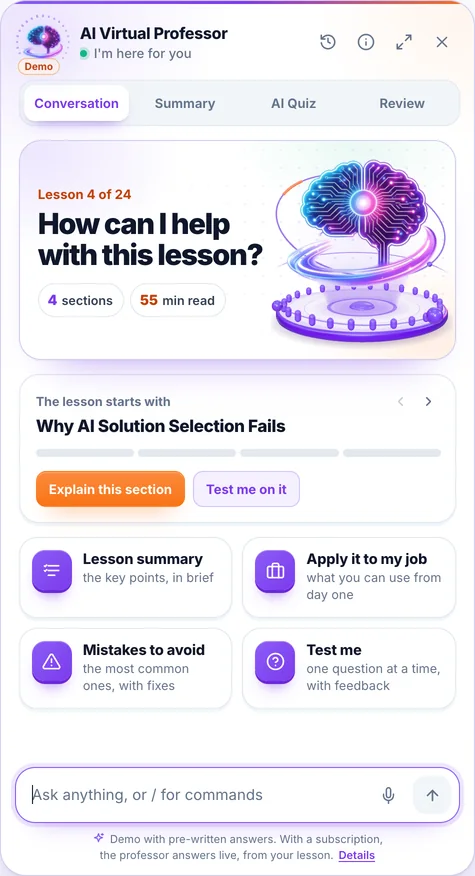
The demo opens on a lesson from the course “AI for Business Leaders”, with prepared answers; voice is off in the demo.
It is an artificial intelligence system, not a human teacher; its answers may contain errors. Details in the Terms & Conditions.
By 2026, artificial intelligence has quietly become part of almost every stage of academic work — but not in the way the hype suggests. It does not do research for you. It does not know whether a claim is true. It has never read your dataset, sat in your lab, or understood your field the way you do after years of study. What it does well is accelerate the supporting work around research: turning a blank page into a first draft, compressing a fifty-page report into a page you can scan, rephrasing a clumsy sentence, and helping you see the shape of an argument before you commit to it.
This course teaches you to use AI as a scholarly co-pilot across the research lifecycle — from finding literature to disseminating results — without ever crossing the lines that matter in academia. Those lines are not decoration. Cross them and you risk your degree, your funding, your publications, and your reputation. Respect them and AI becomes one of the most useful assistants a researcher has ever had.
The research lifecycle, stage by stage
Think of your work as a cycle. AI can support most stages, but its role is different in each.
- Question and design. Brainstorming research questions, pressure-testing a hypothesis, mapping what a methodology involves. AI is a sparring partner here, not an authority.
- Literature discovery. Finding relevant papers, understanding an unfamiliar subfield, mapping how ideas connect. Specialized tools help, but every result must be verified at the source.
- Reading and synthesis. Summarizing dense papers, extracting arguments, building a synthesis across many sources, taking structured notes.
- Analysis. Conceptual help with code for data analysis, explaining a statistical method, debugging a script. AI never invents data or results.
- Writing. Structuring a manuscript, improving clarity, tightening prose — especially valuable for non-native English speakers.
- Funding. Structuring grant proposals, tailoring language to a funder, clarifying aims.
- Dissemination. Presentations, posters, plain-language summaries, and reading peer review more effectively.
Notice a pattern: AI is strongest at structure, language, and speed of a first pass, and weakest at truth, novelty, and judgment. Your scholarly value lives in the second set. Guard it.
What genuinely improves with AI
Let us be precise, because vague promises are how people get burned.
- The blank-page problem disappears. You always have a rough draft to react to, which is far easier than creating from nothing.
- Comprehension speeds up. A dense methods section becomes navigable when AI gives you a plain-language map first — which you then read the original to confirm.
- Language stops being a barrier. A brilliant result described in awkward English gets the clear, precise expression it deserves.
- Iteration is cheap. You can restructure an argument five different ways in minutes and pick the strongest.
What does not change — and must not
Here is the part most AI-hype skips.
- You are fully accountable for every word you submit. Not the model. You. If an AI-inserted citation is fake and it reaches a reviewer, that is your error, not the tool's.
- AI hallucinates confidently. It will invent references, DOIs, quotes, and page numbers that look perfect and do not exist. This is not an edge case; it is a defining property. We will return to it constantly.
- Integrity is non-negotiable. AI is a drafting and thinking aid, not a ghostwriter. Presenting AI-generated scholarship as your own original work — where that is prohibited — is misconduct.
- Policies vary and you must check them. Your institution and each target journal or funder has its own rules on AI use and disclosure. There is no universal rule; there is your rule for your venue, which you look up.
Pick up exactly where you left off
Pick the option that fits you; your account is created at checkout in under a minute:
What's next in this lesson
- The one principle to carry through the whole course
- A first prompt you can use today
- A worked example: one week in a doctoral project
- Decision table: what to delegate, what to keep
- Five failure patterns to recognize from day one
- Your integrity baseline: a setup checklist
- How this course is organized
Everything you'll learn in this course
1 Module 0 — AI in the Research Lifecycle: Mindset and Integrity 4 lessons
- How AI Fits the Research Workflow in 2026 Reading now 50 min
- The 2026 Research AI Toolkit — An Honest Map 50 min
- Academic Integrity: The Spine of Everything 52 min
- Prompting Foundations for Researchers 52 min
2 Module 1 — Literature Discovery and Search 4 lessons
- Building a Literature Search Strategy with AI 52 min
- The AI Literature-Tool Landscape and How to Use It 50 min
- Staying Current: Alerts, Feeds, and Triage 50 min
- Systematic and Scoping Reviews: Where AI Fits 52 min
3 Module 2 — Reading, Summarizing, and Synthesizing 4 lessons
- Summarizing Dense Papers Without Losing Rigor 52 min
- Synthesizing Across Many Papers 52 min
- Smart Note-Taking and a Research Second Brain 50 min
- Critically Appraising Papers with AI Support 52 min
4 Module 3 — Citations, References, and the Hallucination Problem 3 lessons
- Why AI Fabricates Citations — and How to Never Get Burned 52 min
- Reference Management with Zotero, Mendeley, and AI 50 min
- Verifying Facts, Quotes, and Statistics 50 min
5 Module 4 — Research Questions, Design, and Brainstorming 2 lessons
- Brainstorming and Refining Research Questions 52 min
- Conceptual Help with Research Methodology 52 min
6 Module 5 — Academic Writing and Structuring Papers 4 lessons
- Structuring a Paper with AI (IMRaD and Beyond) 52 min
- Clarity for Non-Native English Researchers 52 min
- Responsible Paraphrasing, Plagiarism, and Self-Plagiarism 52 min
- Revising, Editing, and Working with Feedback 52 min
7 Module 6 — Grants, Proposals, and Funding 2 lessons
- Structuring a Grant Proposal with AI 52 min
- Tailoring Proposals to Funders and Reviewers 50 min
8 Module 7 — Data Analysis Help and Coding (Conceptual) 2 lessons
- AI as a Coding Copilot for Data Analysis 52 min
- Explaining Statistics and Debugging, Conceptually 50 min
9 Module 8 — Dissemination: Presentations, Peer Review, and Career 4 lessons
- Presentations and Conference Posters 50 min
- Peer Review: Reading, Responding, and Confidentiality 52 min
- Communicating Research Beyond Academia 52 min
- Managing an Academic Career and Reputation 50 min
10 Final Quiz 1 lessons
- Final Assessment: AI for Research and Academia 22 min
Everything you need to learn effectively
Interactive quizzes
Check your knowledge at the end of every lesson with scored quizzes and feedback.
Personal notes
Save notes on every lesson, accessible anytime from your dashboard.
Scheduled reviews
Revisit lessons exactly when it matters, at the right intervals — so you remember for the long term.
Progress & Achievements
Track your progress, unlock achievements, and visualize what you've learned.
Bookmarks
Save the lessons that matter and find them instantly when you need them.
Questions & Answers
Ask questions right on the lesson and get answers from our team.
Good to know before you start
How do I get access to the course?
You can read the beginning of the first lesson for free, right on this page. For the course you create an account, pick the subscription that fits — a single course or a bundle — and get access immediately after your payment is confirmed. Everything happens 100% online.
Can I cancel my subscription anytime?
Yes. Cancel anytime, straight from your account, in just a few clicks. Your access stays active until the end of the period you have already paid for.
What does the subscription for this course include?
All 30 lessons in the course, interactive quizzes, the AI Professor built into every lesson (select a passage and choose “Explain this to me”), within a fair-use limit, personal notes, automatically saved progress, and content updates included.
Is there a fixed learning schedule?
No. You learn at your own pace, on any device. Lessons are structured step by step, and the platform saves your progress automatically, so you can pick up right where you left off — anytime.
Ready to unlock all the content?
Just this course — €99 / month, VAT included — or every Business course, with smart quizzes and the AI Professor included, in the bundle at €299 / month, VAT included.