
AI Image Generation in 2026: The Real Business Value It Delivers
From the course AI Image Generation: The Complete Guide from Prompt to Publishing
In every lesson
The AI Professor starts from the lesson you have open
You ask it in writing or by voice, right from the lesson, and you can listen to the answer on request. Where needed, it fills in from general knowledge. When you select a passage, a bar appears with “Explain this to me”, “Give me an example”, “Why does it matter?” and “My own question”.
Its panel has four tabs:
- Conversation: you ask, it answers starting from the lesson
- Summary: the key ideas of the lesson, point by point
- AI Quiz: 3, 5 or 10 new questions from the lesson, with explanations
- Review: flashcards made from the lesson
Included in every subscription and in single-course access, within a fair-use limit.
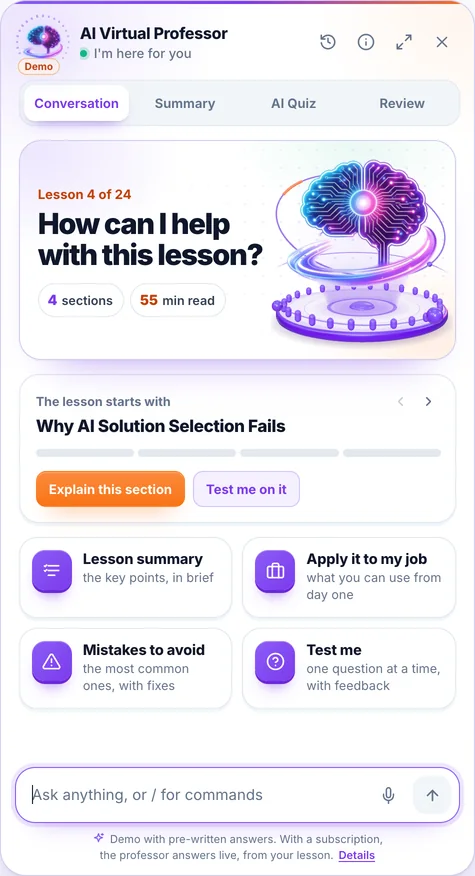
The demo opens on a lesson from the course “AI for Business Leaders”, with prepared answers; voice is off in the demo.
It is an artificial intelligence system, not a human teacher; its answers may contain errors. Details in the Terms & Conditions.
A professional photo shoot for 50 visuals can cost you several thousand euros and days of waiting. The same 50 images, generated with AI, can be ready within a few hours, for the price of two monthly subscriptions. This is the shift that turned AI image generation from a fascinating technological experiment into an indispensable business tool. In 2026, a large share of companies that regularly create visual content already use at least one AI image generation tool, and the global market for generative image technologies has grown at an accelerated pace. This course will guide you from your first steps in AI image generation all the way to publishing your images in real campaigns, with a focus on efficiency, quality, and brand consistency. Whether you are a marketer, entrepreneur, designer, or content creator, you will learn to turn text prompts into professional visuals — quickly, with control, and at a fraction of the traditional cost.
Why AI Image Generation Has Exploded
In just three years, since the launch of DALL-E 2 in April 2022 and Midjourney in the summer of that same year, we have witnessed one of the fastest adoptions of a creative technology in history. Midjourney has attracted millions of active users, and Adobe Firefly has generated billions of images since its launch (March 2023) — Adobe has publicly communicated that the cumulative total of Firefly images has since surpassed the tens of billions. The factors that accelerated this explosion are clear: quality grew exponentially (from images with distorted fingers to photorealism nearly impossible to distinguish from real photographs), prices dropped dramatically, and interfaces became accessible to anyone who can write a sentence.
In 2023, AI image generation was an interesting but unreliable experiment. In 2026, the quality is good enough to be used directly in advertising campaigns, on e-commerce sites, in business presentations, and on social media. Today's models understand composition, lighting, perspective, and style with remarkable precision, and text within images — once a major weak point — is now rendered correctly in most cases.
Adoption was also accelerated by the integration of visual AI into platforms already used by millions of people: Canva added Magic Media, Microsoft integrated DALL-E into Designer and Copilot, and Google launched Imagen in Workspace. This means that AI image generation no longer requires a separate tool — it is included in the tools you already use every day. The barrier to entry dropped from "you need to install and configure Stable Diffusion on a PC with a GPU" to "you type what you want into the text box in Canva".
Types of Generation: Text-to-Image, Img2Img, Inpainting, Outpainting, and Upscaling
AI image generation does not just mean "you write some text and get an image". There are several fundamental techniques, each with distinct applications. Understanding the differences between them is essential for choosing the right approach for each task.
Text-to-Image is the classic method: you describe what you want in natural language, and the model generates the image from scratch. It is the starting point for most users and works best for new concepts, creative visuals, and idea exploration. You write a prompt such as "a modern coffee shop with green plants and natural morning light" and you receive a completely new image that has never existed before. Quality depends directly on how well you formulate the prompt — a topic we will explore in depth in the lesson dedicated to visual prompt engineering.
Pick up exactly where you left off
Pick the option that fits you; your account is created at checkout in under a minute:
What's next in this lesson
- Business Use Cases
- What AI Image Generation Can and Cannot Do
- Cost Comparison: Photographer vs Stock vs AI
- Quality in 2026 vs 2023
Everything you'll learn in this course
1 Fundamentals: AI Image Generation 3 lessons
- AI Image Generation in 2026: The Real Business Value It Delivers Reading now 65 min
- AI Image Generation Platforms: A Comparison with Pricing 65 min
- Visual Prompt Engineering: The Language That Controls the Image 65 min
2 Advanced Prompting and Brand Consistency 3 lessons
- From Brief to Visual: Business Requirements in AI Prompts 60 min
- Brand Style and Consistency: Colors, Visual Tone and Guidelines 60 min
- Advanced Techniques: ControlNet, Image-to-Image and Compositing 65 min
3 Production Workflows for Business 4 lessons
- Social Media Pipeline: From Idea to Publishing with AI 65 min
- E-commerce Visuals: Product, Lifestyle, and Banners with AI 65 min
- Ads Creative Engine: Campaigns, Iteration, and Performance 60 min
- Presentations, Reports, and Internal Materials with AI Images 55 min
4 Editing, Quality and Production at Scale 3 lessons
- Post-Processing: Upscaling, Inpainting, and Color Correction 65 min
- Quality Assurance: A Checklist for Commercial Images 55 min
- Batch Generation, Asset Organization, and Production at Scale 60 min
5 Legal, Ethics and Safety 3 lessons
- Copyright, Licensing, and Publishing Safely 60 min
- AI Image Ethics: Deepfakes, Manipulation, and Transparency 55 min
- Privacy, Data Protection, and Visual Data Flows 55 min
6 ROI, Scaling and Adoption 3 lessons
- Business Metrics and ROI for AI Images 60 min
- Operating Model: Roles, Processes and Visual Governance 60 min
- 30-90-180 Day Roadmap for AI Image Generation 65 min
7 Final Quiz — AI Image Generation 1 lessons
- AI Image Generation — Final Quiz 80 min
8 Hands-On Tutorials: AI Image Generation in Action 3 lessons
- Tutorial: How to Create 30 Social Media Images in One Hour 65 min
- Tutorial: AI Product Photography for E-Commerce in 30 Minutes 60 min
- Tutorial: How to Create a Complete Brand Visual Kit with AI in 2 Hours 65 min
9 AI Image Generation in Emerging European Markets and 2026 Trends 2 lessons
- The Visual Content Market in Emerging European Markets: Platforms, Pricing, and Opportunities 60 min
- 2026 Trends: AI Video, 3D, Realtime, and What Comes Next 55 min
10 Appendix: Official Resources, 2026 Updates and Learning Paths 1 lessons
- Official Resources, 2026 Updates, and Learning Paths 40 min
Everything you need to learn effectively
Interactive quizzes
Check your knowledge at the end of every lesson with scored quizzes and feedback.
Personal notes
Save notes on every lesson, accessible anytime from your dashboard.
Scheduled reviews
Revisit lessons exactly when it matters, at the right intervals — so you remember for the long term.
Progress & Achievements
Track your progress, unlock achievements, and visualize what you've learned.
Bookmarks
Save the lessons that matter and find them instantly when you need them.
Questions & Answers
Ask questions right on the lesson and get answers from our team.
Good to know before you start
How do I get access to the course?
You can read the beginning of the first lesson for free, right on this page. For the course you create an account, pick the subscription that fits — a single course or a bundle — and get access immediately after your payment is confirmed. Everything happens 100% online.
Can I cancel my subscription anytime?
Yes. Cancel anytime, straight from your account, in just a few clicks. Your access stays active until the end of the period you have already paid for.
What does the subscription for this course include?
All 26 lessons in the course, interactive quizzes, the AI Professor built into every lesson (select a passage and choose “Explain this to me”), within a fair-use limit, personal notes, automatically saved progress, and content updates included.
Is there a fixed learning schedule?
No. You learn at your own pace, on any device. Lessons are structured step by step, and the platform saves your progress automatically, so you can pick up right where you left off — anytime.
Ready to unlock all the content?
Just this course — €99 / month, VAT included — or every Business course, with smart quizzes and the AI Professor included, in the bundle at €299 / month, VAT included.