The question every leader is now asking
Every L&D manager, HR director and CTO is facing the same budget conversation in 2026: should we invest in AI training for the whole team, or hire our way out of the skills gap? The tools are already in the building — copilots, chat assistants, automation platforms. What is missing is a workforce that uses them with judgment rather than curiosity.
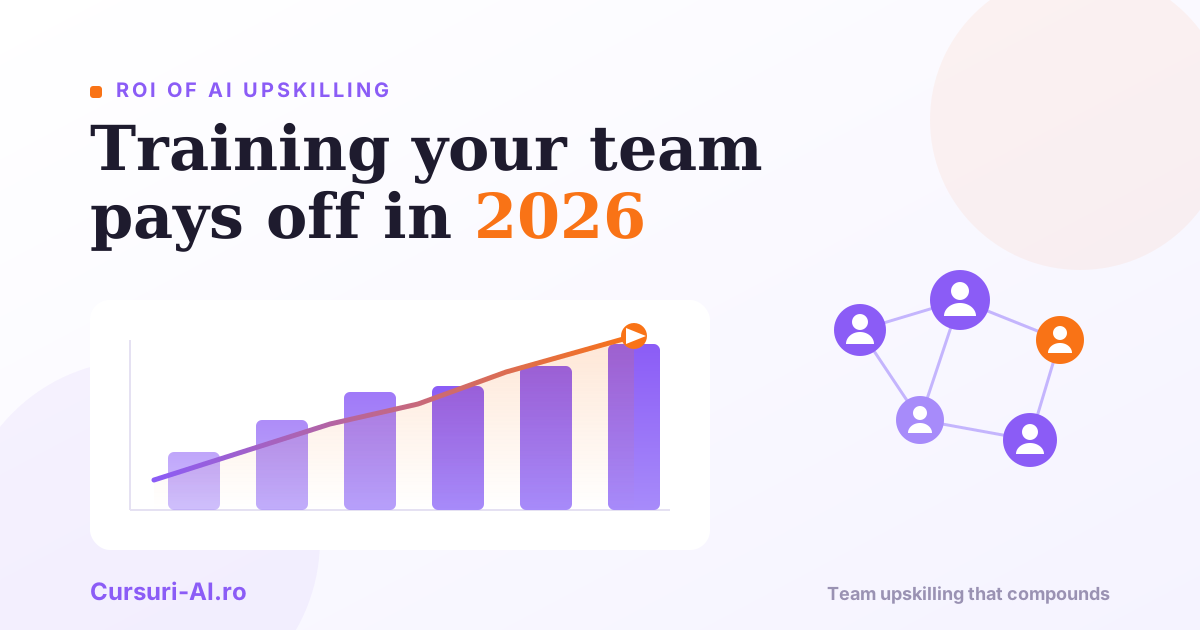
The honest answer is that AI upskilling is one of the few investments that pays back on three separate lines at once: productivity, retention and hiring cost. This article breaks down where that return actually comes from, how to structure training so it sticks, and how to measure it without inventing numbers.
The cost of inaction is invisible — until it isn't
The most expensive line item in an AI strategy rarely appears on a budget: it is the cost of not training people. When a team lacks shared AI fluency, the symptoms are quiet but compounding.
- Shadow AI. People paste sensitive data into consumer tools because nobody taught them a safe workflow. That is a governance and compliance risk, not just a productivity one.
- Uneven adoption. One or two enthusiasts automate their work while the rest of the team keeps doing it by hand. The organisation pays for licences it barely uses.
- Low-trust output. Without training in verification and prompt design, staff either over-trust AI (and ship hallucinated errors) or dismiss it entirely. Both destroy value.
None of these show up as a single dramatic number. They leak out as rework, missed deadlines, and talented people leaving for employers who take their growth seriously. Inaction is not the neutral option — it is a slow, unbudgeted expense.
Where the productivity gains actually come from
It is tempting to promise a headline percentage. Resist it. Credible studies of AI-assisted work — from software development to customer support and writing-heavy roles — consistently point in the same direction: meaningful time savings on well-scoped, repetitive tasks, with smaller or no gains on complex, judgment-heavy work. The size of the gain depends entirely on the task and the skill of the operator.
That last part is the point. The productivity return is not a property of the tool — it is a property of the trained user. Concretely, upskilled teams capture value in a few repeatable places:
- Drafting and summarising. First drafts of emails, reports, specs and documentation move from a blank page to an editable starting point in minutes.
- Structured automation. Classifying tickets, extracting data from documents, and generating routine reports without writing code.
- Faster onboarding. New hires ramp up using an AI assistant as an always-available mentor for internal processes.
- Better decisions, faster. A 40-page report can be summarised and interrogated in the time it used to take to read the executive summary.
The gap between an employee who "uses ChatGPT sometimes" and one who has been trained to work with AI is the same as the gap between someone who can open a spreadsheet and a real data analyst. The tool is identical. The competence is everything.
The practical implication for leaders: budget for competence, not for licences. A seat that a trained person uses ten times a day returns far more than ten seats used once a week.
Retention: the quiet ROI multiplier
Productivity is the return everyone talks about. Retention is the one that quietly dwarfs it. Replacing a skilled professional is one of the most expensive events in any organisation once you add recruiting fees, ramp-up time and lost institutional knowledge.
Growth and learning opportunities are repeatedly cited by employees as a top reason to stay with — or leave — an employer. Offering structured AI upskilling sends a clear signal: we are investing in your relevance, not just extracting your output. That signal matters most for exactly the people you least want to lose — the curious, ambitious ones who are watching whether their skills are appreciating or decaying in your organisation.
There is a second-order effect too. Teams that train together build a shared vocabulary and shared workflows. That reduces friction, makes collaboration smoother, and turns AI from a collection of individual hacks into an actual organisational capability. You can read more about how companies roll this out across departments on our dedicated page for companies.
How to structure team AI training that sticks
The failure mode of corporate training is well known: a one-off webinar, a spike of enthusiasm, and nothing changed a month later. AI upskilling avoids that fate when it is designed around roles and applied immediately.
1. Segment by role, not by seniority
A marketer, a developer and an operations lead need different things from AI. Generic "intro to AI" sessions bore the advanced users and overwhelm the beginners. Map training to job families so every learner sees examples from their own work. Our course catalogue is organised along exactly these lines — practical tracks for IT and non-IT professionals alike.
2. Start leaders first
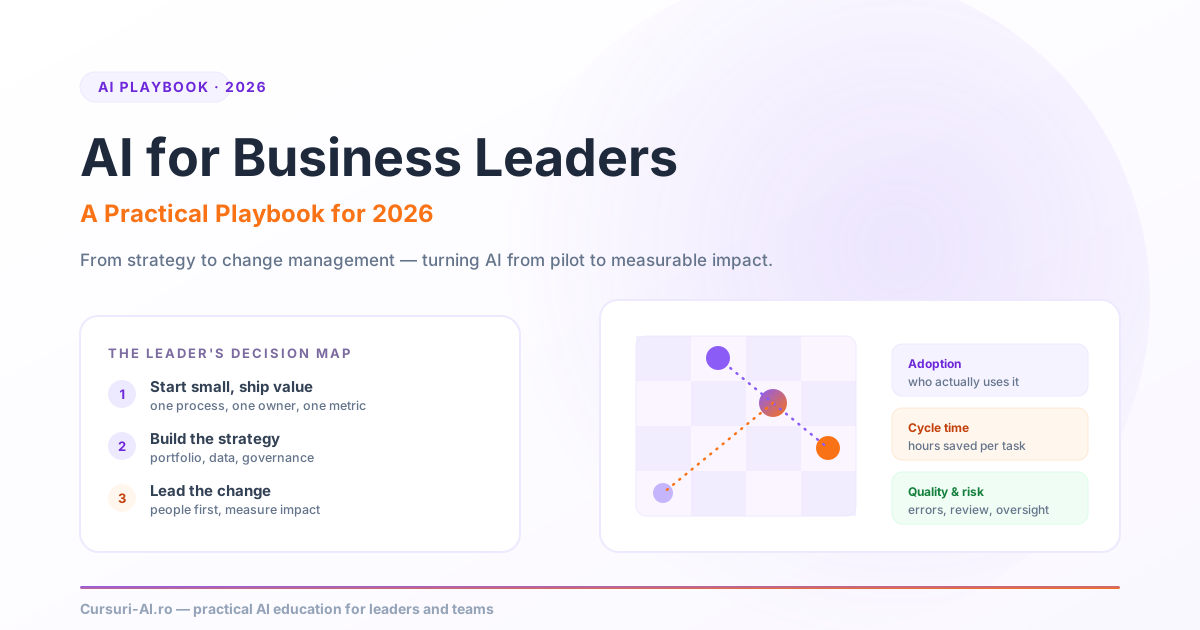
Managers who understand what AI can and cannot do set realistic expectations and unblock adoption. A focused track such as AI for Business Leaders gives decision-makers the strategic framing — risk, governance, and where to place bets — before the whole team dives in.
3. Make it applied, not theoretical
The best retention comes from learning tied to real tasks. Ask each participant to bring a genuine problem from their week and solve it during the course. Interactive lessons, quizzes and hands-on exercises beat passive lectures every time — that is the whole design philosophy behind structured, practice-first learning.
4. Build a rhythm, not an event
Fluency is maintained, not achieved once. Short, regular touchpoints — a monthly new module, a shared prompt library, a channel for wins — keep the capability alive as the tools evolve. Predictable pricing for teams makes this sustainable; you can compare team plans on our pricing page.
Measuring the ROI without fabricating numbers
Here is a simple, honest framework any L&D or HR team can run. You do not need a data science department — you need a baseline and a follow-up.
1. Pick two or three tasks to instrument. Choose high-frequency, measurable tasks — for example, time to draft a proposal, tickets resolved per day, or documents processed per hour.
2. Measure the baseline before training. Capture the current numbers for a representative sample. This is the step most organisations skip, which is why they can never prove ROI afterwards.
3. Train, then re-measure after 4–8 weeks. Give the new skills time to embed, then measure the same tasks again under the same conditions.
4. Convert time saved into money. Multiply hours saved by loaded hourly cost. Add the softer lines — reduced rework, faster onboarding, and retention of key staff — as qualitative context.
5. Track adoption as a leading indicator. Licence usage, number of active users, and internally shared workflows tell you before the productivity numbers do whether the training is taking hold.
The discipline here is honesty. Report the gains you can actually observe in your own organisation, and describe everything else in plain, cautious language. A modest, defensible number beats an impressive, fabricated one in every boardroom.
The bottom line
AI upskilling is not a cost centre dressed up as an initiative. It is a compounding investment that reduces hiring pressure, lifts everyday productivity, and keeps your best people from drifting toward employers who take their growth seriously. The organisations that treat AI fluency as core infrastructure — trained deliberately, measured honestly, refreshed continuously — will spend 2026 pulling ahead of the ones still debating whether to start.
The tools are already on everyone's desk. The return comes from teaching people to use them well.
Frequently Asked Questions (FAQ)
How long before AI training shows a return? Most teams can measure results within four to eight weeks, because AI upskilling targets tasks people already do daily — drafting, summarising, classifying, reporting. The key is to capture a baseline for two or three measurable tasks before training starts, then re-measure the same tasks under the same conditions afterwards. Skipping the baseline is the single most common reason organisations cannot prove their return later.
Should we train the whole team or just a few specialists? Both, in sequence. Start with leaders so they can set realistic expectations and unblock adoption, then roll out role-specific training across the wider team. Concentrating AI skill in one or two enthusiasts creates a bottleneck and leaves most of your licences underused. Shared fluency — a common vocabulary and shared workflows — is what turns AI from individual hacks into an organisational capability.
How do we measure ROI without inventing statistics? Instrument a small number of high-frequency tasks, measure the baseline, train, and re-measure after a few weeks. Convert the hours saved into money using loaded hourly cost, and treat softer benefits like retention and faster onboarding as qualitative context. Report only what you can observe in your own organisation. A modest, defensible figure is far more persuasive to a board than a headline percentage borrowed from someone else's press release.
Is AI upskilling worth it for non-technical teams? Yes — often more so. Marketing, HR, finance and operations roles are full of repetitive, text-heavy tasks where trained AI use saves the most time. Non-technical staff typically see fast wins in drafting, summarising and simple automation, none of which require writing code. The catalogue includes practical tracks built specifically for non-IT professionals.

The course that continues this article
AI for Business Leaders
You have read the theory. In the course you put it into practice: written lessons structured in modules, with examples and exercises, quizzes, the AI Professor in every lesson and progress saved automatically. Once you complete the lessons and reach the minimum quiz score, you get the Certificate of Completion, a private attestation.
From the course syllabus
- AI Fundamentals for Managers and Leaders
- AI Strategy and Implementation for Management
- Practical AI by Department: The Manager's Guide
- Decision-Making and Leadership with AI
+ 6 more modules in the full syllabus
€99 per month for this course, VAT included · or €299 per month for all 25 Business courses (see what you learn across the whole track).
Monthly subscription with automatic renewal · stop the renewal anytime from your account · digital content with immediate access, see the withdrawal conditions. The certificate confirms that you completed the course and is private: it is not a diploma or a state-recognised qualification.