"AI Engineer" is one of the most searched-for job titles of the decade — and also one of the most misunderstood. It is not a rebranded data scientist, and it is not simply a developer who knows how to prompt ChatGPT. It is a distinct discipline built around a new kind of raw material: large language models and other foundation models that you integrate, orchestrate, and ship into production software.
If you have ever wondered what these engineers actually do all day, which skills genuinely matter, and how someone breaks into the field in 2026, this guide gives you a grounded answer — no hype, just the real shape of the role.
What an AI Engineer actually does
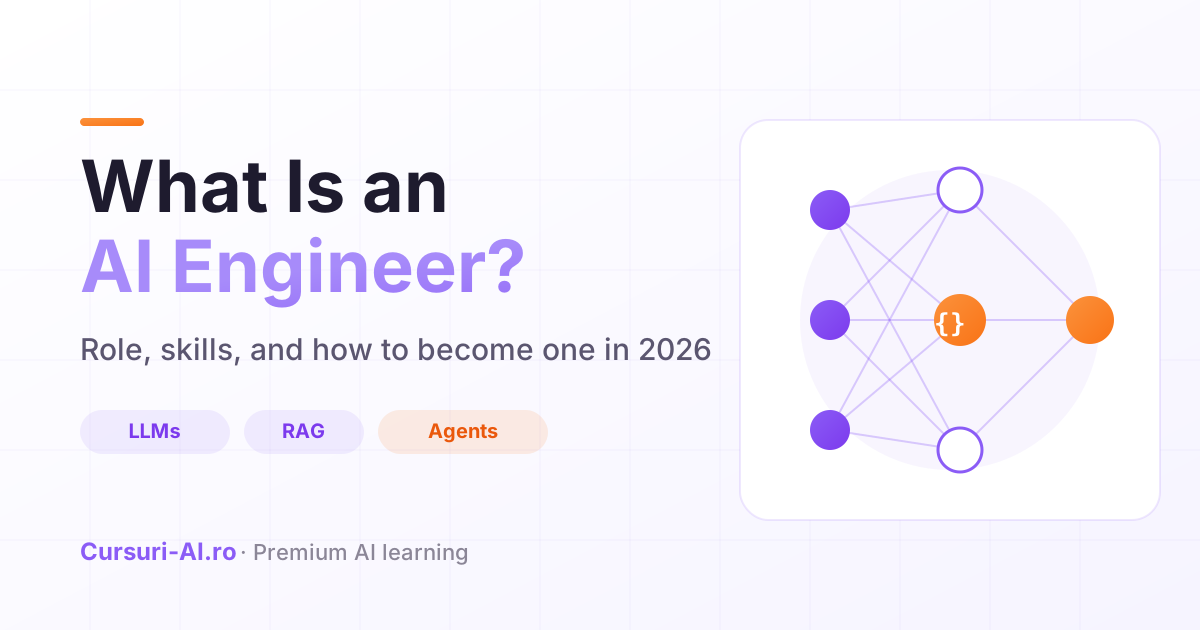
An AI Engineer builds applications on top of pre-trained models rather than training models from scratch. The heavy lifting of pre-training is done by a handful of labs — Anthropic (Claude), OpenAI (GPT), Google (Gemini) and a few open-weight players. The AI Engineer's job is to take those models and turn them into reliable, useful, safe product features.
In practice, a typical week involves work like:
- Designing prompts and system instructions that produce consistent, structured output at scale — not one lucky answer, but the same quality across thousands of real user inputs.
- Building retrieval-augmented generation (RAG) pipelines so a model can answer questions grounded in a company's own documents instead of hallucinating.
- Wiring up tool use and agents — letting a model call functions, query databases, or trigger workflows, then handling what happens when it calls the wrong one.
- Evaluating quality with test sets, LLM-as-judge scoring, and regression checks so a prompt change does not silently break production.
- Managing cost, latency, and reliability — caching, streaming responses, choosing the right model for each task, and adding fallbacks when an API is slow or down.
An AI Engineer is not the person who trains the model. They are the person who makes the model trustworthy enough to put in front of a paying customer.
That distinction matters. The hard, valuable work is rarely the first demo — it is everything that comes after: making the system dependable, observable, and safe when real users push it in ways you never imagined.
AI Engineer vs. ML Engineer vs. Data Scientist
These titles overlap, and job ads use them loosely, but the centre of gravity is different for each.
Data Scientist
Focuses on analysis, experimentation, and drawing conclusions from data — statistics, notebooks, dashboards, and answering "what is happening and why." Historically closer to business insight than to shipping software.
ML Engineer
Focuses on training and deploying custom models — feature pipelines, model training, MLOps, and serving models at scale. Deep expertise in the model-building lifecycle.
AI Engineer
Focuses on building products with foundation models you did not train. The core skills are software engineering, API integration, prompt and context design, retrieval, orchestration, and evaluation. You may never touch a training loop, yet ship AI features used by millions.
A useful shorthand: ML Engineers make the models; AI Engineers make the models useful inside applications. Many strong AI Engineers come from a software or full-stack background, not a research one — which is exactly why the field opened up so quickly.
The core skills that matter in 2026
If you are targeting this role, here is where to invest your time.
1. Solid software engineering. This is the foundation. You need to write clean, testable code, understand APIs, work with async calls, handle errors gracefully, and reason about systems. AI features live inside real applications — the engineering fundamentals never stop mattering.
2. Prompt and context engineering. Not "magic words," but the disciplined craft of structuring instructions, examples, and context windows so models behave predictably. This includes system prompts, few-shot examples, output formatting (JSON, structured schemas), and managing what information the model sees at each step.
3. RAG and vector search. Most useful business applications need the model to reason over private, up-to-date data. That means embeddings, vector databases (such as pgvector, Pinecone, or Qdrant), chunking strategies, and retrieval quality — the single most common architecture in production AI apps today.
4. Agents and tool use. Giving models the ability to call tools, use functions, and take multi-step actions. The frontier — and the hard part — is reliability: knowing when an agent should act autonomously and when a human stays in the loop.
5. Evaluation and observability. Because model outputs are non-deterministic, you cannot ship on vibes. You need eval sets, quality metrics, logging, and monitoring to catch regressions before your users do.
6. Frameworks and platforms. Tools like LangChain, LlamaIndex, and the native SDKs from model providers speed you up — but treat them as accelerators, not substitutes for understanding what happens underneath.
You do not need a PhD, and you do not need to memorise linear algebra to start. What you need is strong engineering instincts plus focused, hands-on practice with modern model APIs.
What the market looks like
Demand for people who can ship reliable AI features is strong across startups and enterprises alike, and the AI Engineer title has moved from novelty to a standard line item in engineering org charts. Compensation tends to sit at or above senior software engineering levels, because the skill set is scarce and the impact is highly visible.
Two honest caveats. First, the tooling changes fast — the model you optimise for today may be superseded next quarter, so the durable skill is adaptability, not loyalty to any one library. Second, employers increasingly filter for people who have actually built something end to end. A working project that handles real inputs, retrieval, and evaluation will teach — and prove — more than any certificate.
How to become an AI Engineer: a concrete path
You do not need to boil the ocean. Follow a focused progression:
- Shore up your software fundamentals. If you can already build and ship a web app or backend service, you are most of the way there. If not, start here.
- Learn how modern LLMs work in practice — tokens, context windows, temperature, structured output, and the trade-offs between models. Get comfortable calling an API directly before reaching for frameworks.
- Build a RAG application end to end. Ingest documents, chunk and embed them, store vectors, retrieve, and generate grounded answers. This one project teaches most of the core stack.
- Add agents and tool use. Extend your app so the model can call functions and take actions, and learn to handle failure gracefully.
- Instrument evaluation. Add a small eval set and quality checks so you can prove your changes improve — not just change — behaviour.
- Ship and iterate in public. Put your project online, gather real usage, and write about what broke. This portfolio is your strongest job application.
Structured learning shortens this journey dramatically. On Cursuri AI, the Introduction to AI Engineering course walks you through the fundamentals with hands-on projects, while RAG in practice and advanced LLM integration in production take you from prototype to production-grade systems. You can explore the full catalogue of AI courses or compare subscription plans to find the track that fits your goals.
The AI Engineer role rewards builders. If you are willing to ship, break things, and iterate, 2026 is an excellent year to start.
Frequently Asked Questions (FAQ)
What does an AI Engineer do? An AI Engineer builds software applications on top of pre-trained foundation models such as Claude, GPT, and Gemini. Their day-to-day work includes designing prompts and system instructions, building retrieval-augmented generation pipelines, wiring up tool use and agents, evaluating output quality, and managing cost, latency, and reliability in production. In short, they turn powerful but unpredictable models into dependable product features.
What is the difference between an AI Engineer and an ML Engineer? An ML Engineer focuses on training, deploying, and serving custom machine learning models — feature pipelines, training loops, and MLOps. An AI Engineer instead builds products using foundation models they did not train, focusing on integration, prompt and context design, retrieval, orchestration, and evaluation. A simple way to remember it: ML Engineers make the models, while AI Engineers make the models useful inside applications.
Do I need a PhD or a machine learning background to become an AI Engineer? No. Many strong AI Engineers come from a software or full-stack background rather than research. The most important foundation is solid software engineering, followed by hands-on skills in prompt engineering, RAG, agents, and evaluation. A working end-to-end project that handles real inputs will teach and demonstrate more than any single credential.
What skills should I learn first to break into AI engineering in 2026? Start with strong software engineering fundamentals, then learn how modern LLM APIs work in practice — tokens, context windows, and structured output. From there, build a retrieval-augmented generation application end to end, add tool use and agents, and instrument evaluation so you can measure quality. Structured courses, such as those on Cursuri AI, can compress this learning path significantly.

The course that continues this article
Introduction to AI Engineering
You have read the theory. In the course you put it into practice: written lessons structured in modules, with examples and exercises, quizzes, the AI Professor in every lesson and progress saved automatically. Once you complete the lessons and reach the minimum quiz score, you get the Certificate of Completion, a private attestation.
From the course syllabus
- Fundamentals of Artificial Intelligence
- Machine Learning Essentials
- Large Language Models and Modern Architectures
- Working with LLM APIs and Integrations
+ 7 more modules in the full syllabus
€99 per month for this course, VAT included · or €399 per month for all 25 IT Pro courses (see what you learn across the whole track).
Monthly subscription with automatic renewal · stop the renewal anytime from your account · digital content with immediate access, see the withdrawal conditions. The certificate confirms that you completed the course and is private: it is not a diploma or a state-recognised qualification.