Most executives no longer ask whether their company should use artificial intelligence. The harder question in 2026 is how — how to move from scattered experiments to a coordinated capability that actually shows up in the numbers. Tools like ChatGPT, Claude, Microsoft Copilot and Google Gemini are now inside everyday work, yet many organizations still struggle to translate that access into durable advantage.
This playbook is written for the people who own the outcome: CEOs, directors and line managers. It is deliberately practical — no hype, no promises of magic. The goal is a clear sequence you can act on this quarter.
Where to start with AI
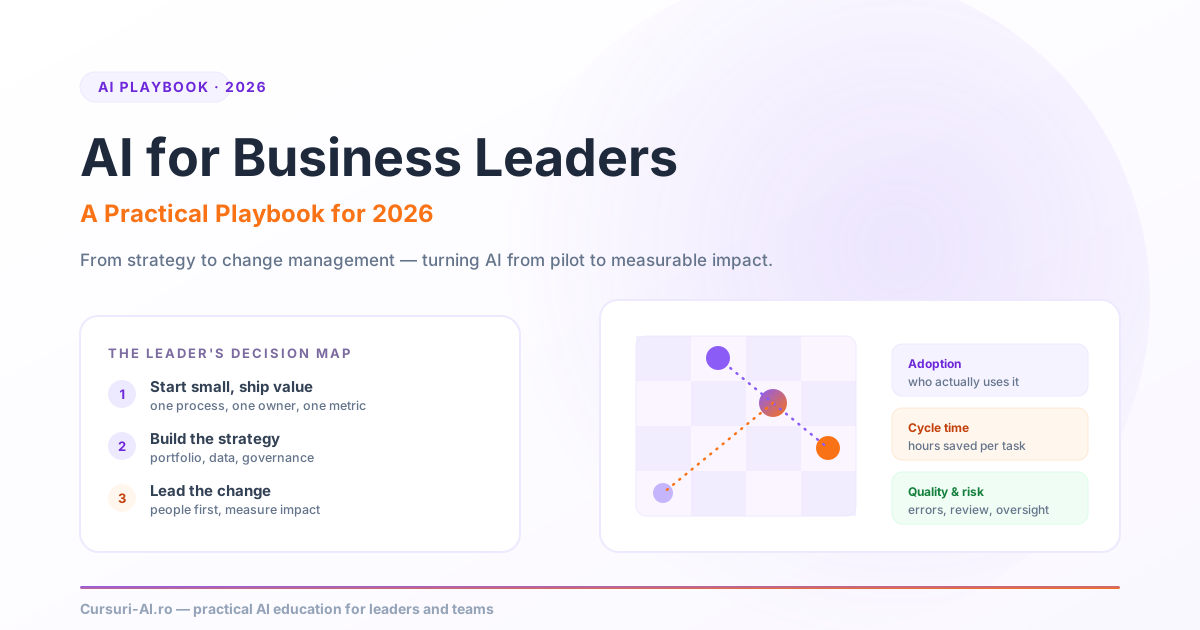
The most common mistake leaders make is starting too big. A twelve-month "AI transformation program" sounds impressive in a board deck and rarely survives contact with reality. The alternative is disciplined and boring in the best way: pick one process, one owner, and one metric.
Good first candidates share three traits. They are high-volume, so small improvements compound. They are text-heavy or data-heavy, where current models are genuinely strong. And they have a clear quality check, so you can tell whether the output is good. Typical starting points include drafting customer responses, summarizing long documents, preparing first-draft reports, and structuring unstructured data.
Run the first initiative as a real project with a defined scope and a two-to-four-week horizon. The point is not to prove that AI is impressive — it obviously is. The point is to learn how your people, your data and your constraints interact with it. That organizational knowledge is the asset you are actually building.
Building an AI strategy
Once a first win is on the board, the question becomes portfolio-level. A useful strategy answers four things clearly.
Where you will play. Not every process deserves AI. Map your value chain and mark where automation or augmentation would move a metric that leadership already cares about — cost, speed, quality, or revenue. Prioritize a short list rather than a long wish list.
How data will support it. AI is only as good as the context you can give it. Leaders do not need to understand model architecture, but they do need to ensure that relevant knowledge — policies, product information, historical decisions — is accessible and reasonably clean.
Who builds and who governs. Decide early which capabilities you buy (off-the-shelf tools and copilots), which you assemble (workflow automation with platforms such as Make.com or Zapier), and which you build. Pair that with a lightweight governance model so decisions are consistent.
How value is captured. A pilot that saves time is only valuable if that time is redeployed. Strategy has to name what people will do with the capacity AI opens up.
Structured education accelerates every one of these decisions. A focused program such as AI for Business Leaders gives decision-makers a shared vocabulary and a repeatable way to evaluate opportunities — which is often the missing ingredient in stalled initiatives.
Common pitfalls to avoid
Even well-intentioned rollouts fail in predictable ways. A short list worth keeping in front of you:
- Tool sprawl without a purpose. Buying licenses for five platforms does not create capability. Adoption comes from solving a specific, visible problem, not from access alone.
- Ignoring data quality. Feeding a capable model messy, contradictory context produces confident, useless answers. Fix the inputs before blaming the output.
- Treating output as truth. Models can generate plausible but incorrect information. Any process touching customers, finance or compliance needs a human review step by design.
- Skipping the economics. If you cannot describe the before-and-after in hours, cost or error rate, you are running a demo, not a project.
- Underestimating the people side. The technology is rarely the hardest part. Adoption is.
The organizations that win with AI are not the ones with the most tools. They are the ones that pick a real problem, measure honestly, and help their people change how they work.
Leading the change
This is where most of the difficulty — and most of the value — lives. AI changes what work looks like, and people respond to that change with a mix of curiosity and anxiety. Leaders who treat adoption as a purely technical rollout consistently underperform those who treat it as a change-management challenge.
A few principles hold up well. Be explicit about intent. If employees suspect AI is a quiet route to headcount cuts, adoption stalls. If the goal is to remove drudgery and raise the ceiling on what teams can do, say so and mean it. Make experts of your people, not spectators. Hands-on training beats a policy memo every time. Recognize the early adopters. Every team has people who lean in; give them room to demonstrate wins their peers can copy.
Managers carry a specific load here, because they translate strategy into daily behavior. Developing that capability deliberately — through a program such as Manager in the AI Era: Change Management — often determines whether a rollout takes root or quietly fades. For companies rolling this out across teams, a structured approach to training at scale keeps the message and the standards consistent.
Measuring impact
If you take one habit from this playbook, make it this: measure before and after. Vague enthusiasm is not evidence. Concrete metrics protect your initiative when budgets tighten and skeptics push back.
Three families of metrics cover most cases:
- Adoption — who is actually using the capability, and how regularly. Access without use is a cost, not a benefit.
- Cycle time — how long a task or process now takes versus its baseline. Hours saved per task, multiplied by volume, is the clearest story you can tell a board.
- Quality and risk — error rates, rework, and the reliability of review steps. Speed that degrades quality is not progress.
Set a baseline before you start, keep the measurement simple, and report it honestly — including where results disappointed. Credibility built on candid measurement is what earns you the mandate for the next, larger initiative.
Governance and risk
Governance is not bureaucracy; it is what makes scaling safe. A practical model addresses a handful of questions: What data can and cannot be entered into which tools? Where is human oversight mandatory? How are outputs that touch customers or compliance reviewed? Who is accountable when something goes wrong?
In the European context, this also means aligning with the EU AI Act as its provisions phase in, and respecting GDPR whenever personal data is involved. Leaders do not need to be lawyers, but they do need a defensible, written position on how the organization uses AI responsibly. Keep the policy short enough that people actually read it, and revisit it as your usage matures.
The path forward
AI in 2026 rewards operators, not spectators. The winning pattern is consistent across industries: start small and ship real value, build a strategy around a prioritized portfolio, avoid the predictable pitfalls, lead the human change deliberately, and measure impact honestly under sensible governance.
None of these steps requires a data-science background. They require judgment, discipline and a willingness to learn in public. If you want a structured way to build that judgment across your leadership team, explore the full catalog of AI courses and choose the path that fits your organization's next move.
Frequently Asked Questions (FAQ)
Where should a company start with AI? Start narrow. Pick one high-volume, text- or data-heavy process with a clear quality check — such as drafting customer responses, summarizing documents, or preparing first-draft reports. Run it as a real two-to-four-week project with one owner and one metric. The goal is not to prove AI is impressive, but to learn how your people, data and constraints interact with it before scaling.
Do business leaders need technical skills to lead AI adoption? No. Leaders do not need to understand model architecture or write code. They need judgment: knowing where AI moves a metric that matters, ensuring relevant data is accessible, deciding what to buy versus build, and leading the human change. A structured program aimed at decision-makers builds this judgment far faster than unaided experimentation.
How do you measure whether AI is actually delivering value? Measure before and after across three areas: adoption (who really uses it and how often), cycle time (hours saved per task versus a baseline, multiplied by volume), and quality and risk (error rates, rework, reliability of review steps). Set the baseline before you start, keep it simple, and report results honestly — including disappointments. Candid measurement is what earns the mandate for the next initiative.
What are the most common reasons AI initiatives fail? The usual causes are buying tools without a specific problem to solve, feeding models messy data, treating output as truth without a human review step, skipping the economics so you cannot prove impact, and underestimating the people side. The technology is rarely the hardest part — adoption and change management are.

The course that continues this article
AI for Business Leaders
You have read the theory. In the course you put it into practice: written lessons structured in modules, with examples and exercises, quizzes, the AI Professor in every lesson and progress saved automatically. Once you complete the lessons and reach the minimum quiz score, you get the Certificate of Completion, a private attestation.
From the course syllabus
- AI Fundamentals for Managers and Leaders
- AI Strategy and Implementation for Management
- Practical AI by Department: The Manager's Guide
- Decision-Making and Leadership with AI
+ 6 more modules in the full syllabus
€99 per month for this course, VAT included · or €299 per month for all 25 Business courses (see what you learn across the whole track).
Monthly subscription with automatic renewal · stop the renewal anytime from your account · digital content with immediate access, see the withdrawal conditions. The certificate confirms that you completed the course and is private: it is not a diploma or a state-recognised qualification.