Why 2026 is a turning point for marketers
Artificial intelligence has moved from a novelty inside marketing teams to part of the daily workflow. Copywriters draft with it, SEO specialists research with it, analysts summarize reports with it, and campaign managers automate the repetitive parts of their day. The question in 2026 is no longer whether to use AI in digital marketing, but how to use it well — with judgment, brand consistency, and measurable results.
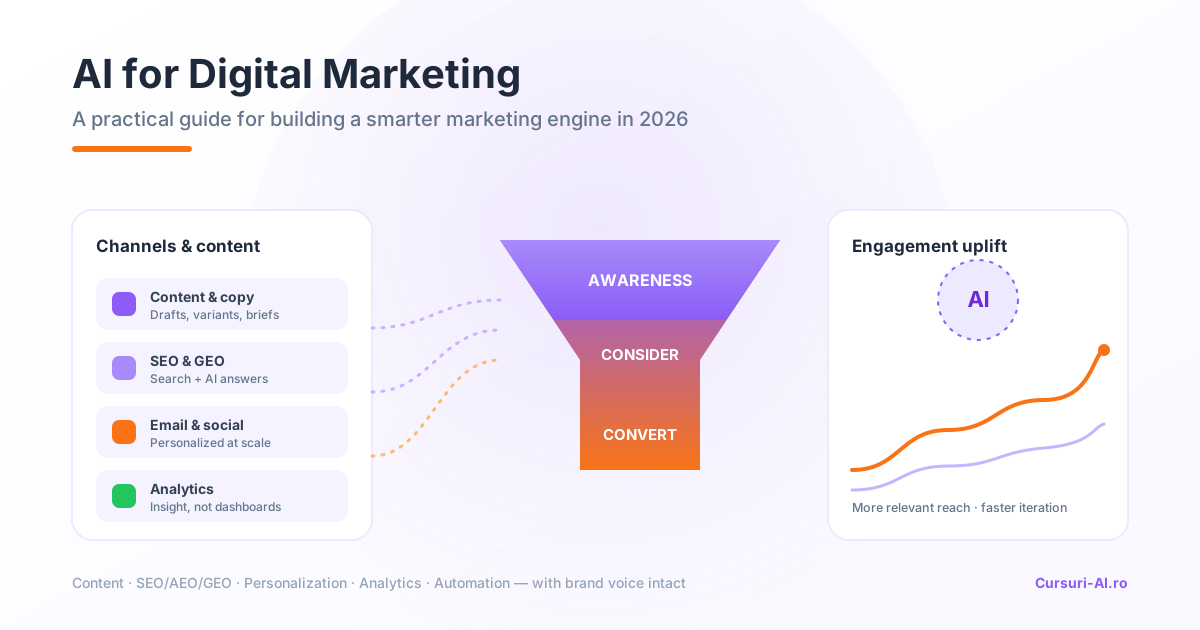
This guide walks through the areas where AI genuinely moves the needle: content creation, search in the AI era, personalization, analytics, and workflow automation. Along the way it names real tools you can evaluate today and, just as importantly, shows where a human still has to stay in the loop.
Content creation that keeps your brand voice
Content is where most teams first adopt AI, and for good reason. Large language models like ChatGPT, Claude, and Google Gemini, along with marketing-focused platforms such as Jasper and Copy.ai, can turn a rough brief into a first draft in seconds. Used properly, they compress the slowest part of the process — getting from a blank page to something you can react to.
The mistake is treating the first draft as the final one. AI-generated copy tends toward the generic, and search engines and readers alike are getting better at spotting it. The reliable pattern is:
- Feed the model your voice, not just your topic. Paste in two or three examples of your best-performing copy and ask the model to match tone, sentence length, and vocabulary before it writes anything new.
- Draft variants, not final answers. Ask for three subject lines or three intros, then choose and edit rather than shipping the first output.
- Add what only you know. Real customer objections, proprietary data, product specifics — the details that make content credible are the ones an AI cannot invent for you.
AI is a faster route to a first draft, never a shortcut past editorial judgment. The teams that win treat it as a tireless junior writer, not an autopilot.
For marketers who want a structured way to build this skill, the course on AI for content creation and copywriting covers prompt patterns, editing workflows, and voice consistency in depth.
SEO in the AI era: AEO and GEO
Search is being reshaped by AI-generated answers. Google's AI Overviews, along with assistants like ChatGPT and Perplexity, increasingly answer questions directly instead of sending every click to a website. This has expanded classic SEO into two adjacent disciplines:
- AEO (Answer Engine Optimization) — structuring content so it can be lifted cleanly into a direct answer: clear questions as headings, concise definitions, and well-formed FAQ and how-to sections.
- GEO (Generative Engine Optimization) — making your brand the source that generative engines cite when they compose an answer, through authoritative, well-structured, frequently referenced content.
Practically, that means writing content that is easy for both people and machines to parse: descriptive headings, short answer-first paragraphs, structured data (FAQ, HowTo, Article schema), and genuine expertise that earns citations. Keyword tools such as Semrush and Ahrefs still matter for research, but the target has shifted from "rank blue link #1" to "be the answer the AI trusts."
If this shift is new to you, the dedicated course on SEO, AEO and GEO in the AI era breaks down how to optimize for Google, AI Overviews, and generative engines at the same time.
Personalization at scale
Personalization used to mean inserting a first name into a subject line. AI raises the ceiling considerably. Models can segment audiences by behavior, generate message variants tailored to each segment, and adapt tone and offer to context — all without a proportional increase in manual work.
Concrete applications that are realistic today:
- Dynamic email variants — generate distinct versions of a campaign for new subscribers, lapsed customers, and power users, each with its own angle and call to action.
- On-site copy that adapts — landing page headlines or product descriptions that shift based on the traffic source or audience segment.
- Smarter A/B testing — use AI to generate a wider set of hypotheses to test, then let real data decide the winner.
The guardrail here is data privacy. Personalization depends on customer data, which means GDPR and consent are not optional. Use data you are permitted to use, be transparent about it, and avoid feeding sensitive customer information into public AI tools that may retain it.
Analytics: from dashboards to decisions
Most marketing teams are drowning in data and starving for insight. This is one of AI's most underrated strengths. Instead of staring at a dashboard, you can ask a model to interpret it.
Paste an anonymized performance export into an assistant and ask: Which campaigns underperformed relative to spend, and what patterns do they share? A well-framed prompt can surface correlations, summarize a fifty-page report in minutes, and translate raw metrics into a plain-language narrative your stakeholders actually read.
Two cautions keep this honest:
- Verify the numbers. AI can misread a table or invent a plausible-sounding statistic. Treat its output as a hypothesis to check against the source data, never as a final figure to quote.
- Protect the data. Strip personally identifiable information before pasting anything into a general-purpose tool.
Workflow automation without the code
The biggest time savings often come not from any single tool but from connecting them. Automation platforms like Zapier and Make now include AI steps, letting you build workflows that read, classify, summarize, and draft — with no engineering required.
Realistic examples marketers run today:
- Automatically summarize incoming leads and route them to the right owner.
- Draft first-pass replies to common inbound questions for a human to approve.
- Turn a published blog post into social captions and an email teaser in one flow.
- Tag and file customer feedback by theme as it arrives.
The principle is to automate the repetitive and reserve human attention for the strategic — the creative angle, the brand decision, the final approval.
Putting it together
None of these areas works in isolation. A strong 2026 marketing engine uses AI to draft content faster, structures that content for both search and AI answers, personalizes it per segment, reads its own analytics for insight, and automates the connective tissue between tools — all while a human keeps the brand voice consistent and the facts accurate.
The differentiator is no longer access to the tools; almost everyone has that. It is the judgment to use them well. A structured learning path shortens that journey considerably. You can explore the full AI for digital marketing course, or browse the complete course catalog to build a broader AI skill set across your team.
Frequently Asked Questions (FAQ)
Will AI replace digital marketers? No credible signal points that way. AI automates parts of the work — drafting, research, summarizing, routing — but it does not set strategy, own brand judgment, verify facts, or understand a specific audience the way a marketer does. The realistic outcome is that marketers who use AI well outcompete those who do not, because they move faster on the mechanical work and spend more time on the parts that require human judgment.
What is the difference between SEO, AEO, and GEO? SEO (Search Engine Optimization) is the classic practice of ranking pages in search results. AEO (Answer Engine Optimization) structures content so it can be pulled cleanly into a direct answer, such as Google's AI Overviews. GEO (Generative Engine Optimization) focuses on becoming a source that generative assistants cite when they compose an answer. In practice they overlap: clear structure, real expertise, and machine-readable formatting serve all three at once.
Is it safe to use AI tools with customer data? Only with care. Personalization and analytics both touch customer data, so GDPR, consent, and data minimization apply. Avoid pasting personally identifiable or sensitive information into public AI tools that may retain inputs, anonymize exports before analysis, and prefer tools with clear data-handling terms. Treat data protection as part of the workflow, not an afterthought.
Which AI tools should a marketing team start with? Start with a general-purpose assistant such as ChatGPT, Claude, or Gemini for content and analysis, add a research tool like Semrush or Ahrefs for search, and introduce an automation platform such as Zapier or Make once your team is comfortable. Adopt tools one at a time so the team builds genuine skill rather than a shelf of half-used subscriptions.

The course that continues this article
AI for Content Creation and Copywriting
You have read the theory. In the course you put it into practice: written lessons structured in modules, with examples and exercises, quizzes, the AI Professor in every lesson and progress saved automatically. Once you complete the lessons and reach the minimum quiz score, you get the Certificate of Completion, a private attestation.
From the course syllabus
- Content AI Fundamentals
- Editorial Strategy and Research with AI
- Text Production and Copywriting with AI
- Multi-Format: Social Media, Video and Audio with AI
+ 5 more modules in the full syllabus
€99 per month for this course, VAT included · or €299 per month for all 25 Business courses (see what you learn across the whole track).
Monthly subscription with automatic renewal · stop the renewal anytime from your account · digital content with immediate access, see the withdrawal conditions. The certificate confirms that you completed the course and is private: it is not a diploma or a state-recognised qualification.