
What Every Creator Needs to Know About AI Video in 2026
From the course AI Video Creation and Editing: From Script to Publish
In every lesson
The AI Professor starts from the lesson you have open
You ask it in writing or by voice, right from the lesson, and you can listen to the answer on request. Where needed, it fills in from general knowledge. When you select a passage, a bar appears with “Explain this to me”, “Give me an example”, “Why does it matter?” and “My own question”.
Its panel has four tabs:
- Conversation: you ask, it answers starting from the lesson
- Summary: the key ideas of the lesson, point by point
- AI Quiz: 3, 5 or 10 new questions from the lesson, with explanations
- Review: flashcards made from the lesson
Included in every subscription and in single-course access, within a fair-use limit.
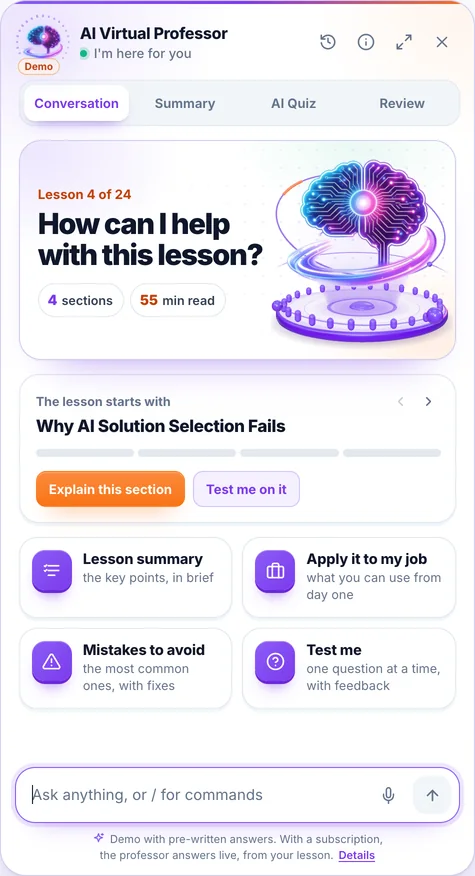
The demo opens on a lesson from the course “AI for Business Leaders”, with prepared answers; voice is off in the demo.
It is an artificial intelligence system, not a human teacher; its answers may contain errors. Details in the Terms & Conditions.
Two years ago, generating a usable video clip from a sentence of text was a party trick — flickering frames, warped hands, five seconds of dreamlike nonsense. In 2026 it is a production tool. A marketing team can storyboard a campaign before their first coffee and review rough cuts by lunch. A solo creator can shoot nothing, appear in nothing, and still publish a polished explainer with a presenter, a voiceover, captions, music and b-roll. That is the shift this course is built around, and this opening lesson gives you the mental model that everything else hangs from.
There is a wide gap between people who use AI video thoughtfully — with a workflow, a brand and a clear grip on the legal line — and people who treat it as a slot machine, pulling the handle until something looks cool. This course puts you firmly in the first group. It teaches a repeatable pipeline you will practise end to end: script → storyboard → generate → voice → edit → finish → publish → measure.
The one idea that ties the whole course together
AI generates the raw material. You direct, curate and are accountable for the final cut.
Every prompt, tool and technique in this course hangs off that sentence, so it is worth unpacking. AI is astonishing at producing options: twenty variations of a shot, five voiceover takes, a dozen thumbnail directions, three edits of the same 30 seconds. It is weak at three things that decide whether a video is any good and whether it is safe to publish — taste, truth and responsibility. Taste is knowing which of the twenty shots actually serves the story. Truth is verifying that the claim on screen is real. Responsibility is making sure the face, the voice, the music and the footage are things you have the right to use. A model has none of these. It does not know your brand, cannot verify a statistic you put on screen, and has no idea whether the face it just generated resembles a real person who never consented. You supply all three. Hold on to that division of labour and most of the hard decisions in this course become obvious.
The map: what AI can do across the video pipeline
Here is the landscape at a glance. Each item becomes a full module later; for now, build the mental map.
- Scriptwriting and pre-production. Large language models — Claude (Opus 5.5, Sonnet 5), GPT-6 Sol, Gemini 3.1 Pro — turn a brief into a script, a hook, a shot list and a storyboard outline. Crucial nuance: these models output text, not video. They are your writers' room, not your camera.
- Text-to-video. Tools such as Runway (Gen-4 family), Google Veo, Kling, Pika, Luma Dream Machine and OpenAI Sora generate short video clips from a text prompt, some with native audio.
- Image-to-video and animation. Feed a still — a product shot, a generated frame, a logo — and get controlled motion out.
- AI avatars and talking heads. HeyGen and Synthesia turn a script into a presenter-led video with a synthetic or licensed human presenter, in many languages.
- AI voice and narration. ElevenLabs and similar tools produce natural voiceover, sound effects, dubbing and lip-synced translation.
- AI-assisted editing. Descript, CapCut and Adobe Premiere Pro offer text-based editing, auto-captions, filler-word removal, silence trimming and b-roll suggestions.
- Music and sound design. Generative tools produce background beds and clean up dialogue — with licensing caveats we will take seriously.
- Upscaling and restoration. Tools such as Topaz Video AI sharpen, denoise, stabilise and enlarge footage.
Pick up exactly where you left off
Pick the option that fits you; your account is created at checkout in under a minute:
What's next in this lesson
- Why this shift matters commercially
- What AI video still cannot — and must not — do for you
- A note on quality: the uncanny valley and "AI slop"
- The disclosure line you need from day one
- A first practical workflow you can run this week
- Who this course is for, and how to get the most from it
- The trust dividend
Everything you'll learn in this course
1 Module 0 — The AI Video Landscape in 2026 3 lessons
- What Every Creator Needs to Know About AI Video in 2026 Reading now 50 min
- The 2026 AI Video Toolstack: A Field Map 50 min
- How Generative Video Actually Works: Frames, Prompts, Duration and Cost 50 min
2 Module 1 — Scriptwriting, Storyboarding and Pre-Production with AI 3 lessons
- Writing Video Scripts with AI That People Actually Watch 50 min
- Storyboarding and Shot Lists with AI 50 min
- Planning for Platform, Format and Audience 50 min
3 Module 2 — Text-to-Video Generation 4 lessons
- Text-to-Video Foundations and the Leading Tools 50 min
- Prompting for Text-to-Video: Speaking the Language of Cinematography 50 min
- Consistency, Seeds and Iterating Across Shots 50 min
- Managing Credits, Cost and Generation Failures at Scale 50 min
4 Module 3 — Image-to-Video, Animation and AI Avatars 3 lessons
- Image-to-Video: Animating Stills, Products and Logos 50 min
- AI Avatars and Talking Heads: HeyGen and Synthesia 50 min
- Consent, Likeness and Custom Avatars: The Non-Negotiable Rules 50 min
5 Module 4 — AI Voice, Narration and Lip-Sync 3 lessons
- AI Voiceover and Narration with ElevenLabs 50 min
- Voice Cloning, Dubbing and Lip-Sync — Done Responsibly 50 min
- Multilingual Video and Localization at Scale 50 min
6 Module 5 — AI-Assisted Editing 3 lessons
- Editing by Editing Text: Descript and the Transcript Workflow 50 min
- Auto-Captions, Auto-Cut and AI B-Roll 50 min
- AI Music and Sound Design 50 min
7 Module 6 — Upscaling, Restoration and Finishing 2 lessons
- Upscaling, Restoration and Frame Interpolation 50 min
- Finishing: Colour, Export and Quality Control 50 min
8 Module 7 — Video for Social, YouTube and Ads 3 lessons
- Short-Form Video: Reels, TikTok and Shorts 50 min
- Long-Form YouTube and Repurposing 50 min
- AI Video Ads and Brand Consistency 50 min
9 Module 8 — Legal and Ethical AI Video 3 lessons
- Copyright, Training Data, Music and Asset Licensing 50 min
- Consent, Likeness, Deepfakes and the EU AI Act Article 50 50 min
- Building a Legal-and-Ethical AI Video Governance Workflow 50 min
10 Module 9 — From Script to Publish: Workflow, Delivery and Measurement 3 lessons
- The End-to-End Workflow: From Script to Publish 50 min
- Measuring and Optimizing Your AI Video 50 min
- Building Your AI Video Studio: Stack, Budget, Team and SOPs 50 min
11 Final Quiz — AI Video Creation and Editing 1 lessons
- Final Assessment: From Script to Publish 40 min
Everything you need to learn effectively
Interactive quizzes
Check your knowledge at the end of every lesson with scored quizzes and feedback.
Personal notes
Save notes on every lesson, accessible anytime from your dashboard.
Scheduled reviews
Revisit lessons exactly when it matters, at the right intervals — so you remember for the long term.
Progress & Achievements
Track your progress, unlock achievements, and visualize what you've learned.
Bookmarks
Save the lessons that matter and find them instantly when you need them.
Questions & Answers
Ask questions right on the lesson and get answers from our team.
Good to know before you start
How do I get access to the course?
You can read the beginning of the first lesson for free, right on this page. For the course you create an account, pick the subscription that fits — a single course or a bundle — and get access immediately after your payment is confirmed. Everything happens 100% online.
Can I cancel my subscription anytime?
Yes. Cancel anytime, straight from your account, in just a few clicks. Your access stays active until the end of the period you have already paid for.
What does the subscription for this course include?
All 31 lessons in the course, interactive quizzes, the AI Professor built into every lesson (select a passage and choose “Explain this to me”), within a fair-use limit, personal notes, automatically saved progress, and content updates included.
Is there a fixed learning schedule?
No. You learn at your own pace, on any device. Lessons are structured step by step, and the platform saves your progress automatically, so you can pick up right where you left off — anytime.
Ready to unlock all the content?
Just this course — €99 / month, VAT included — or every Business course, with smart quizzes and the AI Professor included, in the bundle at €299 / month, VAT included.