Cursuri AI.ro International — AI e-learning for professionals

Try the platform before you pay

Explore the interactive account demo and read the first lesson of Advanced LLM Integration in Production Applications for free, in full — no account, no card.

AI Professor in every lesson Quizzes with feedback Cancel anytime
cursuri-ai.ro/app/courses/advanced-llm-integration-in-production Interactive demo · sample account
Cursuri AI.ro International — AI e-learning for professionals

Welcome! 👋

Welcome to Cursuri AI International — AI e-learning for professionals, now in English. Activate your subscription and start learning.

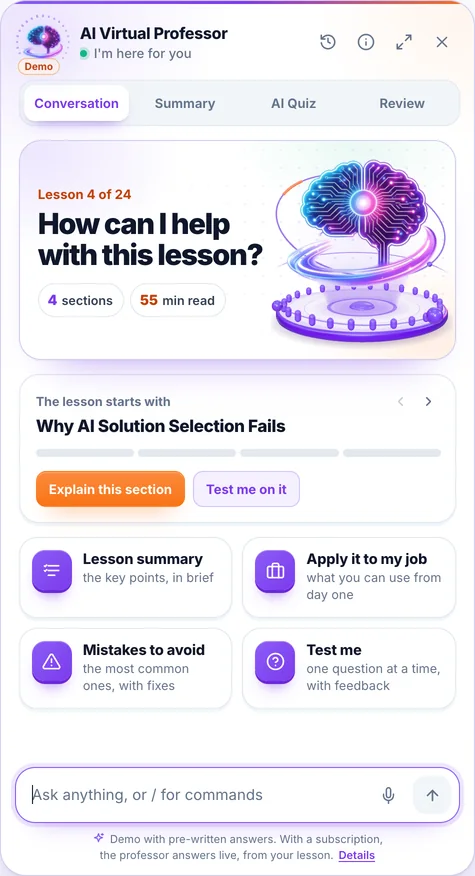
AI virtual professor Exclusive to Cursuri AI

A mentor who knows every lesson in detail and guides you personally.

Included in your subscription

Everything you get with a single subscription

Full access to the entire platform, with no hidden limits or extra costs.

20 premium courses Practical content created by specialists, constantly updated with the latest in AI
24/7 AI virtual professor A personal mentor built into every lesson — ask any question and get an instant answer
555 hands-on lessons Short, structured lessons with practical exercises you can apply at work right away
Smart AI quizzes Automatically generated questions, tailored to your weak spots, with detailed feedback
Save and organize Bookmarks, personal notes and a spaced-repetition system for maximum retention
Progress and analytics Streaks, weekly goals and personalized insights into your growth

Start learning AI today

Pick the right plan and get instant access to premium courses, an AI virtual professor, smart quizzes and hands-on exercises.

No long-term commitment Cancel anytime, no penalties Instant access after payment
This is a preview with sample data. Activate your subscription to save your conversations with the AI Professor.

AI Conversations

The complete history of your dialogues with the AI Virtual Professor

4 Conversations
36 Messages
2 Courses
AI Fundamentals 2 conversations
You

Can you explain how an artificial neuron works?...

AI Professor
AI Professor

An artificial neuron simulates how a biological neuron works: 1. Inputs — it receives multiple numeric values 2. Weights — each input has a weight that determ...

You

What is the ReLU activation function?...

AI Professor
AI Professor

ReLU (Rectified Linear Unit) is the most popular activation function: - Formula: f(x) = max(0, x) - If the input is positive → it passes through unchanged - If the input is negative → it turns it into ...

Prompt Engineering Masterclass 2 conversations
This is sample data Activate a subscription to save and export your real conversations with the AI Professor.
See plans
This is a preview with sample data. Activate a subscription to see your real scores.

Scores

Your performance across 5 assessed courses

79% Overall average
Very good
5
Courses assessed
4 / 5
Passed (≥70%)
22
Quizzes completed
168 / 220
Total points
Score distribution
4 courses ≥70% 1 course 40-69%
Best result Prompt Engineering Masterclass — 92%

Performance by course

92
Prompt Engineering Masterclass Passed
46 / 50 points 5 quizzes 92%
85
Introduction to AI Engineering Passed
34 / 40 points 4 quizzes 85%
76
AI for Digital Marketing Passed
38 / 50 points 5 quizzes 76%
71
RAG — Retrieval Augmented Generation Passed
21 / 30 points 3 quizzes 71%
58
AI Agents & Automation Not passed
29 / 50 points 5 quizzes 58%
This is sample data Activate a subscription to see your real quiz scores.
See plans
Structured learning paths

From zero to expert,
step by step

Career paths and specializations with a clear structure, from fundamentals to advanced level. Each course prepares you for the next — no guessing what to learn next, the platform guides you.

20 Premium courses
555 Hands-on lessons
24/7 AI Professor

How a learning path works

Four simple steps from your first lesson to expert level

01

Choose the right path

Two complete career paths plus focused specializations — for engineers, managers, marketers, or professionals in specialized fields.

02

Complete the stages in order

Each path is divided into clear stages. Each course prepares you for the next — no skipped steps, no lost context.

03

The AI Professor guides you

Ask anything in every lesson. You get explanations, practical examples, and personalized quizzes.

04

Track your progress

Progress per stage and per path, quiz scores, and automatic recommendations for your next step.

AI Virtual Professor Exclusive

Built into every lesson of every path

Throughout your entire path, you have access to an AI professor that knows the content of every lesson. Ask anything — you get detailed explanations, industry examples, and quizzes adapted to your level.

AI chat included in your subscription Answers tailored to the lesson you're studying
Automatic summaries Key points intelligently extracted
Personalized quizzes Unique questions, calibrated to you

Start your first learning path today

Choose the right plan and get instant access to the AI Professor, smart quizzes, and all premium courses.

Instant access Cancel anytime AI Professor included
Individual courses

Choose the courses you're interested in

Subscribe to each course individually. €49 + VAT / month per course, cancel anytime.

IT PRO Advanced Popular

Advanced LLM Integration in Production Applications

The complete masterclass on LLM integration in production — updated for 2026

24 lessons ~26h
BUSINESS Beginner

Microsoft 365 Copilot for Office Work: Role-Based Productivity

Turn Word, Excel, Outlook, Teams and PowerPoint into AI assistants — real productivity for your role, not generic tricks.

32 lessons ~24h
BUSINESS Intermediate Popular

SEO and AEO/GEO in the AI Era: Optimizing for Google, AI Overviews and Generative Engines

Modern SEO plus end-to-end AEO/GEO: how to appear in Google and AI Overviews and get cited by ChatGPT, Perplexity, Gemini

30 lessons ~26h
BUSINESS Intermediate

Manager in the AI Era: Leading Your Team Through the AI Transformation

Lead your team through the AI transformation with proven frameworks: ADKAR, Kotter and the psychology of adoption

30 lessons ~24h
BUSINESS Intermediate Popular

AI Image Generation: The Complete Guide from Prompt to Publishing

Premium course: visual prompt engineering, AI platforms, production at scale, legal, ROI and hands-on tutorials — updated for 2026

26 lessons ~27h
BUSINESS Beginner

No-Code Data Analysis with AI: ChatGPT, Excel and SQL for Non-Programmers

Analyze data with conversational AI, no code: ChatGPT, Excel and SQL for non-programmers, with verification and GDPR.

27 lessons ~24h
BUSINESS Intermediate Popular

AI for Entrepreneurs and Startups: The Complete Guide

Premium course: idea validation, no-code MVP, go-to-market, finance, scaling and the startup ecosystem with AI — updated for 2026

30 lessons ~28h
BUSINESS Intermediate Popular

AI for Sales and CRM

The complete AI masterclass for sales and intelligent CRM — updated for 2026

28 lessons ~25h
BUSINESS Intermediate Popular

AI for Content Creation and Copywriting

Premium course: copywriting, editorial strategy, social media, video, audio, brand voice, SEO, KPIs and scaling with AI — updated for 2025-2026

29 lessons ~29h
BUSINESS Beginner Popular

AI for Digital Marketing

The complete AI masterclass for digital marketers — updated for 2026

31 lessons ~27h
IT PRO Advanced Popular

Context Engineering and Memory for AI Agents: Beyond Prompting

Engineer AI agents' context and memory for reliability at scale: context anatomy, memory types, retrieval, compaction, cost.

25 lessons ~24h
BUSINESS Intermediate Popular

AI for Business Leaders

The complete AI masterclass for leaders and management — updated for 2026

24 lessons ~22h
IT PRO Advanced Popular

Claude Code Mastery: Agentic Coding from the Terminal (multi-file, git, CI, MCP)

Terminal-first agentic coding with Claude Code: multi-file, git, headless, subagents, hooks, CI/CD, MCP, security and routing across the 2026 Anthropic lineup (including Claude Fable 5).

28 lessons ~25h
IT PRO Beginner

Vibe Coding: From Prompt to Application with Lovable, v0, Bolt and Replit Agent

Build full-stack applications from prompts and ship them safely, legally and responsibly — without writing code.

22 lessons ~24h
IT PRO Expert Popular

Cursor as a Pro: AI-Native IDE, Composer and Multi-Agent 2026 (Enterprise Edition)

Cursor 3 Pro: from Composer to Background Agents and Enterprise — April 2026

30 lessons ~25h
IT PRO Advanced Popular

MCP (Model Context Protocol) — Building Servers and Integrations (Enterprise Edition)

The complete MCP guide: from architecture to production servers — Python, TypeScript, security, deployment

22 lessons ~25h
IT PRO Advanced Popular

AI Agents: Architecting and Automating Autonomous Systems

The complete AI Agents and Automation masterclass for engineers — updated for 2026

30 lessons ~26h
IT PRO Advanced Popular

RAG: Retrieval-Augmented Generation in Practice

The complete RAG masterclass for AI Engineers — updated for 2026

27 lessons ~24h
IT PRO Intermediate Popular

The Complete Prompt Engineering Masterclass

Advanced prompting techniques for professionals — updated for 2026

32 lessons ~27h
IT PRO Beginner Popular

Introduction to AI Engineering

The complete AI Engineering masterclass for developers — updated for 2026

28 lessons ~25h
This is a preview with sample data. Activate a subscription to save your lessons and notes.

Saved & Notes

Your saved lessons and personal notes, organized by course.

5 saved lessons 3 notes
Prompt Engineering Masterclass 3
Chain-of-Thought Prompting — The Complete Guide Mar 18
Few-Shot vs Zero-Shot — When to Use Each Mar 16
Advanced System Prompts for GPT-5.5 and Claude Mar 14
AI for Digital Marketing 2
Generating Ad Copy with AI — Meta & Google Ads Mar 12
Automating Campaigns with AI Agents Mar 10
This is sample data Activate a subscription to save your own lessons and personal notes.
View plans
This is a preview with sample data. Activate a subscription to generate personalized review flashcards.

Review

Key concepts from your lessons, generated by the AI Virtual Professor

3 Lessons
10 Cards
2 Courses
AI Fundamentals 7 cards
Prompt Engineering Masterclass 3 cards
This is sample data Activate a subscription to generate personalized review flashcards for every lesson.
View plans
This is a preview with demo data. Activate a subscription to see your real statistics.

Learning Insights

Your learning statistics

15h 30m total time 7 achievements
12/7 Lessons 175/180 Minutes 14/21 Streak
12
Lessons completed
175
Minutes invested
59%
5
Quizzes taken
14
Day streak

Personal records

21 days Longest streak
175m Most active week
45 days Total active days
22m/day Daily average
This is demo data Activate a subscription to see your real statistics and achievements.
See plans

Saved articles

The blog articles you saved for later, all in one place.

0 saved articles

No saved articles yet

When you read an article on the blog, hit the “Save” button to find it again quickly right here.

My account

Welcome

The premium AI education platform. Manage your account, subscription and progress.

Demo data. Activate a subscription to see your real progress.

Your progress

See courses
3
Courses in progress
5
Courses completed
47
Lessons completed
14
Day streak

You don't have an active subscription.

Choose a plan
Premium feature

Available with an account

This section becomes active once you create an account.

See available plans
20 premium courses 555 hands-on lessons 24/7 AI Professor Secure payments with Stripe Cancel anytime
Full lesson, free Module 1 · Lesson 1

The LLM Landscape in 2026 — Models, Providers, and Ecosystem

From the course Advanced LLM Integration in Production Applications

60 min read Advanced Quiz included + 23 lessons with a subscription
Tip: select any passage in the lesson and hit “Ask the AI Professor” — that's exactly how it works inside the platform.

Built-in AI Professor Exclusive

Ask anything about the lesson and get an instant answer. The AI Professor knows the course content and helps you learn more effectively.

Select a passage in the lesson → it explains it on the spot Interactive chat — answers any question Automatic summaries with key points Personalized AI-generated quizzes

Introduction

In 2023, choosing an LLM meant betting on an unstable ecosystem and hoping the API would not change overnight. In 2026, the problem has flipped: you are no longer short on good models, but on criteria for choosing correctly between them — and a developer who integrates a Large Language Model (LLM) without understanding the provider landscape pays the difference in cost and in performance, on every request. The market has matured radically compared to the "GPT chaos" of 2023-2024: stable models, mature SDKs, predictable pricing and, crucially, proven production patterns — but it is precisely this abundance that makes the wrong choice more expensive than ever.

This lesson gives you a complete map of the LLM ecosystem in 2026. We will not do marketing for any provider — we will objectively analyze the capabilities, costs, and trade-offs of each one. By the end of the lesson you will be able to make an informed decision about which model and which provider fits your project.

Why does this matter? Choosing the wrong model can mean costs that are 10x higher, unacceptable latency, or output of insufficient quality. We have seen startups burn tens of thousands of euros using GPT-5.5 for tasks that Haiku 4.5 solved just as well, at a fraction of the cost.


1. The Overall Landscape — How We Got Here

1.1 The Evolution 2023 → 2026

Let's quickly recap the trajectory:

Year Defining moment Impact
2023 GPT-4 and the ChatGPT explosion "AI for everyone" — but integration was fragile
2024 Claude 3.5, GPT-4o, Gemini 1.5 Large context windows, multimodality
2025 Claude Opus 4, GPT-5, reasoning models Autonomous agents, mature code generation
2026 (Q1) Claude Opus 4.7, GPT-5.4, Gemini 3.1 Enterprise stability, 1M+ context, reduced costs
2026 (Q2) Claude Opus 4.8, GPT-5.5, Gemini 3.5 New tokenizer, adaptive thinking, natively omnimodal

The main trend: the commoditization of intelligence. The differences between top models have shrunk significantly. The real differentiator is now how you integrate — not which model you use.

1.2 The Three Categories of Models

In 2026, LLM models fall clearly into three categories:

  1. Frontier Models (Claude Fable 5, Claude Opus 4.8, GPT-5.5, Gemini 3.1 Pro) — The most capable, the most expensive. Used for complex tasks: multi-step reasoning, legal analysis, complex code generation. Claude Fable 5 (GA June 9, 2026, $10/$50) is Anthropic's most capable model — a tier above Opus. Note: Opus 4.7 and GPT-5.4 remain available as legacy.

  2. Balanced Models (Claude Sonnet 5 — the new default, $2/$10 intro until Aug 31, 2026 —, Claude Sonnet 4.6, GPT-5.5-mini, Gemini 3.5 Flash) — Excellent quality/price ratio. They cover 80% of production use cases.

  3. Speed Models (Claude Haiku 4.5, GPT-5.5-nano) — Minimal latency, minimal cost. Ideal for classification, extraction, short summarization, routing.


2. The Major Providers — Detailed Analysis

2.1 Anthropic — Claude Family

Anthropic has differentiated itself through safety, long context, and consistency. The Claude family in 2026:

Model Context Window Strengths Ideal For
Claude Fable 5 1M tokens Anthropic's most capable model (a tier above Opus), $10/$50 Critical tasks, frontier reasoning
Claude Opus 4.8 1M tokens ([1m] variant) Complex reasoning, agentic coding, reliable tool use across dozens of turns Autonomous agents, enterprise tasks
Claude Sonnet 5 1M tokens The new default, "the most agentic Sonnet" ($2/$10 intro until Aug 31, 2026) Production APIs, chatbots
Claude Sonnet 4.6 1M tokens Speed-quality balance (previous Sonnet generation) Compatibility, gradual migration
Claude Haiku 4.5 200K tokens Speed, low cost Classification, extraction, routing
Claude Opus 4.7 (legacy) 1M tokens Available for compatibility Gradual migration

Key Anthropic advantages (Opus 4.8, released May 28, 2026 — the top of the Opus family; Anthropic's most capable model is Claude Fable 5):

  • 1M token context window on the claude-opus-4-8[1m] variant — you can process entire books, large codebases
  • New tokenizer (introduced in 4.7): it may use more tokens for the same text vs older generations — a range of roughly 1.0–1.35× depending on content, not a fixed factor; nominal per-token pricing is identical, but the effective cost goes up; budget accordingly
  • Code reliability: Opus 4.8 leaves significantly fewer unhandled errors in code compared to 4.7
  • Output consistency — less "drift" between identical calls
  • Stabilized native tool use — robust function calling across sessions with dozens of consecutive calls
  • Adaptive thinking — Opus 4.8 automatically adjusts reasoning effort; Sonnet 4.6 offers extended thinking with a configurable budget
  • High-resolution vision: useful for scanned documents and detailed diagrams (exact resolution limits differ per model — check the official Anthropic documentation)
  • Max output of 128K tokens
  • Prompt caching (90% discount on cached input, 5-minute TTL) and Batch API (50% discount)

Limitations:

  • No native image generation
  • Opus 4.8 pricing is premium ($5 input / $25 output per million — nominally identical to 4.7, but the new tokenizer can produce up to ~35% more tokens depending on content, so real cost is higher)
  • Stricter rate limits on the free tier

Authentication and SDK:

# Python — official Anthropic SDK
# pip install anthropic

import anthropic

client = anthropic.Anthropic(
    api_key="sk-ant-..."  # or ANTHROPIC_API_KEY env var
)

message = client.messages.create(
    model="claude-opus-4-8",
    max_tokens=4096,
    messages=[
        {
            "role": "user",
            "content": "Explain the architecture of an LLM-based invoice processing system."
        }
    ]
)

print(message.content[0].text)
// TypeScript — official Anthropic SDK
// npm install @anthropic-ai/sdk

import Anthropic from '@anthropic-ai/sdk';

const client = new Anthropic({
    apiKey: process.env.ANTHROPIC_API_KEY,
});

const message = await client.messages.create({
    model: 'claude-sonnet-4-6-20260301',
    max_tokens: 4096,
    system: 'You are a technical assistant who answers clearly and concisely.',
    messages: [
        {
            role: 'user',
            content: 'What are the steps for integrating an LLM into a Flask application?'
        }
    ],
});

console.log(message.content[0].text);

2.2 OpenAI — GPT Family

OpenAI remains the largest ecosystem by volume and variety of models:

Model Context Window Strengths Ideal For
GPT-5.5 1M tokens Natively omnimodal (text+img+audio+video), versatility General-purpose, omnimodal applications
GPT-5.5 Pro 1M tokens Maximum performance (82.7% Terminal-Bench, per OpenAI's announcement) Coding agents, deep reasoning
GPT-5.5-mini 1M tokens Low cost, good speed High-volume production
GPT-5.5-nano 1M tokens Minimal latency, minimal cost Routing, classification
GPT-5.4 (legacy) 1M tokens Available for compatibility Gradual migration
o3-pro 200K tokens Mathematical reasoning, logic STEM problems, formal verification

Key OpenAI advantages (GPT-5.5, released April 23, 2026):

  • First base model retrained since GPT-4.5 — not just tuning, a new architecture
  • NATIVELY OMNIMODAL — text, images, audio, and video processed end-to-end in a single endpoint (simplifies architecture — no separate pipelines per modality)
  • 1M context on all variants (including mini and nano)
  • Token efficiency: ~40% fewer tokens per task on Codex, per OpenAI's announcement
  • The largest ecosystem — the most third-party libraries, tutorials, community
  • The o3 reasoning models — excellent for mathematics and formal logic
  • Integrated DALL-E and TTS — image generation and text-to-speech in the same API
  • Accessible fine-tuning — a simple process for model customization

Watch out for GPT-5.5 pricing:

  • Standard: $5 input / $30 output per million tokens (double vs GPT-5.4 which was $2.50 / $15)
  • Pro: $30 input / $180 output per million
  • Justification: native omnimodality + full retraining. Token efficiency partially compensates (~40% fewer tokens on Codex tasks).

Limitations:

  • A fragmented ecosystem — many models, it is not clear which is best for each task
  • Fluctuating prices — they have changed multiple times
  • Output sometimes too "verbose"

Authentication and SDK:

# Python — official OpenAI SDK
# pip install openai

from openai import OpenAI

client = OpenAI(
    api_key="sk-proj-..."  # or OPENAI_API_KEY env var
)

response = client.chat.completions.create(
    model="gpt-5.5",
    messages=[
        {
            "role": "system",
            "content": "You are an expert in software architectures. You answer concisely and technically."
        },
        {
            "role": "user",
            "content": "Compare the Gateway pattern with a direct API call for LLM integration."
        }
    ],
    max_tokens=2048,
    temperature=0.7
)

print(response.choices[0].message.content)
// TypeScript — official OpenAI SDK
// npm install openai

import OpenAI from 'openai';

const client = new OpenAI({
    apiKey: process.env.OPENAI_API_KEY,
});

const response = await client.chat.completions.create({
    model: 'gpt-5.5-mini',
    messages: [
        { role: 'system', content: 'You answer clearly and concisely.' },
        { role: 'user', content: 'What is an embedding and how is it used?' }
    ],
    max_tokens: 1024,
});

console.log(response.choices[0].message.content);

2.3 Google — Gemini Family

Google re-entered strongly with Gemini 3.1, emphasizing multimodality and ultra-long context:

Model Context Window Strengths Ideal For
Gemini 3.1 Pro 2M tokens Ultra-long context, multimodal Large document analysis, video
Gemini 3.1 Flash 1M tokens Speed, low cost Production, classification

Key Google advantages:

  • 2M token context on Gemini 3.1 Pro — the largest context window available
  • Native multimodality — text, images, audio, video in the same call
  • Google Cloud integration — Vertex AI, BigQuery, Cloud Functions
  • Grounding with Google Search — answers anchored in current information

Limitations:

  • Historically less stable API (frequent changes)
  • Sometimes inconsistent documentation
  • Dependence on the Google Cloud ecosystem
# Python — official Google GenAI SDK
# pip install google-genai

from google import genai

client = genai.Client(api_key="AIza...")

response = client.models.generate_content(
    model="gemini-3.1-pro",
    contents="Analyze this microservices architecture and suggest improvements.",
    config=genai.types.GenerateContentConfig(
        max_output_tokens=4096,
        temperature=0.5,
    )
)

print(response.text)

2.4 Open Source Models — Self-Hosting

Open source models have made enormous progress. The main candidates:

Model Parameters Context License When To Use It
Llama 4 Scout 17B active / 109B total MoE (16 experts) 10M Llama 4 Community License Efficient self-hosting, sensitive data
Llama 4 Maverick 400B+ MoE 1M Llama 4 Community License Maximum on-premise performance
DeepSeek V4-Flash 13B active / 284B MoE 1M MIT Reasoning, agentic, low cost
gpt-oss-120B 5.1B active / ~117B MoE 128K Apache 2.0 Open weights from OpenAI, general-purpose
gpt-oss-20B 3.6B active / ~21B MoE 128K Apache 2.0 Edge deployment, fine-tuning
Qwen3 (MoE) dense + MoE variants 128K-256K Apache 2.0 Multilingual, coding, reasoning
Gemma 4 27B 128K Apache 2.0 Efficiency, on-device, fine-tuning
Mistral Large 3 (Dec 2025) 123B 128K Apache 2.0 (previous Mistral Large generations: Research License) EU compliance, multilingual

Watch out for open-weight licenses: Qwen3, DeepSeek (MIT), gpt-oss, and Gemma 4 (Apache 2.0) allow commercial use without thresholds. Gemma 3, however, uses the custom "Gemma Terms of Use" license (with a Prohibited Use Policy), NOT Apache 2.0. Llama 4 has a "Community License" with conditions (a 700M monthly active users threshold, "Built with Llama" attribution). Always check the exact license of the version you deploy.

When self-hosting makes sense:

  • Strict GDPR requirements — data CANNOT leave your infrastructure
  • Very high volume — the cost per token becomes lower than the API
  • Predictable latency — no dependence on external rate limits
  • Deep customization — fine-tuning on your own data

When it does NOT make sense:

  • A small team without MLOps experience
  • Small-to-medium volume (under 100M tokens/month)
  • A limited GPU infrastructure budget

Deployment example with vLLM:

# Install vLLM for serving Llama 4 Scout
pip install vllm

# Start an OpenAI API-compatible server
python -m vllm.entrypoints.openai.api_server \
    --model meta-llama/Llama-4-Scout-17B-16E-Instruct \
    --tensor-parallel-size 4 \
    --max-model-len 131072 \
    --port 8000
# The call is identical to the OpenAI SDK — you only change base_url
from openai import OpenAI

client = OpenAI(
    base_url="http://localhost:8000/v1",
    api_key="not-needed"  # self-hosted, no authentication
)

response = client.chat.completions.create(
    model="meta-llama/Llama-4-Scout-17B-16E-Instruct",
    messages=[
        {"role": "user", "content": "Explain the advantages of MoE (Mixture of Experts)."}
    ]
)

print(response.choices[0].message.content)

Tip: Using the OpenAI SDK with a custom base_url is a standard pattern. Most inference servers (vLLM, TGI, Ollama) expose an OpenAI-compatible endpoint.


3. Authentication — Patterns and Security

3.1 API Keys — The Standard Method

All major providers use API keys as the primary method:

import os

# NEVER hardcoded in code!
# Use environment variables or a secret manager

# Good ✅
api_key = os.environ["ANTHROPIC_API_KEY"]

# Even better ✅✅ — with validation
api_key = os.environ.get("ANTHROPIC_API_KEY")
if not api_key:
    raise ValueError(
        "ANTHROPIC_API_KEY is not set. "
        "Check the .env file or the secret manager."
    )

3.2 Managing Keys in Production

# Recommended pattern with AWS Secrets Manager
import boto3
import json

def get_api_key(secret_name: str) -> str:
    """Fetches the API key from AWS Secrets Manager with caching."""
    client = boto3.client('secretsmanager', region_name='eu-central-1')
    response = client.get_secret_value(SecretId=secret_name)
    secret = json.loads(response['SecretString'])
    return secret['api_key']

# Usage
anthropic_key = get_api_key("prod/anthropic-api-key")
openai_key = get_api_key("prod/openai-api-key")

3.3 OAuth 2.0 — For Enterprise Integrations

Some enterprise integrations (Azure OpenAI, Vertex AI) use OAuth:

# Azure OpenAI with Managed Identity
from openai import AzureOpenAI
from azure.identity import DefaultAzureCredential

credential = DefaultAzureCredential()

# For Managed Identity / Entra ID, use azure_ad_token_provider,
# NOT api_key (which is for the resource's static keys):
from azure.identity import get_bearer_token_provider

token_provider = get_bearer_token_provider(
    credential, "https://cognitiveservices.azure.com/.default"
)

client = AzureOpenAI(
    azure_endpoint="https://my-resource.openai.azure.com/",
    azure_ad_token_provider=token_provider,
    api_version="2026-01-01"
)

4. Pricing — Detailed Comparison

4.1 Comparative Pricing Table (June 2026)

Warning: Prices change frequently. Always check the official documentation.

Model Input (per 1M tokens) Output (per 1M tokens) Batch (Input) Status
Claude Fable 5 $10.00 $50.00 $5.00 Current — most capable Anthropic model
Claude Opus 4.8 $5.00 $25.00 $2.50 Current — top Opus
Claude Opus 4.7 $5.00 $25.00 $2.50 Legacy
Claude Sonnet 5 $2.00 (intro) $10.00 (intro) $1.00 Current — the new default (intro until Aug 31, 2026, then $3/$15)
Claude Sonnet 4.6 $3.00 $15.00 $1.50 Current (previous Sonnet generation)
Claude Haiku 4.5 $1.00 $5.00 $0.50 Current
GPT-5.5 $5.00 $30.00 $2.50 Current
GPT-5.5 Pro $30.00 $180.00 $15.00 Current
GPT-5.5-mini $1.00 $6.00 $0.50 Current
GPT-5.5-nano $0.25 $1.50 $0.125 Current
GPT-5.4 $2.50 $15.00 $1.25 Legacy
GPT-5.4-mini $0.75 $4.50 $0.375 Legacy
GPT-5.4-nano $0.20 $1.25 $0.10 Legacy
o3-pro $20.00 $80.00 N/A Current
Gemini 3.1 Pro $2.00 $12.00 $1.00 Current
Gemini 3.5 Flash $1.50 $9.00 $0.75 Current

Token budgeting for Opus 4.8: the new tokenizer (introduced in 4.7) may use more tokens for the same text vs older generations — a range of roughly 1.0–1.35× depending on content, not a fixed factor. Nominal pricing is identical, but the effective cost per request goes up. Measure on your own prompts and recalculate your budget when you migrate.

Gemini 3.1 Pro note: the price above is for prompts under 200K tokens. Above 200K tokens, the rate is $4 input / $18 output per million.

GPT-5.5 cost strategy: the per-token price doubled vs 5.4 ($5/$30 vs $2.50/$15). Compensate through (a) token efficiency (~40% fewer tokens on Codex, per OpenAI's announcement), (b) aggressive prompt caching, (c) the batch API (50% off). For non-real-time workloads, batch + caching combined can keep the effective cost close to 5.4.

4.2 Cost Estimation — Practical Example

def estimate_cost(
    model: str,
    input_tokens: int,
    output_tokens: int,
    requests_per_day: int
) -> dict:
    """Estimates the monthly cost for a specific use case."""

    pricing = {
        # Current (June 2026)
        "claude-opus-4.8": {"input": 5.0, "output": 25.0},
        "claude-sonnet-4.6": {"input": 3.0, "output": 15.0},
        "claude-haiku-4.5": {"input": 1.0, "output": 5.0},
        "gpt-5.5": {"input": 5.0, "output": 30.0},
        "gpt-5.5-pro": {"input": 30.0, "output": 180.0},
        "gpt-5.5-mini": {"input": 1.0, "output": 6.0},
        "gpt-5.5-nano": {"input": 0.25, "output": 1.50},
        "gemini-3.1-pro": {"input": 2.0, "output": 12.0},   # rate for <200K tokens
        "gemini-3.1-flash": {"input": 0.15, "output": 0.60},
        # Legacy
        "claude-opus-4.7": {"input": 5.0, "output": 25.0},
        "gpt-5.4": {"input": 2.50, "output": 15.0},
        "gpt-5.4-mini": {"input": 0.75, "output": 4.50},
        "gpt-5.4-nano": {"input": 0.20, "output": 1.25},
    }

    if model not in pricing:
        raise ValueError(f"Unknown model: {model}")

    p = pricing[model]
    cost_per_request = (
        (input_tokens / 1_000_000) * p["input"] +
        (output_tokens / 1_000_000) * p["output"]
    )

    daily_cost = cost_per_request * requests_per_day
    monthly_cost = daily_cost * 30

    return {
        "model": model,
        "cost_per_request_usd": round(cost_per_request, 6),
        "daily_cost_usd": round(daily_cost, 2),
        "monthly_cost_usd": round(monthly_cost, 2),
    }

# Example: a chatbot with ~2000 tokens input, ~500 tokens output, 10,000 req/day
for model in ["claude-sonnet-4.6", "gpt-5.5-mini", "gemini-3.1-flash"]:
    result = estimate_cost(model, 2000, 500, 10_000)
    print(f"{result['model']}: ${result['monthly_cost_usd']}/month")

# Estimated output:
# claude-sonnet-4.6: $4,050.00/month  (20M input tokens x $3 + 5M output x $15 = $135/day x 30)
# gpt-5.5-mini: $1,500.00/month  (vs ~$1,125 on gpt-5.4-mini — about 33% more expensive)
# gemini-3.1-flash: $180.00/month

Key lesson: The cost difference between a frontier model and a speed model is ~5x within the Anthropic family (Opus 4.8 at $5/$25 vs Haiku 4.5 at $1/$5) and grows to over 20x if you go with nano models (e.g., GPT-5.5-nano at $0.25 input). Do not use Opus 4.8 for simple classifications!

Watch out when migrating GPT-5.4 → 5.5: if your budget depended on the old pricing ($2.50/$15), expect a gross increase of ~2x. Compensate through: (1) aggressive prompt caching (system + few-shot examples), (2) routing: GPT-5.5-mini ($1/$6) or Haiku 4.5 for simple tasks, (3) batch processing (50% discount) where possible, (4) exploiting token efficiency (~40% fewer tokens per task on Codex, per OpenAI's announcement).


5. Decision Framework — How To Choose the Right Model

5.1 The Decision Matrix

Use this decision tree:

1. Does the task require complex multi-step reasoning?
   ├── YES → Claude Opus 4.8 or GPT-5.5 Pro
   └── NO →
       2. Does the task require multimodal processing (images/audio/video end-to-end)?
          ├── YES → GPT-5.5 (natively omnimodal) or Gemini 3.1 Pro
          └── NO →
              3. Is the volume > 100K requests/day?
                 ├── YES → Claude Haiku 4.5 or Gemini 3.1 Flash
                 └── NO →
                     4. Must latency be < 500ms?
                        ├── YES → Claude Haiku 4.5
                        └── NO → Claude Sonnet 4.6 or GPT-5.5-mini

5.2 Model Routing — Advanced Pattern

The most efficient production systems do not use a single model. They route requests to the optimal model:

from enum import Enum
from dataclasses import dataclass

class Complexity(Enum):
    LOW = "low"
    MEDIUM = "medium"
    HIGH = "high"

class TaskType(Enum):
    CLASSIFICATION = "classification"
    EXTRACTION = "extraction"
    GENERATION = "generation"
    REASONING = "reasoning"
    MULTIMODAL = "multimodal"

@dataclass
class ModelConfig:
    model_id: str
    provider: str
    max_tokens: int
    temperature: float

def route_to_model(task_type: TaskType, complexity: Complexity) -> ModelConfig:
    """Routes the task to the optimal model."""

    routing_table = {
        (TaskType.CLASSIFICATION, Complexity.LOW): ModelConfig(
            model_id="claude-haiku-4-5-20251001",
            provider="anthropic",
            max_tokens=100,
            temperature=0.0
        ),
        (TaskType.EXTRACTION, Complexity.LOW): ModelConfig(
            model_id="claude-haiku-4-5-20251001",
            provider="anthropic",
            max_tokens=2048,
            temperature=0.0
        ),
        (TaskType.GENERATION, Complexity.MEDIUM): ModelConfig(
            model_id="claude-sonnet-4-6-20260301",
            provider="anthropic",
            max_tokens=4096,
            temperature=0.7
        ),
        (TaskType.REASONING, Complexity.HIGH): ModelConfig(
            model_id="claude-opus-4-8",
            provider="anthropic",
            max_tokens=8192,
            temperature=0.3
        ),
        (TaskType.MULTIMODAL, Complexity.HIGH): ModelConfig(
            model_id="gemini-3.1-pro",
            provider="google",
            max_tokens=8192,
            temperature=0.5
        ),
    }

    config = routing_table.get((task_type, complexity))
    if not config:
        # Fall back to Sonnet — balanced default
        return ModelConfig(
            model_id="claude-sonnet-4-6-20260301",
            provider="anthropic",
            max_tokens=4096,
            temperature=0.5
        )

    return config

# Usage
model = route_to_model(TaskType.CLASSIFICATION, Complexity.LOW)
print(f"Using {model.model_id} via {model.provider}")
# → Using claude-haiku-4-5-20251001 via anthropic

5.3 Practical Evaluation Checklist

Before choosing a model for production, go through this list:

  • Accuracy — Test on a minimum of 50 real examples from your domain
  • Latency — Measure P50, P95, P99 (not just the average!)
  • Cost — Calculate the monthly cost at the estimated volume
  • Rate Limits — Check your tier with the provider (tokens/min, requests/min)
  • Availability — Check the provider's SLA (99.9%? 99.5%?)
  • Compliance — Can your data be sent outside the EU? (GDPR!)
  • Fallback — Which secondary model do you use if the first is unavailable?

6. Official SDKs — Installation and Configuration

6.1 The Common Structure

All modern SDKs follow a similar pattern:

1. You install the package
2. You create a client with an API key
3. You call the generation method
4. You process the response

6.2 Complete Multi-Provider Setup

# requirements.txt
# anthropic>=0.40.0
# openai>=1.60.0
# google-genai>=1.5.0

import os
from anthropic import Anthropic
from openai import OpenAI
from google import genai

class MultiProviderClient:
    """Unified client for multiple LLM providers."""

    def __init__(self):
        self.anthropic = Anthropic(
            api_key=os.environ["ANTHROPIC_API_KEY"]
        )
        self.openai = OpenAI(
            api_key=os.environ["OPENAI_API_KEY"]
        )
        self.google = genai.Client(
            api_key=os.environ["GOOGLE_API_KEY"]
        )

    def generate(
        self,
        provider: str,
        model: str,
        prompt: str,
        system: str = "",
        max_tokens: int = 4096,
        temperature: float = 0.7
    ) -> str:
        """Generates text using the specified provider."""

        if provider == "anthropic":
            response = self.anthropic.messages.create(
                model=model,
                max_tokens=max_tokens,
                system=system,
                messages=[{"role": "user", "content": prompt}],
                temperature=temperature,
            )
            return response.content[0].text

        elif provider == "openai":
            messages = []
            if system:
                messages.append({"role": "system", "content": system})
            messages.append({"role": "user", "content": prompt})

            response = self.openai.chat.completions.create(
                model=model,
                messages=messages,
                max_tokens=max_tokens,
                temperature=temperature,
            )
            return response.choices[0].message.content

        elif provider == "google":
            response = self.google.models.generate_content(
                model=model,
                contents=prompt,
                config=genai.types.GenerateContentConfig(
                    system_instruction=system,
                    max_output_tokens=max_tokens,
                    temperature=temperature,
                )
            )
            return response.text

        else:
            raise ValueError(f"Unknown provider: {provider}")


# Usage
client = MultiProviderClient()

# Same task, different providers
for provider, model in [
    ("anthropic", "claude-sonnet-4-6-20260301"),
    ("openai", "gpt-5.5-mini"),
    ("google", "gemini-3.1-flash"),
]:
    result = client.generate(
        provider=provider,
        model=model,
        prompt="Summarize in 3 sentences what a transformer is.",
        system="Respond in clear, concise English.",
    )
    print(f"\n--- {provider}/{model} ---")
    print(result)

7. Resources and Official Documentation


Summary

  • The LLM ecosystem in 2026 has matured: we have three clear categories of models (frontier, balanced, speed)
  • Anthropic excels at long context (1M tokens) and consistency; OpenAI has the largest ecosystem; Google dominates multimodality; open source is viable for strict compliance
  • Authentication is done through API keys (stored in secret managers, NEVER in code)
  • Costs vary by ~5x between a frontier model (Opus 4.8 at $5/$25) and a speed model (Haiku 4.5 at $1/$5) in the Anthropic family — and much more if you include nano models — choose based on the task
  • The most efficient systems use model routing — the right model for each task
  • Modern SDKs are very similar — the client → create → response pattern is universal

But knowing the map of the LLM ecosystem — who excels at what, how much it costs, how authentication works — is only the ground on which construction begins. The map does not yet tell you how to make these models work together, how to orchestrate them, and how to make them respond predictably under real traffic. In the next lesson we start exactly from there: we turn the three categories of models and the universal client → create → response pattern into code that survives in production — and each lesson adds a piece until you can design the LLM integration layer of a real application on your own.

Real quiz · from Lesson 1

[Easy] What is the maximum context window of the Claude Opus 4.8 model?

First lesson — read in full, for free

Enjoyed it? All 24 lessons look like this.

You just read a complete lesson, exactly as it appears in the platform. Create your account in under a minute and pick the option that fits you best:

Just this course €49+ VAT / month All 24 lessons + AI Professor (fair-use limit)
Recommended IT Pro bundle €399+ VAT / month Every IT Pro course + smart quizzes + full AI Professor
Instant access to Lesson 2 All 24 lessons in the course Interactive quizzes with feedback AI Professor built into every lesson Notes & progress saved automatically Access from any device
Instant access Cancel anytime Secure payment via Stripe

Up next in the course

  • 2 Anatomy of an API Call — Request, Response, and Control Parameters 55 min
  • 3 LLM Integration Architectures and Patterns 55 min
  • 4 Streaming with SSE — Time to First Token and User Experience 55 min
Unlock all 24 lessons
Course curriculum

Everything you'll learn in this course

9 modules
24 lessons
~21h of content
Advanced level
1 Fundamentals of LLM Integration in 2026 3 lessons
  • The LLM Landscape in 2026 — Models, Providers, and Ecosystem Reading now 60 min
  • Anatomy of an API Call — Request, Response, and Control Parameters 55 min
  • LLM Integration Architectures and Patterns 55 min
2 Streaming and Error Handling 2 lessons
  • Streaming with SSE — Time to First Token and User Experience 55 min
  • Advanced Error Handling — Classification, Retry, and Circuit Breakers 55 min
3 Function Calling and Tool Use 3 lessons
  • Function Calling — From Text to Action 60 min
  • Practical Implementation: OpenAI and Anthropic 60 min
  • Multi-Tool Orchestration and the ReAct Pattern 55 min
4 Model Context Protocol (MCP) 2 lessons
  • MCP — The Universal Standard for LLM Integration 60 min
  • Building and Consuming MCP Servers 55 min
5 Multi-Model Orchestration and Optimization 3 lessons
  • Model Routing Strategies in 2026 60 min
  • Fallback, Load Balancing, and Multi-Provider Resilience 55 min
  • Cost Optimization — Tiering, Prompt Caching, and the Batch API 60 min
6 Productionization 3 lessons
  • Caching LLM Responses — Exact, Semantic, and Prompt Caching 55 min
  • Rate Limiting, Throttling, and Cost Governance 55 min
  • Observability — Logging, Metrics, and Distributed Tracing 60 min
7 Security and Compliance 2 lessons
  • Prompt Injection — Attacks, Defense, and Guardrails 55 min
  • GDPR, the EU AI Act, and Compliance for LLM Applications 50 min
8 Advanced Capabilities for 2026 5 lessons
  • Reasoning Models — Extended Thinking and Chain-of-Thought 55 min
  • Structured Outputs, Vision, and Multimodal Integration 55 min
  • Agentic AI: Building Autonomous Systems with LLMs 45 min
  • gpt-oss, DeepSeek V4, and Open-Source Models in Production 40 min
  • Official Resources, 2026 Updates, and Learning Paths 35 min
9 Final Quiz — Advanced LLM Integration 1 lessons
  • Final Assessment Test 25 min
What you get on the platform

Everything you need to learn effectively

Interactive quizzes

Check your knowledge at the end of every lesson with scored quizzes and feedback.

Personal notes

Save notes on every lesson, accessible anytime from your dashboard.

Scheduled reviews

Revisit lessons exactly when it matters, at the right intervals — so you remember for the long term.

Progress & Achievements

Track your progress, unlock achievements, and visualize what you've learned.

Bookmarks

Save the lessons that matter and find them instantly when you need them.

Questions & Answers

Ask questions right on the lesson and get answers from our team.

Frequently asked questions

Good to know before you start

How do I get access to the course?

You can read the first lesson in full for free, right on this page — no account needed. For the rest of the course you create an account, pick the subscription that fits — a single course or a bundle — and get access immediately after your payment is confirmed. Everything happens 100% online.

Can I cancel my subscription anytime?

Yes. Cancel anytime, straight from your account, in just a few clicks. Your access stays active until the end of the period you have already paid for.

What does the subscription for this course include?

All 24 lessons in the course, interactive quizzes, the AI professor built into every lesson (select any passage and it explains it on the spot), personal notes, automatically saved progress, and content updates included.

Is there a fixed learning schedule?

No. You learn at your own pace, on any device. Lessons are structured step by step, and the platform saves your progress automatically, so you can pick up right where you left off — anytime.

Ready to unlock all the content?

Just this course — €49 + VAT / month — or every IT Pro course, with smart quizzes and the full AI Professor, in the bundle at €399 + VAT / month.

Instant access Cancel anytime Secure payment via Stripe
From €49 + VAT / month · Cancel anytime
Read the free lesson