
What a Leader Needs to Know About AI in 2026
From the course AI for Business Leaders
In every lesson
The AI Professor starts from the lesson you have open
You ask it in writing or by voice, right from the lesson, and you can listen to the answer on request. Where needed, it fills in from general knowledge. When you select a passage, a bar appears with “Explain this to me”, “Give me an example”, “Why does it matter?” and “My own question”.
Its panel has four tabs:
- Conversation: you ask, it answers starting from the lesson
- Summary: the key ideas of the lesson, point by point
- AI Quiz: 3, 5 or 10 new questions from the lesson, with explanations
- Review: flashcards made from the lesson
Included in every subscription and in single-course access, within a fair-use limit.
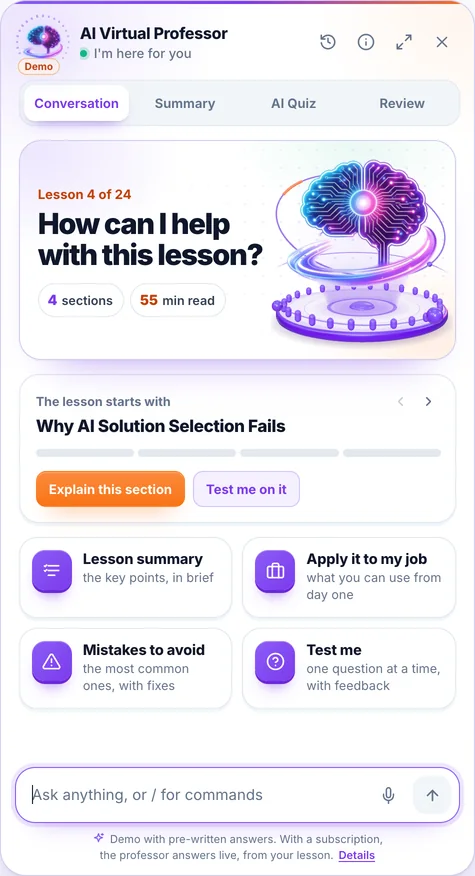
The demo opens on a lesson from the course “AI for Business Leaders”, with prepared answers; voice is off in the demo.
It is an artificial intelligence system, not a human teacher; its answers may contain errors. Details in the Terms & Conditions.
If you are a CEO, managing director, board member, or department manager, this course was created exclusively for you. Not for programmers, not for data engineers, not for the IT team. For you — the people who make the strategic decisions that determine the company's direction, the allocation of resources and, ultimately, the survival or dominance of your organization in a market where artificial intelligence is rewriting the rules of the game. This first lesson gives you the complete map of the 2026 AI landscape, dismantles the persistent myths, and equips you with a decision-making framework you can start applying tomorrow morning.
The AI Landscape in 2026: The Executive's Perspective
The year 2026 marks an inflection point. We are no longer talking about the "potential" of artificial intelligence — we are talking about the concrete consequences of adopting it or failing to adopt it. Recurring industry studies (including McKinsey's "The State of AI" series) show that adoption has become mainstream: the vast majority of large organizations already report regular use of AI in at least one business function. The adoption figure itself is no longer surprising. What is surprising is the distribution of value: only a minority of organizations report significant financial impact (measurable EBIT gains attributable to AI). The rest sit in a gray zone — they have AI, but they do not know how to turn it into measurable value.
Market analyses estimate accelerated, double-digit growth in global spending on AI software and services in 2026. At the same time, research from the consulting world (Boston Consulting Group, McKinsey) converges on a consistent conclusion: organizations with a coherent AI strategy, owned at C-suite level, achieve a significantly higher return than those that leave AI initiatives to the discretion of individual departments (BCG, "The Widening AI Value Gap", 2025; McKinsey, "The State of AI", 2025 — correlations, not proven causal links).
For emerging European markets, particularly in Central and Eastern Europe, the situation is even more relevant. Eurostat data show that effective AI adoption in companies across much of the region is still below the EU average (in 2025, 5.2% of enterprises with 10 or more employees in Romania, 8.4% in Poland and 8.5% in Bulgaria used at least one AI technology, versus 20% across the EU), and PwC analyses of the region confirm that mature implementation (beyond isolated pilots) remains limited to a minority of organizations. This is your opportunity — these markets are at the stage where the decisions made now will determine the market leaders of the next decade.
Demystifying AI: What It Can and Cannot Do
As a leader, it is essential to understand exactly what artificial intelligence is and what it is not, without technical jargon, but with conceptual precision.
What AI CAN do in 2026:
- Processing and synthesis at scale: An AI model can analyze 10,000 legal contracts in the time it takes a lawyer to analyze 3. It can synthesize 500 financial reports into an actionable executive summary in 2 minutes.
- Cognitive automation: Tasks that previously required mid-level human judgment — email classification, support-ticket triage, the first draft of an analytical report — can now be automated with high accuracy, which you must nevertheless measure on your own data before dropping human review.
- Prediction and pattern recognition: Identifying patterns in data that the human eye cannot detect: anomalies in financial transactions, customer churn prediction, supply chain optimization.
- Content generation: From copywriting to reports, presentations, code, images and training materials — production speed increases by 5-15x.
- Natural interaction: Virtual assistants that converse naturally with customers, in human language, 24/7, in any language.
What AI CANNOT do (and what you need to know to avoid the traps):
- It cannot replace strategic judgment. AI can generate options, but it cannot evaluate the political, cultural or emotional context of a boardroom decision.
- It cannot operate without data. "Garbage in, garbage out" remains the fundamental law. If your organization's data is chaotic, incomplete or unstructured, AI will produce chaotic results.
- It cannot guarantee 100% accuracy. The phenomenon of "hallucination" — where the model generates plausible but false information — remains a reality. It has decreased significantly in 2026 compared to 2023, but it has not disappeared.
- It cannot solve poorly defined problems. If you cannot clearly articulate which business problem you are trying to solve, no AI model will save you.
- It cannot function without human governance. The EU AI Act, GDPR regulations and internal ethical standards require permanent human oversight.
Pick up exactly where you left off
Pick the option that fits you; your account is created at checkout in under a minute:
What's next in this lesson
- GPT-6 Astra, Claude Opus 5.5, Gemini 3.1 Pro — What a Manager Needs to Know
- AI as a Management Tool, Not an IT Tool
- AI Adoption Statistics in 2026 and the Impact on the Manager's Role
- Competitive Advantage Through AI: Executive Case Studies
- The Emerging European AI Market in 2026
- Your First Step as a Leader: The 48-Hour Framework
- Conclusion: Why Every Day Counts
Everything you'll learn in this course
1 AI Fundamentals for Managers and Leaders 3 lessons
- What a Leader Needs to Know About AI in 2026 Reading now 55 min
- The Real ROI of AI Implementation: How to Calculate It and Present It to the Board 55 min
- Assessing Your Organization's AI Maturity: Where We Are and Where We Are Going 55 min
2 AI Strategy and Implementation for Management 3 lessons
- The IMPACT Framework for Choosing the Right AI Solution 55 min
- Change Management for AI Implementation 55 min
- Building an AI-First Culture in Your Organization 55 min
3 Practical AI by Department: The Manager's Guide 3 lessons
- AI in Marketing, Sales, and Customer Experience 55 min
- AI in Operations, Supply Chain, and Finance 55 min
- AI in HR, Legal, and Compliance from the Manager's Perspective 55 min
4 Decision-Making and Leadership with AI 3 lessons
- Decision Intelligence: How AI Transforms Managerial Decisions 55 min
- The Leader's Arsenal: Generative AI Tools for Management 55 min
- Executive Communication and Presentations with AI 55 min
5 Risks, Ethics and Regulation for Leaders 2 lessons
- The EU AI Act and Leaders' Real Obligations in 2026 55 min
- Ethics, Bias, and Responsible AI Governance 55 min
6 Managing Teams and Talent in the AI Era 3 lessons
- Leading AI-Augmented Teams 55 min
- Upskilling and Reskilling: Preparing the Organization for AI 55 min
- Organizational Structures and AI Governance 55 min
7 Measurement, Scaling and Strategic Planning 3 lessons
- KPIs, Dashboards and Measuring AI Success 55 min
- The AI Strategic Plan: From Pilot to Organizational Transformation 55 min
- The Future of Management: AI Trends 2026-2030 55 min
8 Case Studies and Hands-On Projects 2 lessons
- Case Study: The AI Transformation of a 500+ Employee European Company 55 min
- Hands-On Project: Build Your Organization's AI Strategic Plan 60 min
9 Appendix: Official Resources, 2026 Updates and Learning Paths 1 lessons
- Official Resources, 2026 Updates and Learning Paths 35 min
10 Final Quiz — AI for Leaders and Management 1 lessons
- Final Assessment: AI for Leaders and Management 60 min
Everything you need to learn effectively
Interactive quizzes
Check your knowledge at the end of every lesson with scored quizzes and feedback.
Personal notes
Save notes on every lesson, accessible anytime from your dashboard.
Scheduled reviews
Revisit lessons exactly when it matters, at the right intervals — so you remember for the long term.
Progress & Achievements
Track your progress, unlock achievements, and visualize what you've learned.
Bookmarks
Save the lessons that matter and find them instantly when you need them.
Questions & Answers
Ask questions right on the lesson and get answers from our team.
Good to know before you start
How do I get access to the course?
You can read the beginning of the first lesson for free, right on this page. For the course you create an account, pick the subscription that fits — a single course or a bundle — and get access immediately after your payment is confirmed. Everything happens 100% online.
Can I cancel my subscription anytime?
Yes. Cancel anytime, straight from your account, in just a few clicks. Your access stays active until the end of the period you have already paid for.
What does the subscription for this course include?
All 24 lessons in the course, interactive quizzes, the AI Professor built into every lesson (select a passage and choose “Explain this to me”), within a fair-use limit, personal notes, automatically saved progress, and content updates included.
Is there a fixed learning schedule?
No. You learn at your own pace, on any device. Lessons are structured step by step, and the platform saves your progress automatically, so you can pick up right where you left off — anytime.
Ready to unlock all the content?
Just this course — €99 / month, VAT included — or every Business course, with smart quizzes and the AI Professor included, in the bundle at €299 / month, VAT included.