
How AI Is Transforming Digital Marketing in 2026
From the course AI for Digital Marketing
In every lesson
The AI Professor starts from the lesson you have open
You ask it in writing or by voice, right from the lesson, and you can listen to the answer on request. Where needed, it fills in from general knowledge. When you select a passage, a bar appears with “Explain this to me”, “Give me an example”, “Why does it matter?” and “My own question”.
Its panel has four tabs:
- Conversation: you ask, it answers starting from the lesson
- Summary: the key ideas of the lesson, point by point
- AI Quiz: 3, 5 or 10 new questions from the lesson, with explanations
- Review: flashcards made from the lesson
Included in every subscription and in single-course access, within a fair-use limit.
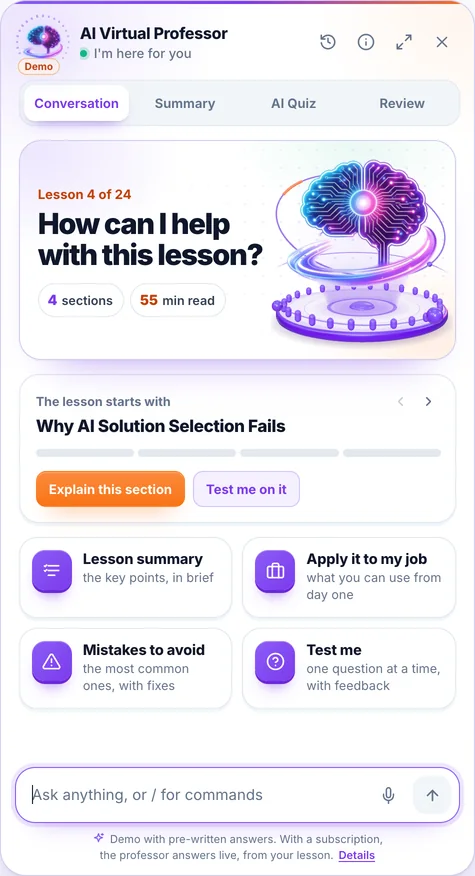
The demo opens on a lesson from the course “AI for Business Leaders”, with prepared answers; voice is off in the demo.
It is an artificial intelligence system, not a human teacher; its answers may contain errors. Details in the Terms & Conditions.
Two marketers with the same budget and the same market can achieve completely different results today — not because one has more talent, but because one lets AI handle the routine work and saves their energy for strategy, while the other still writes every post and every email by hand. In 2026, this has become the line separating marketers who move ahead from those who fall behind. AI has completely redefined the digital marketing landscape — from content generation to campaign optimization, from experience personalization to predictive analysis of buying behavior — and it is no longer a competitive advantage, but a condition of survival. In this lesson you will see exactly what changed between 2024 and 2026, what the real industry numbers are, and where the marketer fits in a world orchestrated by AI.
The AI revolution in marketing: what changed between 2024 and 2026
Between 2024 and 2026, digital marketing went through the fastest transformation in its history. If in 2024 we were discussing AI's potential and the first experiments with ChatGPT for copywriting, in 2026 we are talking about complete marketing ecosystems orchestrated by artificial intelligence.
Major structural changes:
| Aspect | 2024 | 2026 |
|---|---|---|
| Content generation | Experiments with GPT-4, basic texts | GPT-6 Sol and Claude Opus 5.5 generate complete multichannel campaigns |
| Ads optimization | Manual A/B testing, simple automated rules | AI optimizes bids, creatives and audiences simultaneously in real time |
| Personalization | Segmentation on 5-10 criteria | 1:1 hyper-personalization based on hundreds of behavioral signals |
| Analytics | Retrospective reports, static dashboards | Predictive analysis, automatic anomaly detection, proactive recommendations |
| Customer journey | Predefined linear funnels | Real-time adaptive journeys, orchestrated by AI |
The global market for AI in marketing has grown rapidly in recent years, but estimates of its size vary significantly from one source to another (check recent reports from Statista, Grand View Research or MarketsandMarkets for the up-to-date figure). More important than the absolute market value is the fact that the adoption of AI tools in marketing departments has become the majority: 86.4% of the marketing teams surveyed by HubSpot say they use AI in at least a few marketing areas (HubSpot, State of Marketing 2026), and marketing and sales are consistently among the functions where respondents most often report using AI (McKinsey, The state of AI in 2025).
Industry trends
Recent industry data and surveys consistently point to significant transformations — even if the exact percentages differ from one report to another and must be verified at the primary source:
- AI adoption in marketing has become the majority — most of the B2B and B2C marketing teams surveyed already use AI in at least a few marketing areas (HubSpot, State of Marketing 2026)
- Higher ROI for AI-augmented campaigns compared to those managed exclusively by hand (industry reports; treat exact percentages as indicative)
- Cost per lead trending down for companies with mature MarTech stacks integrated with AI
- Content production time reduced significantly, without compromising quality when human editing is in place
- More precise targeting through machine-learning-based audience models
Pick up exactly where you left off
Pick the option that fits you; your account is created at checkout in under a minute:
What's next in this lesson
- From manual management to AI orchestration: the paradigm shift
- The 5 areas where AI has the biggest impact in marketing
- 1. Content generation and optimization
- 2. Intelligent programmatic advertising
- 3. Predictive and prescriptive analytics
- 4. Personalization at scale
- 5. Customer journey automation
- AI-native vs AI-augmented marketing
Everything you'll learn in this course
1 Fundamentals of AI in Digital Marketing 4 lessons
- How AI Is Transforming Digital Marketing in 2026 Reading now 50 min
- Essential AI Tools for Marketers 50 min
- MarTech Stack Architecture with AI 50 min
- AI Automation Levels in Marketing 50 min
2 Content Generation and SEO with AI 4 lessons
- AI Content Generation: From Idea to Publication 55 min
- SEO Optimization with AI and Google AI Overviews 55 min
- AI Copywriting: Ads, Email, and Landing Pages 50 min
- Content Strategy and Editorial Calendar with AI 50 min
3 Social Media and Community with AI 3 lessons
- Social Media Automation with AI 55 min
- Creating Visual and Video Content for Social Media with AI 50 min
- Community Management and Social Listening with AI 50 min
4 Email Marketing and Automation with AI 3 lessons
- Intelligent Email Marketing with AI 50 min
- AI-Powered Automations and Funnels 55 min
- Advanced Personalization and Segmentation with AI 50 min
5 Paid Ads and Performance Marketing with AI 3 lessons
- Google Ads with AI: Performance Max and Beyond 55 min
- Meta Ads and Paid Social with AI 55 min
- Campaign Optimization, ROAS, and Budgeting with AI 50 min
6 Analytics, Data and Personalisation with AI 3 lessons
- Customer Analytics and Predictive Marketing with AI 55 min
- Personalization at scale with AI 50 min
- Dashboards, reporting, and decision-making with AI 50 min
7 Video, Audio and Visual Marketing with AI 3 lessons
- AI Image Generation and Visual Design 55 min
- AI Video Marketing: From Script to Publishing 55 min
- Audio, Podcast, and Voice Marketing with AI 50 min
8 Ethics, Regulation and an AI-First Strategy 3 lessons
- Ethics and Brand Safety in AI Marketing 50 min
- Legislation: EU AI Act, GDPR, and Marketing Compliance 55 min
- AI-First Marketing Strategy: Roadmap and Implementation 55 min
9 Case Studies and Hands-On Projects 3 lessons
- Case Study: The AI-Driven Digital Transformation of an Online Fashion Store 55 min
- Case Study: An AI Strategy for a Marketing Agency 55 min
- Hands-On Project: Build Your AI Marketing Strategy 60 min
10 Official Resources, 2026 Updates and Learning Paths 1 lessons
- Official Resources, What Changed in 2026, and Next Steps 38 min
11 Final Quiz — AI for Digital Marketing 1 lessons
- Final Assessment — AI for Digital Marketing 60 min
Everything you need to learn effectively
Interactive quizzes
Check your knowledge at the end of every lesson with scored quizzes and feedback.
Personal notes
Save notes on every lesson, accessible anytime from your dashboard.
Scheduled reviews
Revisit lessons exactly when it matters, at the right intervals — so you remember for the long term.
Progress & Achievements
Track your progress, unlock achievements, and visualize what you've learned.
Bookmarks
Save the lessons that matter and find them instantly when you need them.
Questions & Answers
Ask questions right on the lesson and get answers from our team.
Good to know before you start
How do I get access to the course?
You can read the beginning of the first lesson for free, right on this page. For the course you create an account, pick the subscription that fits — a single course or a bundle — and get access immediately after your payment is confirmed. Everything happens 100% online.
Can I cancel my subscription anytime?
Yes. Cancel anytime, straight from your account, in just a few clicks. Your access stays active until the end of the period you have already paid for.
What does the subscription for this course include?
All 31 lessons in the course, interactive quizzes, the AI Professor built into every lesson (select a passage and choose “Explain this to me”), within a fair-use limit, personal notes, automatically saved progress, and content updates included.
Is there a fixed learning schedule?
No. You learn at your own pace, on any device. Lessons are structured step by step, and the platform saves your progress automatically, so you can pick up right where you left off — anytime.
Ready to unlock all the content?
Just this course — €99 / month, VAT included — or every Business course, with smart quizzes and the AI Professor included, in the bundle at €299 / month, VAT included.