Cursuri AI.ro International — AI e-learning for professionals

Try the platform before you pay

Explore the interactive account demo and read the first lesson of MCP (Model Context Protocol) — Building Servers and Integrations (Enterprise Edition) for free, in full — no account, no card.

AI Professor in every lesson Quizzes with feedback Cancel anytime
cursuri-ai.ro/app/courses/building-mcp-servers-and-integrations Interactive demo · sample account
Cursuri AI.ro International — AI e-learning for professionals

Welcome! 👋

Welcome to Cursuri AI International — AI e-learning for professionals, now in English. Activate your subscription and start learning.

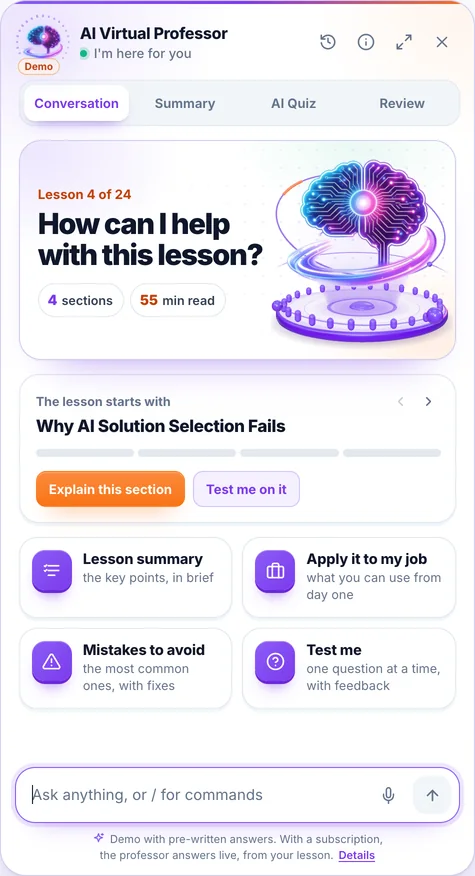
AI virtual professor Exclusive to Cursuri AI

A mentor who knows every lesson in detail and guides you personally.

Included in your subscription

Everything you get with a single subscription

Full access to the entire platform, with no hidden limits or extra costs.

20 premium courses Practical content created by specialists, constantly updated with the latest in AI
24/7 AI virtual professor A personal mentor built into every lesson — ask any question and get an instant answer
555 hands-on lessons Short, structured lessons with practical exercises you can apply at work right away
Smart AI quizzes Automatically generated questions, tailored to your weak spots, with detailed feedback
Save and organize Bookmarks, personal notes and a spaced-repetition system for maximum retention
Progress and analytics Streaks, weekly goals and personalized insights into your growth

Start learning AI today

Pick the right plan and get instant access to premium courses, an AI virtual professor, smart quizzes and hands-on exercises.

No long-term commitment Cancel anytime, no penalties Instant access after payment
This is a preview with sample data. Activate your subscription to save your conversations with the AI Professor.

AI Conversations

The complete history of your dialogues with the AI Virtual Professor

4 Conversations
36 Messages
2 Courses
AI Fundamentals 2 conversations
You

Can you explain how an artificial neuron works?...

AI Professor
AI Professor

An artificial neuron simulates how a biological neuron works: 1. Inputs — it receives multiple numeric values 2. Weights — each input has a weight that determ...

You

What is the ReLU activation function?...

AI Professor
AI Professor

ReLU (Rectified Linear Unit) is the most popular activation function: - Formula: f(x) = max(0, x) - If the input is positive → it passes through unchanged - If the input is negative → it turns it into ...

Prompt Engineering Masterclass 2 conversations
This is sample data Activate a subscription to save and export your real conversations with the AI Professor.
See plans
This is a preview with sample data. Activate a subscription to see your real scores.

Scores

Your performance across 5 assessed courses

79% Overall average
Very good
5
Courses assessed
4 / 5
Passed (≥70%)
22
Quizzes completed
168 / 220
Total points
Score distribution
4 courses ≥70% 1 course 40-69%
Best result Prompt Engineering Masterclass — 92%

Performance by course

92
Prompt Engineering Masterclass Passed
46 / 50 points 5 quizzes 92%
85
Introduction to AI Engineering Passed
34 / 40 points 4 quizzes 85%
76
AI for Digital Marketing Passed
38 / 50 points 5 quizzes 76%
71
RAG — Retrieval Augmented Generation Passed
21 / 30 points 3 quizzes 71%
58
AI Agents & Automation Not passed
29 / 50 points 5 quizzes 58%
This is sample data Activate a subscription to see your real quiz scores.
See plans
Structured learning paths

From zero to expert,
step by step

Career paths and specializations with a clear structure, from fundamentals to advanced level. Each course prepares you for the next — no guessing what to learn next, the platform guides you.

20 Premium courses
555 Hands-on lessons
24/7 AI Professor

How a learning path works

Four simple steps from your first lesson to expert level

01

Choose the right path

Two complete career paths plus focused specializations — for engineers, managers, marketers, or professionals in specialized fields.

02

Complete the stages in order

Each path is divided into clear stages. Each course prepares you for the next — no skipped steps, no lost context.

03

The AI Professor guides you

Ask anything in every lesson. You get explanations, practical examples, and personalized quizzes.

04

Track your progress

Progress per stage and per path, quiz scores, and automatic recommendations for your next step.

AI Virtual Professor Exclusive

Built into every lesson of every path

Throughout your entire path, you have access to an AI professor that knows the content of every lesson. Ask anything — you get detailed explanations, industry examples, and quizzes adapted to your level.

AI chat included in your subscription Answers tailored to the lesson you're studying
Automatic summaries Key points intelligently extracted
Personalized quizzes Unique questions, calibrated to you

Start your first learning path today

Choose the right plan and get instant access to the AI Professor, smart quizzes, and all premium courses.

Instant access Cancel anytime AI Professor included
Individual courses

Choose the courses you're interested in

Subscribe to each course individually. €49 + VAT / month per course, cancel anytime.

IT PRO Advanced Popular

MCP (Model Context Protocol) — Building Servers and Integrations (Enterprise Edition)

The complete MCP guide: from architecture to production servers — Python, TypeScript, security, deployment

22 lessons ~25h
BUSINESS Beginner

Microsoft 365 Copilot for Office Work: Role-Based Productivity

Turn Word, Excel, Outlook, Teams and PowerPoint into AI assistants — real productivity for your role, not generic tricks.

32 lessons ~24h
BUSINESS Intermediate Popular

SEO and AEO/GEO in the AI Era: Optimizing for Google, AI Overviews and Generative Engines

Modern SEO plus end-to-end AEO/GEO: how to appear in Google and AI Overviews and get cited by ChatGPT, Perplexity, Gemini

30 lessons ~26h
BUSINESS Intermediate

Manager in the AI Era: Leading Your Team Through the AI Transformation

Lead your team through the AI transformation with proven frameworks: ADKAR, Kotter and the psychology of adoption

30 lessons ~24h
BUSINESS Intermediate Popular

AI Image Generation: The Complete Guide from Prompt to Publishing

Premium course: visual prompt engineering, AI platforms, production at scale, legal, ROI and hands-on tutorials — updated for 2026

26 lessons ~27h
BUSINESS Beginner

No-Code Data Analysis with AI: ChatGPT, Excel and SQL for Non-Programmers

Analyze data with conversational AI, no code: ChatGPT, Excel and SQL for non-programmers, with verification and GDPR.

27 lessons ~24h
BUSINESS Intermediate Popular

AI for Entrepreneurs and Startups: The Complete Guide

Premium course: idea validation, no-code MVP, go-to-market, finance, scaling and the startup ecosystem with AI — updated for 2026

30 lessons ~28h
BUSINESS Intermediate Popular

AI for Sales and CRM

The complete AI masterclass for sales and intelligent CRM — updated for 2026

28 lessons ~25h
BUSINESS Intermediate Popular

AI for Content Creation and Copywriting

Premium course: copywriting, editorial strategy, social media, video, audio, brand voice, SEO, KPIs and scaling with AI — updated for 2025-2026

29 lessons ~29h
BUSINESS Beginner Popular

AI for Digital Marketing

The complete AI masterclass for digital marketers — updated for 2026

31 lessons ~27h
IT PRO Advanced Popular

Context Engineering and Memory for AI Agents: Beyond Prompting

Engineer AI agents' context and memory for reliability at scale: context anatomy, memory types, retrieval, compaction, cost.

25 lessons ~24h
BUSINESS Intermediate Popular

AI for Business Leaders

The complete AI masterclass for leaders and management — updated for 2026

24 lessons ~22h
IT PRO Advanced Popular

Claude Code Mastery: Agentic Coding from the Terminal (multi-file, git, CI, MCP)

Terminal-first agentic coding with Claude Code: multi-file, git, headless, subagents, hooks, CI/CD, MCP, security and routing across the 2026 Anthropic lineup (including Claude Fable 5).

28 lessons ~25h
IT PRO Beginner

Vibe Coding: From Prompt to Application with Lovable, v0, Bolt and Replit Agent

Build full-stack applications from prompts and ship them safely, legally and responsibly — without writing code.

22 lessons ~24h
IT PRO Expert Popular

Cursor as a Pro: AI-Native IDE, Composer and Multi-Agent 2026 (Enterprise Edition)

Cursor 3 Pro: from Composer to Background Agents and Enterprise — April 2026

30 lessons ~25h
IT PRO Advanced Popular

AI Agents: Architecting and Automating Autonomous Systems

The complete AI Agents and Automation masterclass for engineers — updated for 2026

30 lessons ~26h
IT PRO Advanced Popular

Advanced LLM Integration in Production Applications

The complete masterclass on LLM integration in production — updated for 2026

24 lessons ~26h
IT PRO Advanced Popular

RAG: Retrieval-Augmented Generation in Practice

The complete RAG masterclass for AI Engineers — updated for 2026

27 lessons ~24h
IT PRO Intermediate Popular

The Complete Prompt Engineering Masterclass

Advanced prompting techniques for professionals — updated for 2026

32 lessons ~27h
IT PRO Beginner Popular

Introduction to AI Engineering

The complete AI Engineering masterclass for developers — updated for 2026

28 lessons ~25h
This is a preview with sample data. Activate a subscription to save your lessons and notes.

Saved & Notes

Your saved lessons and personal notes, organized by course.

5 saved lessons 3 notes
Prompt Engineering Masterclass 3
Chain-of-Thought Prompting — The Complete Guide Mar 18
Few-Shot vs Zero-Shot — When to Use Each Mar 16
Advanced System Prompts for GPT-5.5 and Claude Mar 14
AI for Digital Marketing 2
Generating Ad Copy with AI — Meta & Google Ads Mar 12
Automating Campaigns with AI Agents Mar 10
This is sample data Activate a subscription to save your own lessons and personal notes.
View plans
This is a preview with sample data. Activate a subscription to generate personalized review flashcards.

Review

Key concepts from your lessons, generated by the AI Virtual Professor

3 Lessons
10 Cards
2 Courses
AI Fundamentals 7 cards
Prompt Engineering Masterclass 3 cards
This is sample data Activate a subscription to generate personalized review flashcards for every lesson.
View plans
This is a preview with demo data. Activate a subscription to see your real statistics.

Learning Insights

Your learning statistics

15h 30m total time 7 achievements
12/7 Lessons 175/180 Minutes 14/21 Streak
12
Lessons completed
175
Minutes invested
59%
5
Quizzes taken
14
Day streak

Personal records

21 days Longest streak
175m Most active week
45 days Total active days
22m/day Daily average
This is demo data Activate a subscription to see your real statistics and achievements.
See plans

Saved articles

The blog articles you saved for later, all in one place.

0 saved articles

No saved articles yet

When you read an article on the blog, hit the “Save” button to find it again quickly right here.

My account

Welcome

The premium AI education platform. Manage your account, subscription and progress.

Demo data. Activate a subscription to see your real progress.

Your progress

See courses
3
Courses in progress
5
Courses completed
47
Lessons completed
14
Day streak

You don't have an active subscription.

Choose a plan
Premium feature

Available with an account

This section becomes active once you create an account.

See available plans
20 premium courses 555 hands-on lessons 24/7 AI Professor Secure payments with Stripe Cancel anytime
Full lesson, free Module 1 · Lesson 1

Why MCP: The AI Integration Problem and the Birth of a Universal Standard

From the course MCP (Model Context Protocol) — Building Servers and Integrations (Enterprise Edition)

50 min read Advanced Quiz included + 21 lessons with a subscription
Tip: select any passage in the lesson and hit “Ask the AI Professor” — that's exactly how it works inside the platform.

Built-in AI Professor Exclusive

Ask anything about the lesson and get an instant answer. The AI Professor knows the course content and helps you learn more effectively.

Select a passage in the lesson → it explains it on the spot Interactive chat — answers any question Automatic summaries with key points Personalized AI-generated quizzes

The Model Context Protocol (MCP) is the open protocol that standardizes how large language models (LLMs) connect to external data sources and tools. Released by Anthropic in November 2024 under the MIT license, MCP evolved in roughly a year and a half from an experimental specification into the AI industry's de facto standard for model-tool integrations. This lesson explores the problem MCP solves, its history, its adoption dynamics, and its fundamental impact on how we build AI systems.

The M×N Problem: Why We Needed MCP

The pre-MCP integration explosion

Before MCP, every AI model provider implemented its own mechanism for interacting with external tools. OpenAI had Function Calling (launched in June 2023), Anthropic had Tool Use, Google had Function Declarations in Gemini, and every framework — LangChain, LlamaIndex, CrewAI — had its own abstractions. The result was a fragmented ecosystem:

The pre-MCP situation (2023-2024):

Claude ──→ Custom tool handler for PostgreSQL
Claude ──→ Custom tool handler for GitHub
Claude ──→ Custom tool handler for Slack
GPT ────→ Custom function calling for PostgreSQL
GPT ────→ Custom function calling for GitHub
GPT ────→ Custom function calling for Slack
Gemini ──→ Custom function declaration for PostgreSQL
Gemini ──→ Custom function declaration for GitHub
Gemini ──→ Custom function declaration for Slack

Total: 3 models × 3 tools = 9 unique integrations
      M models × N tools = M×N integrations

Every integration requires custom code, separate documentation, dedicated tests, and independent maintenance. At enterprise scale — with 5-10 AI models and 20-50 internal tools — you ended up with hundreds of point-to-point integrations, each with its own bugs and limitations.

The real cost of fragmentation

Fragmentation was not just an engineering problem — it was a business problem. The typical pre-MCP scenario for an enterprise team looked like this:

  • Months of development to integrate a few AI models with internal systems
  • Engineers dedicated exclusively to integration maintenance — every API update from a provider triggers cascading changes
  • Severe vendor lock-in: switching from one model to another requires rewriting most of the integration code
  • Zero portability: tools built for one model did not work with another

The problem was identical to the one in the hardware industry before USB-C: every manufacturer had its own connector, and consumers (in our case, developers) paid the price of fragmentation.

The USB-C analogy — and its limits

The "USB-C for AI" metaphor is useful but imperfect. USB-C standardizes a physical connector — a single plug type for power, data, and video. MCP standardizes a communication protocol — a set of rules through which AI models discover, invoke, and receive results from external tools.

The analogy works along three dimensions:

Dimension USB-C MCP
Universality One connector → any device One protocol → any model + tool
Complexity reduction Eliminates the drawer full of cables Eliminates custom code per integration
Adoption through utility Adopted because it is better Adopted because it is more efficient

The analogy breaks down when we talk about complexity. USB-C is "plug and play" — you connect the cable and it works. MCP requires implementing servers, configuring transports, managing authentication, and validating security. MCP is closer to being the AI equivalent of the HTTP protocol — a communication standard on top of which complex systems are built, not a connector you plug in and forget.

The MCP Solution: M + N Instead of M × N

The fundamental principle

MCP solves the M×N problem by introducing a standardized abstraction layer:

The MCP solution:

Claude ──→ MCP Client ─┐
GPT ─────→ MCP Client ──┼──── MCP Protocol ────┬── MCP Server PostgreSQL
Gemini ──→ MCP Client ─┘                         ├── MCP Server GitHub
Llama ───→ MCP Client ──────────────────────────├── MCP Server Slack
                                                  └── MCP Server Jira

Total: 4 clients + 4 servers = 8 implementations (instead of 16)
       M clients + N servers = M + N (instead of M × N)

Each AI model implements a single MCP client. Each tool implements a single MCP server. Any model-tool combination works automatically through the protocol — with no additional custom code.

What MCP concretely standardizes

MCP defines a complete communication protocol based on JSON-RPC 2.0, which standardizes:

  1. Capability discovery — the client asks the server which tools, resources, and prompts it offers
  2. Tool invocation — the client sends a structured request, the server returns the result
  3. Data access — the server exposes resources (read-only data) that the model can consume
  4. Interaction templates — predefined prompts that guide the model in using the tools
  5. Transport — how the client physically communicates with the server (local stdio or remote HTTP)
# Example: The same MCP server works with ANY AI model
from mcp.server.fastmcp import FastMCP

mcp = FastMCP("demo-server")

@mcp.tool()
def cautare_clienti(nume: str, oras: str = None) -> str:
    """Search for customers in the CRM database by name and optionally by city."""
    rezultate = db.query(
        "SELECT * FROM clienti WHERE nume ILIKE %s AND (%s IS NULL OR oras = %s)",
        [f"%{nume}%", oras, oras]
    )
    return format_tabel(rezultate)

# This server works identically with Claude, GPT, Gemini, Llama
# No code changes whatsoever — the MCP protocol guarantees compatibility

The History of MCP: From Anthropic's Decision to an Industry Standard

November 2024: The public launch

Anthropic published the MCP specification on November 25, 2024, together with:

  • The complete protocol specification (JSON-RPC 2.0)
  • Reference SDKs for Python and TypeScript
  • Native integration in Claude Desktop
  • A few demonstration MCP servers (filesystem, Git, PostgreSQL)
  • Complete documentation at modelcontextprotocol.io

The decision to release MCP as an open standard under the MIT license was strategic. Anthropic understood a fundamental principle of communication standards: the value of a protocol grows exponentially with adoption. A proprietary standard would inevitably have spawned competing standards — OpenAI would have created its own protocol, Google would have created another, and the ecosystem would have become even more fragmented.

2025: Industry validation

The first strong signal came in March 2025, when OpenAI announced MCP integration in its ecosystem. In April 2025, GitHub Copilot launched Agent Mode with MCP support in VS Code. Then, in September 2025, ChatGPT received full MCP support in "Developer Mode" — with read and write access to MCP servers.

More followed quickly:

  • Google: MCP integration in the Gemini API/SDK (2026), plus managed MCP servers for Google Cloud
  • Cursor, Windsurf, Zed: native MCP support in AI IDEs
  • JetBrains: MCP client since IntelliJ 2025.1, MCP server since 2025.2 (30+ built-in tools)
  • Block (formerly Square), Replit: production adoption
  • MCP Registry (the official registry): launched in preview on September 8, 2025 at https://registry.modelcontextprotocol.io

December 2025: MCP becomes an industry standard under the Linux Foundation

On December 9, 2025, Anthropic donated MCP to the Agentic AI Foundation (AAIF), a new foundation under the Linux Foundation. AAIF was co-founded by Anthropic, OpenAI, and Block, with supporting members: Google, Microsoft, AWS, Cloudflare, Bloomberg. AAIF's founding projects are: MCP, Goose (Block), and AGENTS.md (OpenAI).

At the time of the transfer, the MCP ecosystem had reached massive adoption scale: tens of millions of monthly SDK downloads, thousands of active MCP servers, and hundreds of clients (hosts) implementing the protocol — a clear signal of the transition from experimental project to de facto industry infrastructure.

2026: Maturity and ecosystem

By mid-2026, the MCP ecosystem had reached maturity:

  • Specification 2025-11-25 — the latest stable version, with Tasks (asynchronous operations), the Extensions framework, and CIMD
  • Python SDK v1.27.0 and TypeScript SDK v1.29.0 — continuously updated
  • FastMCP 3.2.4 (Prefect) — the reference framework, with Providers, Transforms, OpenTelemetry
  • Models optimized for MCP: Claude Opus 4.8 (claude-opus-4-8, the top of the Opus family, 1M token context) maintains reliable tool use across dozens of consecutive rounds — the essential characteristic for MCP agents orchestrating many servers; Opus 4.7 remains available as the previous generation, and Anthropic's most capable general model as of this update (July 2026) is Claude Fable 5 (claude-fable-5, $10/$50, 1M). Claude Sonnet 5 (claude-sonnet-5, launched June 30, 2026, "the most agentic Sonnet", introductory pricing of $2/$10 until August 31, 2026, then $3/$15), Claude Sonnet 4.6 / Haiku 4.5, and GPT-5.5 (OpenAI, ~1M context) are the other current models with solid MCP support
  • Adoption in regulated sectors: financial, healthcare, government
  • A2A (Agent-to-Agent Protocol) from Google — a complementary protocol for agent-to-agent communication, also under AAIF

Comparison: MCP vs Function Calling vs Plugin Systems vs LangChain Tools

Function Calling (OpenAI, Anthropic, Google)

Function calling is the native mechanism through which an AI model generates a structured function call request, which the host application executes. It is a model-specific mechanism — code that processes function calls from GPT does not work with Claude or Gemini without adaptation.

# Function Calling (OpenAI) — specific to a single model
response = openai.chat.completions.create(
    model="gpt-5.5",
    messages=[{"role": "user", "content": "Search for the customer Ion Popescu"}],
    tools=[{
        "type": "function",
        "function": {
            "name": "cautare_clienti",
            "description": "Search for customers in the CRM",
            "parameters": {
                "type": "object",
                "properties": {
                    "nume": {"type": "string"},
                    "oras": {"type": "string"}
                },
                "required": ["nume"]
            }
        }
    }]
)
# You must manually process tool_calls, execute the function,
# and send the result back — all of it specific to the OpenAI API
# MCP — works with ANY model, no model-specific code
from mcp.server.fastmcp import FastMCP

mcp = FastMCP("crm")

@mcp.tool()
def cautare_clienti(nume: str, oras: str = None) -> str:
    """Search for customers in the CRM by name and optionally by city."""
    return query_crm(nume, oras)

# The server connects to Claude, GPT, Gemini — zero changes

Plugin Systems (ChatGPT Plugins, deprecated)

OpenAI launched ChatGPT Plugins in March 2023 and deprecated them in March 2024. The failure of plugins demonstrated the limitations of a proprietary approach:

  • They only worked with ChatGPT
  • They required approval from OpenAI
  • The API was rigid and hard to extend
  • Developers had no control over the lifecycle

MCP learned from these mistakes: an open protocol, no approval required, extensible by design.

LangChain / LlamaIndex Tools

Frameworks such as LangChain offer their own tool abstractions, but they are framework-specific — a LangChain tool does not work in LlamaIndex or CrewAI without adaptation.

Criterion MCP Function Calling Plugins LangChain Tools
Standardization Open protocol Per provider Per platform Per framework
Portability Cross-model A single model A single product A single framework
Transport stdio + HTTP N/A (in-process) HTTP only N/A (in-process)
Ecosystem Universal registry Per provider Marketplace Community hub
Security Protocol-level App-level Platform-level App-level
State Stateful (session) Stateless Stateless Varies
Discovery Automatic (initialize) Manual (tools param) Marketplace Manual (import)

When you do NOT need MCP

MCP is not the universal solution. You do not need MCP when:

  • You use a single AI model and have no plans to switch
  • You have 1-2 simple tools, with no plans to extend
  • Your application does not need access to external tools (conversation only)
  • Zero latency is critical (MCP adds protocol overhead)

MCP shines when:

  • You are building AI systems that must interact with many tools
  • You want portability across AI models (vendor independence)
  • Your team builds reusable tools
  • Your organization needs centralized governance

The Impact of MCP on Development Workflows

Before MCP: An AI Engineer's workflow

1. Choose the AI model (e.g., Claude)
2. Read the Tool Use/Function Calling documentation
3. Define the JSON schema for each tool
4. Write the dispatch code (parse tool calls, execute the function, return)
5. Manually test each tool
6. Repeat everything if you switch models

With MCP: The simplified workflow

1. Build an MCP server with the tools you need
2. Test with MCP Inspector (universal)
3. Configure it in any MCP host (Claude Desktop, Cursor, Claude Code)
4. It works with any model that supports MCP
5. Switching models = zero changes to the server

Concrete example: Developing with Claude Code

Claude Code, Anthropic's official CLI, supports MCP natively. A developer can configure custom MCP servers in the project's .mcp.json file:

{
    "mcpServers": {
        "baza-date-proiect": {
            "command": "python",
            "args": ["-m", "mcp_server_postgres"],
            "env": {
                "DATABASE_URL": "postgresql://localhost:5432/myapp"
            }
        },
        "documentatie-interna": {
            "command": "npx",
            "args": ["-y", "@company/mcp-docs-server"],
            "env": {
                "DOCS_PATH": "./docs"
            }
        }
    }
}

With this configuration, Claude Code can:

  • Query the database directly from the conversation
  • Search the internal documentation
  • No custom code, no proprietary integrations

The MCP Specification: Versions and Evolution

Version Date Main additions
2024-11-05 November 2024 Initial release: Resources, Tools, Prompts, Sampling, stdio + HTTP+SSE transport
2025-03-26 March 2025 Streamable HTTP (replaces SSE), Tool annotations, audio support
2025-06-18 June 2025 Structured tool outputs, Elicitation (server→user interaction), OAuth 2.1 with RFC 9728
2025-11-25 November 2025 Tasks (asynchronous operations — experimental), Extensions framework, CIMD, mandatory PKCE, authorization extensions

The specification is versioned by date (YYYY-MM-DD format), not with semantic version numbers. Each version is backward-compatible — old servers work with new clients, and old clients can connect to new servers (with functionality limited to the negotiated capabilities). Governance of the protocol was transferred from Anthropic to the Agentic AI Foundation (under the Linux Foundation) in December 2025.

Official Resources

Conclusion

MCP transforms AI integration from an M×N problem (every model-tool combination requires custom code) into an M+N problem (every model and every tool implements a single standard interface). This complexity reduction is not incremental — it is fundamental. It allows organizations to build once, reuse universally, and switch AI providers without rewriting their integrations. In the following lessons, we will explore the protocol's detailed architecture and start building working MCP servers.

Real quiz · from Lesson 1

[Easy] What fundamental problem does MCP solve in the AI ecosystem?

First lesson — read in full, for free

Enjoyed it? All 22 lessons look like this.

You just read a complete lesson, exactly as it appears in the platform. Create your account in under a minute and pick the option that fits you best:

Just this course €49+ VAT / month All 22 lessons + AI Professor (fair-use limit)
Recommended IT Pro bundle €399+ VAT / month Every IT Pro course + smart quizzes + full AI Professor
Instant access to Lesson 2 All 22 lessons in the course Interactive quizzes with feedback AI Professor built into every lesson Notes & progress saved automatically Access from any device
Instant access Cancel anytime Secure payment via Stripe

Up next in the course

  • 2 MCP Architecture in Depth: Host, Client, Server, and Transport 50 min
  • 3 The Four MCP Primitives: Resources, Tools, Prompts, and Sampling 45 min
  • 4 The MCP Ecosystem in 2026: Governance, Registry, Adoption, and A2A 45 min
Unlock all 22 lessons
Course curriculum

Everything you'll learn in this course

9 modules
22 lessons
~17h of content
Advanced level
1 MCP Fundamentals and Architecture 4 lessons
  • Why MCP: The AI Integration Problem and the Birth of a Universal Standard Reading now 50 min
  • MCP Architecture in Depth: Host, Client, Server, and Transport 50 min
  • The Four MCP Primitives: Resources, Tools, Prompts, and Sampling 45 min
  • The MCP Ecosystem in 2026: Governance, Registry, Adoption, and A2A 45 min
2 Building MCP Servers with Python 4 lessons
  • Your First MCP Server in Python: Setup, Structure, and FastMCP 50 min
  • Advanced Tools: Validation, Async, Error Handling, and Production Patterns 50 min
  • Resources, Prompts, and Sampling: Complete Python Server Capabilities 45 min
  • FastMCP 3.x Standalone: Providers, Transforms, and the Modern Architecture 50 min
3 Building MCP Servers with TypeScript 2 lessons
  • The MCP SDK for TypeScript: Setup, Server, and Patterns 50 min
  • MCP Server for Databases: PostgreSQL and Redis 50 min
4 Transport, Authentication and Configuration 3 lessons
  • stdio and HTTP Transports: Configuration, Debugging, and Host Integration 45 min
  • Authentication and Authorization: OAuth 2.1, API Keys, and RBAC 50 min
  • Advanced Features: Elicitation, Structured Outputs, Tasks, and Extensions 55 min
5 Enterprise Patterns and Production Architectures 2 lessons
  • Design Patterns for Production MCP Servers 45 min
  • Multi-Server Orchestration and MCP Gateway Architecture 50 min
6 MCP Security and Compliance 2 lessons
  • MCP Server Security: Threat Model and Defense Strategies 50 min
  • GDPR, EU AI Act, and Compliance for MCP Integrations 45 min
7 Testing, Containerization and CI/CD 2 lessons
  • Testing MCP Servers: Unit, Integration, and End-to-End 45 min
  • Docker Containerization and Cloud Deployment 45 min
8 End-to-End Practical Projects 2 lessons
  • Complete Project: MCP Server for Project Management with PostgreSQL 55 min
  • Official Resources, 2026 Updates, and Learning Paths 40 min
9 Final Quiz — MCP: Building Servers and Integrations 1 lessons
  • Final Assessment — MCP: Building Servers and Integrations 30 min
What you get on the platform

Everything you need to learn effectively

Interactive quizzes

Check your knowledge at the end of every lesson with scored quizzes and feedback.

Personal notes

Save notes on every lesson, accessible anytime from your dashboard.

Scheduled reviews

Revisit lessons exactly when it matters, at the right intervals — so you remember for the long term.

Progress & Achievements

Track your progress, unlock achievements, and visualize what you've learned.

Bookmarks

Save the lessons that matter and find them instantly when you need them.

Questions & Answers

Ask questions right on the lesson and get answers from our team.

Frequently asked questions

Good to know before you start

How do I get access to the course?

You can read the first lesson in full for free, right on this page — no account needed. For the rest of the course you create an account, pick the subscription that fits — a single course or a bundle — and get access immediately after your payment is confirmed. Everything happens 100% online.

Can I cancel my subscription anytime?

Yes. Cancel anytime, straight from your account, in just a few clicks. Your access stays active until the end of the period you have already paid for.

What does the subscription for this course include?

All 22 lessons in the course, interactive quizzes, the AI professor built into every lesson (select any passage and it explains it on the spot), personal notes, automatically saved progress, and content updates included.

Is there a fixed learning schedule?

No. You learn at your own pace, on any device. Lessons are structured step by step, and the platform saves your progress automatically, so you can pick up right where you left off — anytime.

Ready to unlock all the content?

Just this course — €49 + VAT / month — or every IT Pro course, with smart quizzes and the full AI Professor, in the bundle at €399 + VAT / month.

Instant access Cancel anytime Secure payment via Stripe
From €49 + VAT / month · Cancel anytime
Read the free lesson