Cursuri AI.ro International — AI e-learning for professionals

Try the platform before you pay

Explore the interactive account demo and read the first lesson of Claude Code Mastery: Agentic Coding from the Terminal (multi-file, git, CI, MCP) for free, in full — no account, no card.

AI Professor in every lesson Quizzes with feedback Cancel anytime
cursuri-ai.ro/app/courses/claude-code-mastery-agentic-coding Interactive demo · sample account
Cursuri AI.ro International — AI e-learning for professionals

Welcome! 👋

Welcome to Cursuri AI International — AI e-learning for professionals, now in English. Activate your subscription and start learning.

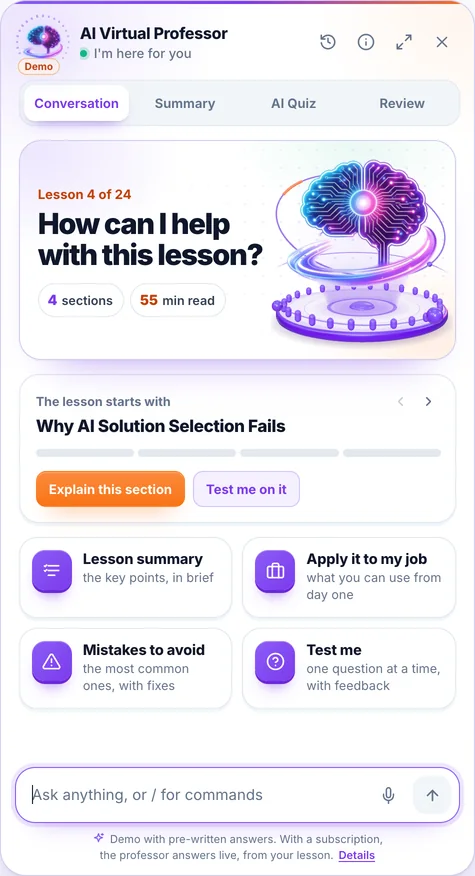
AI virtual professor Exclusive to Cursuri AI

A mentor who knows every lesson in detail and guides you personally.

Included in your subscription

Everything you get with a single subscription

Full access to the entire platform, with no hidden limits or extra costs.

20 premium courses Practical content created by specialists, constantly updated with the latest in AI
24/7 AI virtual professor A personal mentor built into every lesson — ask any question and get an instant answer
555 hands-on lessons Short, structured lessons with practical exercises you can apply at work right away
Smart AI quizzes Automatically generated questions, tailored to your weak spots, with detailed feedback
Save and organize Bookmarks, personal notes and a spaced-repetition system for maximum retention
Progress and analytics Streaks, weekly goals and personalized insights into your growth

Start learning AI today

Pick the right plan and get instant access to premium courses, an AI virtual professor, smart quizzes and hands-on exercises.

No long-term commitment Cancel anytime, no penalties Instant access after payment
This is a preview with sample data. Activate your subscription to save your conversations with the AI Professor.

AI Conversations

The complete history of your dialogues with the AI Virtual Professor

4 Conversations
36 Messages
2 Courses
AI Fundamentals 2 conversations
You

Can you explain how an artificial neuron works?...

AI Professor
AI Professor

An artificial neuron simulates how a biological neuron works: 1. Inputs — it receives multiple numeric values 2. Weights — each input has a weight that determ...

You

What is the ReLU activation function?...

AI Professor
AI Professor

ReLU (Rectified Linear Unit) is the most popular activation function: - Formula: f(x) = max(0, x) - If the input is positive → it passes through unchanged - If the input is negative → it turns it into ...

Prompt Engineering Masterclass 2 conversations
This is sample data Activate a subscription to save and export your real conversations with the AI Professor.
See plans
This is a preview with sample data. Activate a subscription to see your real scores.

Scores

Your performance across 5 assessed courses

79% Overall average
Very good
5
Courses assessed
4 / 5
Passed (≥70%)
22
Quizzes completed
168 / 220
Total points
Score distribution
4 courses ≥70% 1 course 40-69%
Best result Prompt Engineering Masterclass — 92%

Performance by course

92
Prompt Engineering Masterclass Passed
46 / 50 points 5 quizzes 92%
85
Introduction to AI Engineering Passed
34 / 40 points 4 quizzes 85%
76
AI for Digital Marketing Passed
38 / 50 points 5 quizzes 76%
71
RAG — Retrieval Augmented Generation Passed
21 / 30 points 3 quizzes 71%
58
AI Agents & Automation Not passed
29 / 50 points 5 quizzes 58%
This is sample data Activate a subscription to see your real quiz scores.
See plans
Structured learning paths

From zero to expert,
step by step

Career paths and specializations with a clear structure, from fundamentals to advanced level. Each course prepares you for the next — no guessing what to learn next, the platform guides you.

20 Premium courses
555 Hands-on lessons
24/7 AI Professor

How a learning path works

Four simple steps from your first lesson to expert level

01

Choose the right path

Two complete career paths plus focused specializations — for engineers, managers, marketers, or professionals in specialized fields.

02

Complete the stages in order

Each path is divided into clear stages. Each course prepares you for the next — no skipped steps, no lost context.

03

The AI Professor guides you

Ask anything in every lesson. You get explanations, practical examples, and personalized quizzes.

04

Track your progress

Progress per stage and per path, quiz scores, and automatic recommendations for your next step.

AI Virtual Professor Exclusive

Built into every lesson of every path

Throughout your entire path, you have access to an AI professor that knows the content of every lesson. Ask anything — you get detailed explanations, industry examples, and quizzes adapted to your level.

AI chat included in your subscription Answers tailored to the lesson you're studying
Automatic summaries Key points intelligently extracted
Personalized quizzes Unique questions, calibrated to you

Start your first learning path today

Choose the right plan and get instant access to the AI Professor, smart quizzes, and all premium courses.

Instant access Cancel anytime AI Professor included
Individual courses

Choose the courses you're interested in

Subscribe to each course individually. €49 + VAT / month per course, cancel anytime.

IT PRO Advanced Popular

Claude Code Mastery: Agentic Coding from the Terminal (multi-file, git, CI, MCP)

Terminal-first agentic coding with Claude Code: multi-file, git, headless, subagents, hooks, CI/CD, MCP, security and routing across the 2026 Anthropic lineup (including Claude Fable 5).

28 lessons ~25h
BUSINESS Beginner

Microsoft 365 Copilot for Office Work: Role-Based Productivity

Turn Word, Excel, Outlook, Teams and PowerPoint into AI assistants — real productivity for your role, not generic tricks.

32 lessons ~24h
BUSINESS Intermediate Popular

SEO and AEO/GEO in the AI Era: Optimizing for Google, AI Overviews and Generative Engines

Modern SEO plus end-to-end AEO/GEO: how to appear in Google and AI Overviews and get cited by ChatGPT, Perplexity, Gemini

30 lessons ~26h
BUSINESS Intermediate

Manager in the AI Era: Leading Your Team Through the AI Transformation

Lead your team through the AI transformation with proven frameworks: ADKAR, Kotter and the psychology of adoption

30 lessons ~24h
BUSINESS Intermediate Popular

AI Image Generation: The Complete Guide from Prompt to Publishing

Premium course: visual prompt engineering, AI platforms, production at scale, legal, ROI and hands-on tutorials — updated for 2026

26 lessons ~27h
BUSINESS Beginner

No-Code Data Analysis with AI: ChatGPT, Excel and SQL for Non-Programmers

Analyze data with conversational AI, no code: ChatGPT, Excel and SQL for non-programmers, with verification and GDPR.

27 lessons ~24h
BUSINESS Intermediate Popular

AI for Entrepreneurs and Startups: The Complete Guide

Premium course: idea validation, no-code MVP, go-to-market, finance, scaling and the startup ecosystem with AI — updated for 2026

30 lessons ~28h
BUSINESS Intermediate Popular

AI for Sales and CRM

The complete AI masterclass for sales and intelligent CRM — updated for 2026

28 lessons ~25h
BUSINESS Intermediate Popular

AI for Content Creation and Copywriting

Premium course: copywriting, editorial strategy, social media, video, audio, brand voice, SEO, KPIs and scaling with AI — updated for 2025-2026

29 lessons ~29h
BUSINESS Beginner Popular

AI for Digital Marketing

The complete AI masterclass for digital marketers — updated for 2026

31 lessons ~27h
IT PRO Advanced Popular

Context Engineering and Memory for AI Agents: Beyond Prompting

Engineer AI agents' context and memory for reliability at scale: context anatomy, memory types, retrieval, compaction, cost.

25 lessons ~24h
BUSINESS Intermediate Popular

AI for Business Leaders

The complete AI masterclass for leaders and management — updated for 2026

24 lessons ~22h
IT PRO Beginner

Vibe Coding: From Prompt to Application with Lovable, v0, Bolt and Replit Agent

Build full-stack applications from prompts and ship them safely, legally and responsibly — without writing code.

22 lessons ~24h
IT PRO Expert Popular

Cursor as a Pro: AI-Native IDE, Composer and Multi-Agent 2026 (Enterprise Edition)

Cursor 3 Pro: from Composer to Background Agents and Enterprise — April 2026

30 lessons ~25h
IT PRO Advanced Popular

MCP (Model Context Protocol) — Building Servers and Integrations (Enterprise Edition)

The complete MCP guide: from architecture to production servers — Python, TypeScript, security, deployment

22 lessons ~25h
IT PRO Advanced Popular

AI Agents: Architecting and Automating Autonomous Systems

The complete AI Agents and Automation masterclass for engineers — updated for 2026

30 lessons ~26h
IT PRO Advanced Popular

Advanced LLM Integration in Production Applications

The complete masterclass on LLM integration in production — updated for 2026

24 lessons ~26h
IT PRO Advanced Popular

RAG: Retrieval-Augmented Generation in Practice

The complete RAG masterclass for AI Engineers — updated for 2026

27 lessons ~24h
IT PRO Intermediate Popular

The Complete Prompt Engineering Masterclass

Advanced prompting techniques for professionals — updated for 2026

32 lessons ~27h
IT PRO Beginner Popular

Introduction to AI Engineering

The complete AI Engineering masterclass for developers — updated for 2026

28 lessons ~25h
This is a preview with sample data. Activate a subscription to save your lessons and notes.

Saved & Notes

Your saved lessons and personal notes, organized by course.

5 saved lessons 3 notes
Prompt Engineering Masterclass 3
Chain-of-Thought Prompting — The Complete Guide Mar 18
Few-Shot vs Zero-Shot — When to Use Each Mar 16
Advanced System Prompts for GPT-5.5 and Claude Mar 14
AI for Digital Marketing 2
Generating Ad Copy with AI — Meta & Google Ads Mar 12
Automating Campaigns with AI Agents Mar 10
This is sample data Activate a subscription to save your own lessons and personal notes.
View plans
This is a preview with sample data. Activate a subscription to generate personalized review flashcards.

Review

Key concepts from your lessons, generated by the AI Virtual Professor

3 Lessons
10 Cards
2 Courses
AI Fundamentals 7 cards
Prompt Engineering Masterclass 3 cards
This is sample data Activate a subscription to generate personalized review flashcards for every lesson.
View plans
This is a preview with demo data. Activate a subscription to see your real statistics.

Learning Insights

Your learning statistics

15h 30m total time 7 achievements
12/7 Lessons 175/180 Minutes 14/21 Streak
12
Lessons completed
175
Minutes invested
59%
5
Quizzes taken
14
Day streak

Personal records

21 days Longest streak
175m Most active week
45 days Total active days
22m/day Daily average
This is demo data Activate a subscription to see your real statistics and achievements.
See plans

Saved articles

The blog articles you saved for later, all in one place.

0 saved articles

No saved articles yet

When you read an article on the blog, hit the “Save” button to find it again quickly right here.

My account

Welcome

The premium AI education platform. Manage your account, subscription and progress.

Demo data. Activate a subscription to see your real progress.

Your progress

See courses
3
Courses in progress
5
Courses completed
47
Lessons completed
14
Day streak

You don't have an active subscription.

Choose a plan
Premium feature

Available with an account

This section becomes active once you create an account.

See available plans
20 premium courses 555 hands-on lessons 24/7 AI Professor Secure payments with Stripe Cancel anytime
Full lesson, free Module 1 · Lesson 1

Agent-First vs IDE-First: Why Agentic Coding from the Terminal Changes the Rules of the Game

From the course Claude Code Mastery: Agentic Coding from the Terminal (multi-file, git, CI, MCP)

52 min read Advanced Quiz included + 27 lessons with a subscription
Tip: select any passage in the lesson and hit “Ask the AI Professor” — that's exactly how it works inside the platform.

Built-in AI Professor Exclusive

Ask anything about the lesson and get an instant answer. The AI Professor knows the course content and helps you learn more effectively.

Select a passage in the lesson → it explains it on the spot Interactive chat — answers any question Automatic summaries with key points Personalized AI-generated quizzes

Most developers who try an AI programming assistant use it without tapping into what it can truly do: they keep it captive inside the editor, like a smarter autocomplete that proposes the next line, while they remain the ones opening files, positioning the cursor, and running commands. Claude Code proposes something radically different — an agent that lives in the terminal, takes over execution based on your intent, and closes the loop on its own between reading code, modifying it across multiple files simultaneously, and running the tests. The difference is not one of interface, but of role: you stop being the typist who translates intent into every character and become the director who formulates it and judges its result. And this entire shift begins with a distinction worth internalizing from the very start: agent-first versus IDE-first.

What Claude Code Is

Claude Code is a terminal-first coding agent developed by Anthropic. Unlike an autocomplete plugin that lives inside an editor, Claude Code is a standalone program that runs on the command line (CLI) and receives controlled access to your project directory, the file system, and the shell.

Anthropic distributes Claude Code in two main forms, officially documented at code.claude.com/docs:

  • CLI (Command-Line Interface) — typically installed via npm (npm install -g @anthropic-ai/claude-code) or through the official installer. This is the form you will use daily, interactively, from the terminal.
  • SDK (Software Development Kit) — libraries for TypeScript and Python that let you embed the agent's capabilities into your own applications, pipelines, and automations. The SDK is the foundation on which the more advanced integrations are built (for example, agents running in CI).

The code and documentation are publicly accessible: the official repository is github.com/anthropics/claude-code, and the official action for GitHub integration lives at github.com/anthropics/claude-code-action. The fact that we are talking about a tool with a public, versioned, documented presence matters: it means you can verify its behavior, read the changelog, and not rely on assumptions.

What a terminal-first code agent can concretely do

An agent like Claude Code does not merely suggest your next line. It runs through a complete cycle:

  1. Understands the intent — it receives a natural-language description of what you want to achieve.
  2. Navigates and reads — it explores the project structure, opens the relevant files, searches for definitions and usages.
  3. Edits across multiple files — it makes coordinated changes to several files simultaneously, keeping them consistent with one another.
  4. Runs commands — it executes builds, tests, linters, git commands, within the permission boundaries you have set.
  5. Iterates — it reads the output of commands (for example, a failing test), corrects its own work, and repeats the cycle until the objective is reached or it hits a decision that belongs to you.

This cycle — understand → navigate → edit → execute → observe → correct — is the essence of what we call agentic coding.

The Two Mental Models: Agent-First vs IDE-First

To use Claude Code correctly, you need to internalize the distinction between the two paradigms. They are not merely different interfaces; they assume different roles for you, the developer.

IDE-First: intelligence as a layer on top of the editor

In the IDE-first model, the AI assistant is an assistance layer overlaid on your editor. You remain the direct driver of every action: you open the files, you position the cursor, you accept or reject each suggestion. The intelligence manifests predominantly through:

  • Autocomplete (completion) — as you type, the model proposes the rest of the line or block.
  • Inline suggestions — code fragments offered in context, which you accept with a keystroke.
  • Side chat — a conversation in which you ask for explanations or snippets, but you copy/apply them manually.

Representative tools for this model are GitHub Copilot, Cursor, and Windsurf (in their classic assistance modes). The advantage is fine-grained control and predictability: you see every character before it enters your code. The limitation is that you remain the bottleneck — orchestration, navigation, and execution fall on your shoulders.

Agent-First: intelligence as an autonomous executor

In the agent-first model, you describe the intent, and the agent takes over execution. You no longer position the cursor; you formulate an objective ("add validation to the registration form and cover it with tests") and the agent:

  • decides which files need to be read,
  • plans the changes,
  • applies them across multiple files,
  • runs the tests,
  • reads the errors and corrects itself.

You move from the role of operator to the role of director and reviewer: you set the direction, impose constraints, verify the result, approve or reject. Claude Code, OpenAI Codex (in agentic mode), and the agentic modes of Cursor/Windsurf belong to this family.

Dimension IDE-First Agent-First
Unit of work The current line / block The complete task
Who navigates You The agent
Multi-file editing Manual, file by file Coordinated automatically by the agent
Running commands You, separately The agent, in a loop with output observation
Your role Operator (you write) Director & reviewer (you describe, you verify)
Granularity of control Every character Every approval / direction decision
Risk surface Narrow (suggestions) Wider (executes commands) → requires guardrails

Note the last row: the power of agent-first comes bundled with a larger attack surface. Because the agent can run commands and read/write files, security becomes a first-class discipline — a topic we treat in depth in the dedicated module. Here we only flag the connection.

Why the Terminal, Not the Editor

Anthropic's decision to make Claude Code terminal-first is not an aesthetic one. The terminal is the universal common denominator of software development:

  • Composability. In the terminal, the output of one command is input for another. An agent that lives here integrates naturally with git, with running tests, with build scripts, with CI pipelines.
  • Portability. It does not depend on any particular editor. It works the same on your laptop, on a server over SSH, inside a container, or in a CI job.
  • Automation. What you run interactively in the terminal can later be automated without a graphical interface — exactly what the SDK does.

This design explains why agentic coding from the terminal gained significant traction in the developer community in 2026: the agent is no longer locked inside an editor window, but becomes a first-class participant in the entire ecosystem of command-line tools.

The course's hook. An important and growing share of programming work — including visible contributions in commits on GitHub — is today assisted by code agents like Claude Code. We state this qualitatively, without claiming an exact percentage: the trend is clear and significant, and mastering a terminal-first agent has become a core competency, not a curiosity.

The 2026 Anthropic Models and Their Role in Routing

Claude Code does not run a single monolithic model for everything. It relies on the 2026 Anthropic model family, each with a distinct profile of capability, latency, and cost:

Model Profile Typical role in the agentic flow
Claude Fable 5 The most powerful and most intelligent model — a new tier, above Opus; premium pricing The peak of reasoning: heavy planning, sweeping refactors, subtle debugging, long-running agentic sessions where correctness matters more than cost
Claude Opus 4.8 Highly capable, deep reasoning; the default in Claude Code on Max, Team Premium, and Enterprise/API (PAYG) plans Complex day-to-day tasks: planning, large refactors, difficult debugging, with a better capability/cost ratio than Fable
Claude Opus 4.7 Highly capable, the previous Opus generation Heavy tasks when a capability/cost balance is preferred
Claude Sonnet 5 "The most agentic Sonnet" (June 30, 2026), 1M context, new tokenizer (~1.0–1.35× more tokens); the default in Claude Code on Pro and Team Standard plans; $2/$10 introductory until August 31, 2026, then $3/$15 The new default for day-to-day work: edits, frequent iterations, high-volume agentic tasks
Claude Sonnet 4.6 Balanced, fast, 1M context, the previous Sonnet generation (old tokenizer) Day-to-day work in already-calibrated pipelines
Claude Haiku 4.5 Lightweight, very fast, cheap Small operations, classifications, high-volume auxiliary steps

Indicative API pricing (as of this update — July 2026; always check the official Anthropic pricing page):

Model Input / Output ($ per million tokens)
Claude Fable 5 $10 / $50
Claude Opus 4.8 $5 / $25
Claude Sonnet 5 $2 / $10 introductory until August 31, 2026, then $3 / $15
Claude Sonnet 4.6 $3 / $15
Claude Haiku 4.5 $1 / $5

The idea behind routing is that a well-designed agentic system can direct each subtask to the right model: the heaviest reasoning goes to the top of the range (Fable 5 or Opus 4.8), while a quick summarization or a binary decision can go to Haiku. For you, the developer, the practical message is: model choice is a cost and performance lever — the more capable the model, the more expensive it is per token, so you reserve the top tier for the tasks that genuinely require it. Claude Code gives you direct control over it. We will return to routing strategies and agent architecture in the dedicated module; for now, just retain the model map.

A note on knowledge hygiene. In this course we exclusively use the current 2026 models. Models such as Claude 3.x / 3.5, GPT-4 / 4o / 4.1, or Gemini 1.5 / 2.0 / 2.5 are outdated and do not reflect the capabilities we discuss. When evaluating documentation or tutorials, always check the model generation.

A Concrete Example: The Same Task, Two Paradigms

Suppose you have a date-parsing function that does not handle time zones correctly, and you want to fix it plus add tests.

In the IDE-first model, your flow would be roughly:

1. You manually search for the file containing the function (Cmd+P, type the name).
2. You read the code, identify the problematic line.
3. You ask the chat for a corrected version, copy it, paste it.
4. You open the test file, write or request a few cases.
5. You switch to the terminal, run the tests manually.
6. You see a test fail, go back to the editor, adjust, repeat.

In the agent-first model, the flow becomes a single intent:

> The parseEventDate function in src/lib/dates.ts mishandles time
  zones when crossing midnight. Fix it and add tests that cover UTC,
  one positive offset, and one negative offset. Run the test suite
  and make sure it passes.

The agent locates src/lib/dates.ts, reads the function, proposes a fix, writes the tests in a file that matches the project's conventions, runs the suite, reads any failure, corrects itself, and comes back with a summary of the changes. You step in at the decision points: you approve running the commands, you review the diffs, you request adjustments. You did not position a single cursor.

The Boundaries of This Lesson (What We Do NOT Cover Now)

To preserve clarity, we explicitly mark what remains for other modules:

  • The detailed comparison with Cursor and other IDEs — here we stayed at the conceptual level (terminal vs editor). A feature-by-feature analysis, if it appears, is treated separately.
  • Building MCP (Model Context Protocol) servers — extending the agent with your own tools and data sources is the subject of a dedicated advanced module.
  • The general architecture of agents and subagents — orchestration, delegation, and multi-agent patterns come in a module of their own.

What you need right now is the correct mental model: Claude Code is a terminal-first agent that takes over execution based on your intent, under guardrails that you control.

The Execution Loop and the Role of Context

To master an agent, you must understand not just what it does, but how it thinks mechanically. The heart of any code agent is a loop in which the model alternates between two types of actions: reasoning (deciding what needs to be done) and tool actions (reading a file, writing a change, running a command). After each action, its result — the file's contents, the test output, the error message — is fed back into the model's context, which reasons again. The loop closes when the objective is reached or when the agent arrives at a decision that belongs to you.

This mechanic explains two essential practical properties:

  1. The agent learns from the environment's feedback. When a test fails, the agent does not get stuck: it reads the error message, formulates a hypothesis about the cause, and attempts a fix. The ability to observe the result of its own actions is exactly what separates an agent from a mere text generator.
  2. Context is a finite and precious resource. The 2026 model family offers generous context windows (up to 1M tokens on Sonnet 4.6, for example), but even these are not infinite. The more you fill the context with irrelevant information, the more you dilute the model's attention on what matters. Hence the importance of context hygiene — a theme we will refine constantly: give the agent exactly the information it needs for the current task, no more, no less.
Loop element What the agent does Why it matters to you
Reasoning Plans the next step based on the objective and the context The quality of the plan depends on the clarity of your intent
Tool action Reads/writes files, runs commands under permissions This is where your guardrails and approvals come in
Observation Feeds the action's result back into the context Enables self-correction; consumes context
Decision Continues or requests your intervention You stay in control of the critical nodes

The takeaway message: the agent is powerful precisely because it closes the loop between intent, action, and observation. Your role is to formulate clear intents, provide relevant context, and keep control at the decision points.

Why It Matters Now: The Maturing of the Ecosystem

In 2026, agentic coding moved from experimental novelty to production tool. Several factors converged toward this maturation:

  • Models more capable at multi-step reasoning. Anthropic's top models — Claude Fable 5, followed by the Opus 4.8/4.7 family and by Sonnet 5 / Sonnet 4.6 — reason significantly better on tasks that require multi-step planning and maintaining coherence across files — exactly what agentic coding demands.
  • Large context windows. A 1M-token context allows the agent to "hold in mind" many files simultaneously, which makes it possible to work on real codebases, not just isolated fragments.
  • Integration with real tools. Through protocols like MCP (covered in a dedicated module), the agent can connect to external data sources and tools, going beyond the limits of a simple chat session.
  • Distribution as infrastructure. The fact that Claude Code exists as both a CLI and an SDK means it can live both in your interactive workflow and in automated pipelines (CI), a flexibility we will exploit in advanced modules.

For you, the practical conclusion is that investing in mastering a terminal-first agent is not a passing curiosity, but a long-lived competency that will compound with every project.

Conclusion: A Change of Role, Not Just of Tool

The transition from IDE-first to agent-first does not merely change your tools; it changes your role. You are no longer the typist who translates intent into every character; you become the architect who formulates the intent, imposes the constraints, and judges the result. This shift amplifies productivity, but it moves the responsibility toward the clarity of your instructions and the verification of the results — exactly the competencies we will develop throughout the rest of the course.

So far you have gained the correct mental model; what comes next is putting it into your hands. In the following lessons we move from concept to practice — we install Claude Code, authenticate, and run the first real agentic task, then we give the agent a persistent project memory through the CLAUDE.md file. From that first task onward, each lesson adds one more lever of control, until the agent in your terminal no longer feels like a tool you are trying out, but one you drive with confidence.

Real quiz · from Lesson 1

[Easy] How is Claude Code officially distributed by Anthropic?

First lesson — read in full, for free

Enjoyed it? All 28 lessons look like this.

You just read a complete lesson, exactly as it appears in the platform. Create your account in under a minute and pick the option that fits you best:

Just this course €49+ VAT / month All 28 lessons + AI Professor (fair-use limit)
Recommended IT Pro bundle €399+ VAT / month Every IT Pro course + smart quizzes + full AI Professor
Instant access to Lesson 2 All 28 lessons in the course Interactive quizzes with feedback AI Professor built into every lesson Notes & progress saved automatically Access from any device
Instant access Cancel anytime Secure payment via Stripe

Up next in the course

  • 2 Installation, Authentication, and Your First Run: From npm to Your First Agentic Task 50 min
  • 3 CLAUDE.md as Project Memory: Instructions, Conventions, and Persistent Context 50 min
  • 4 The Plan / Edit / Review Loop: How the Agent Works on Multiple Files at Once 51 min
Unlock all 28 lessons
Course curriculum

Everything you'll learn in this course

11 modules
28 lessons
~23h of content
Advanced level
1 Claude Code Fundamentals: Installation, CLI and the Agent-First Mental Model 3 lessons
  • Agent-First vs IDE-First: Why Agentic Coding from the Terminal Changes the Rules of the Game Reading now 52 min
  • Installation, Authentication, and Your First Run: From npm to Your First Agentic Task 50 min
  • CLAUDE.md as Project Memory: Instructions, Conventions, and Persistent Context 50 min
2 Multi-File and Large Codebases: Plan, Edit, Review and Context Management 3 lessons
  • The Plan / Edit / Review Loop: How the Agent Works on Multiple Files at Once 51 min
  • Context Management in Large Codebases: The Context Window, /compact, and Efficiency Strategies 52 min
  • Refactoring at Scale with Zero Regressions: Migrations, Renames, and Cross-Cutting Changes 53 min
3 The Full Git Workflow: Branches, Commits, Conflicts, Code Review and PRs 3 lessons
  • Assisted Git from the Terminal: Branches, Staging, and Quality Commit Messages 50 min
  • Resolving Merge Conflicts and Assisted Rebase: Strategies for a Clean History 51 min
  • AI-Assisted Code Review and Pull Requests: From Diff to PR with the gh CLI 51 min
4 Headless Mode (claude -p) and Non-Interactive Automation 2 lessons
  • claude -p: Programmatic Execution, Structured Output, and Script Integration 52 min
  • Non-Interactive Pipelines and Batch Operations: Repeatable, Safe Automation 51 min
5 Subagents and Agent Teams: Orchestration, Delegation and Controlled Parallelization 2 lessons
  • Subagents: Context Isolation, the Task Tool, and Defining Specialized Agents 52 min
  • Agent Teams and Controlled Parallelization: Delegation, Orchestration, and Safety Limits 52 min
6 Lifecycle Hooks: Deterministic Guardrails and Custom Automations 2 lessons
  • The Anatomy of Hooks: PreToolUse, PostToolUse, Stop, SubagentStop, and Configuration in settings.json 53 min
  • Hooks in Practice: Deterministic Guardrails, Automatic Formatting, and Custom Validations 52 min
7 CI/CD Integration: GitHub Actions with claude-code-action and GitLab CI/CD 2 lessons
  • claude-code-action on GitHub Actions: Setup, Triggers, and PR Automation 53 min
  • GitLab CI/CD and Portable Agentic Pipelines: Headless Mode on Any Runner 51 min
8 MCP in Practice: Consuming External Tools with Least-Privilege Permissions 2 lessons
  • Connecting Claude Code to MCP Servers: Configuration, Scope, and Transport 52 min
  • Least-Privilege MCP: Minimal Permissions, Tool Approvals, and Trusted Data Sources 52 min
9 Security and Sandboxing: Deny Rules, Least-Privilege and Lessons from Real 2026 CVEs 3 lessons
  • The Code Agent's Threat Model: CVE-2025-59536 and CVE-2026-21852 Dissected 53 min
  • Deny Rules, Permissions, and Never-Run-as-Root: Defensive Configuration of Claude Code 52 min
  • Sandboxing, Isolation, and the OWASP Agentic Top 10: Defense in Depth for Coding Agents 53 min
10 Capstone Project: An End-to-End Agentic Pipeline on a Realistic Repo 3 lessons
  • From Issue to Code: Multi-File Implementation, Branch, and an Agent-Guided PR 53 min
  • Headless, Subagents, and a Generated Guide: Automating Documentation and Verification 52 min
  • CI, Security, and Delivery: claude-code-action, Deny Rules, and the Final Production Posture 53 min
11 2026 Appendix: Official Resources, Updates, Learning Paths and the Agent SDK 3 lessons
  • Official Resources, 2026 Updates, and Learning Paths 34 min
  • Claude Design → Claude Code: The Design-to-Code Handoff (Anthropic Labs, 2026) 18 min
  • Agent SDK: From claude -p to Custom Agents in Production 30 min
What you get on the platform

Everything you need to learn effectively

Interactive quizzes

Check your knowledge at the end of every lesson with scored quizzes and feedback.

Personal notes

Save notes on every lesson, accessible anytime from your dashboard.

Scheduled reviews

Revisit lessons exactly when it matters, at the right intervals — so you remember for the long term.

Progress & Achievements

Track your progress, unlock achievements, and visualize what you've learned.

Bookmarks

Save the lessons that matter and find them instantly when you need them.

Questions & Answers

Ask questions right on the lesson and get answers from our team.

Frequently asked questions

Good to know before you start

How do I get access to the course?

You can read the first lesson in full for free, right on this page — no account needed. For the rest of the course you create an account, pick the subscription that fits — a single course or a bundle — and get access immediately after your payment is confirmed. Everything happens 100% online.

Can I cancel my subscription anytime?

Yes. Cancel anytime, straight from your account, in just a few clicks. Your access stays active until the end of the period you have already paid for.

What does the subscription for this course include?

All 28 lessons in the course, interactive quizzes, the AI professor built into every lesson (select any passage and it explains it on the spot), personal notes, automatically saved progress, and content updates included.

Is there a fixed learning schedule?

No. You learn at your own pace, on any device. Lessons are structured step by step, and the platform saves your progress automatically, so you can pick up right where you left off — anytime.

Ready to unlock all the content?

Just this course — €49 + VAT / month — or every IT Pro course, with smart quizzes and the full AI Professor, in the bundle at €399 + VAT / month.

Instant access Cancel anytime Secure payment via Stripe
From €49 + VAT / month · Cancel anytime
Read the free lesson