
What Prompt Engineering Means in Production
From the course The Complete Prompt Engineering Masterclass
In every lesson
The AI Professor starts from the lesson you have open
You ask it in writing or by voice, right from the lesson, and you can listen to the answer on request. Where needed, it fills in from general knowledge. When you select a passage, a bar appears with “Explain this to me”, “Give me an example”, “Why does it matter?” and “My own question”.
Its panel has four tabs:
- Conversation: you ask, it answers starting from the lesson
- Summary: the key ideas of the lesson, point by point
- AI Quiz: 3, 5 or 10 new questions from the lesson, with explanations
- Review: flashcards made from the lesson
Included in every subscription and in single-course access, within a fair-use limit.
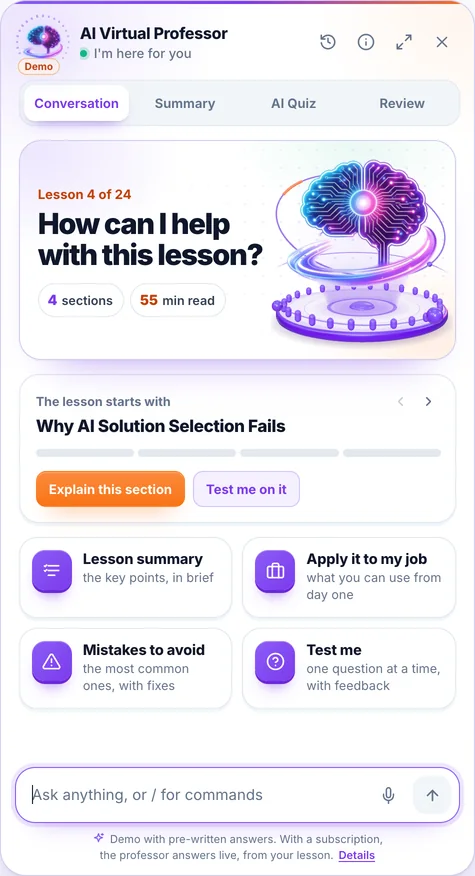
The demo opens on a lesson from the course “AI for Business Leaders”, with prepared answers; voice is off in the demo.
It is an artificial intelligence system, not a human teacher; its answers may contain errors. Details in the Terms & Conditions.
The same prompt that works flawlessly during a demo can start returning invalid JSON the next day, in production, without anyone having changed a single line of code — and the team loses entire hours hunting a bug that does not live in the code, but in the way the instruction was worded. This is exactly where you see the difference between someone who "talks nicely" to an LLM and the engineer who treats the prompt as a reproducible operational contract: with defined inputs, guaranteed outputs and testable behavior. In 2026, as frontier models (today GPT-6 Sol, Claude Opus 5.5, Gemini 3.1 Pro) enter production workflows, this very difference is what separates the impressive demo from the stable product.
Why prompt engineering is engineering, not art
The term "prompt engineering" has evolved radically since 2023-2024. Back then, a good prompt meant phrasing a question more cleverly than average. Today, in production, a prompt is a formal contract between your application and the language model. This contract specifies:
- Accepted inputs — what data the model receives and in what format
- Expected behavior — what transformation must be applied
- Guaranteed outputs — the exact structure of the response (JSON, Markdown, CSV, etc.)
- Safety constraints — what the model must NOT do under any circumstances
Think of a classic software function: it has input parameters, internal logic, a return type and error handling. A production prompt follows exactly the same paradigm. The difference is that the "internal logic" is a stochastic model with hundreds of billions of parameters — which makes the contract specification even more critical.
Conversation vs. Production — two different worlds
| Dimension | Conversation (chat) | Production (pipeline) |
|---|---|---|
| Frequency | Occasional, interactive | Thousands-millions of calls/day |
| Variability | Acceptable, even desirable | Unacceptable — consistency is mandatory |
| Feedback | Human, real-time | Automated, aggregated metrics |
| Cost | Negligible | Major budget line |
| Consequences of errors | You rephrase the question | Misclassified tickets, invalid invoices, lost customers |
| Versioning | Nonexistent | Mandatory (Git, prompt registry) |
When a developer tests Claude Opus 5.5 in a conversation and gets an impressive answer, this does not prove that the prompt will work in production. The demo benefits from conversational context, iterative rephrasing and subjective tolerance. Production has none of these safety nets.
Why models impress in demos but disappoint without a good prompt
There is a phenomenon we call the "demo illusion". A model like GPT-6 Sol or Claude Opus 5.5 can generate remarkable answers in an interactive session, but the same model, without a rigorous prompt, produces systematic inconsistencies at scale:
1. Missing format anchoring — Without an explicit specification, the model "decides" the response format on its own. Over 10 calls, you will get 10 different formats.
2. Semantic drift — Across thousands of calls, the model interprets ambiguous instructions in subtly different ways, generating a "drift" that is hard to detect.
3. Order sensitivity — The order of information inside the prompt dramatically influences the output. What works with 3 examples may fail with 5.
Pick up exactly where you left off
Pick the option that fits you; your account is created at checkout in under a minute:
What's next in this lesson
- Example: fragile prompt (do NOT do this in production)
- Problem: the model may respond with:
- - "The category is: Billing"
- - "This appears to be a billing issue."
- - "BILLING"
- - "I think it belongs to the billing department, but it could also be..."
- The lifecycle of a production prompt
- 1. Design
Everything you'll learn in this course
1 Prompt Engineering Fundamentals 4 lessons
- What Prompt Engineering Means in Production Reading now 52 min
- The Anatomy of an Effective Prompt 53 min
- The CRISP Framework and Temperature in Real-World Decisions 50 min
- AI Models in 2026: Capabilities, Limits, and Choosing the Right One 50 min
2 Advanced Prompting Techniques 4 lessons
- Chain-of-Thought Prompting in Practice 50 min
- Few-Shot and Zero-Shot in Real-World Systems 50 min
- Tree-of-Thought and Self-Consistency for Complex Decisions 50 min
- Prompt Chaining and Intelligent Routing 50 min
3 Multi-Modal Prompt Engineering 3 lessons
- Prompting with Images and Documents 53 min
- Audio and Video Prompting 50 min
- Multi-Modal Pipelines in Production 53 min
4 Prompt Engineering for AI Agents 3 lessons
- Prompting for Tool Use and Function Calling 50 min
- Designing AI Agents: Instructions and Orchestration 50 min
- MCP, Claude Code, and Codex: Agents in Practice 53 min
5 Prompt Engineering for Code 3 lessons
- Code Generation with Prompts 50 min
- Debugging with AI 53 min
- Code Review and Refactoring with AI 51 min
6 Prompt Engineering for Business 3 lessons
- Content Generation with AI 53 min
- Data Analysis with Prompts 50 min
- Automation and Prompt Libraries 53 min
7 Prompt Security and Guardrails 3 lessons
- Prompt Injection: Attacks and Defense 53 min
- Guardrails and Output Filtering 50 min
- Governance, Compliance, and the EU AI Act 51 min
8 Evaluating and Optimising Prompts 3 lessons
- Building Your Own Eval Sets and Benchmarks 50 min
- A/B Testing and Systematic Experimentation 50 min
- Cost and Performance Optimization 50 min
9 Case Studies and Real-World Projects 5 lessons
- Case Study: AI Assistant for Customer Support 55 min
- Case Study: AI Pipeline for E-Commerce 55 min
- Capstone Project: Build Your Own AI System 55 min
- Programmatic Prompt Optimization: DSPy, GEPA, and Meta-Prompting 26 min
- Official Resources, 2026 Updates, and Learning Paths 24 min
10 Final Quiz 1 lessons
- Final Assessment — Prompt Engineering Masterclass 60 min
Everything you need to learn effectively
Interactive quizzes
Check your knowledge at the end of every lesson with scored quizzes and feedback.
Personal notes
Save notes on every lesson, accessible anytime from your dashboard.
Scheduled reviews
Revisit lessons exactly when it matters, at the right intervals — so you remember for the long term.
Progress & Achievements
Track your progress, unlock achievements, and visualize what you've learned.
Bookmarks
Save the lessons that matter and find them instantly when you need them.
Questions & Answers
Ask questions right on the lesson and get answers from our team.
Good to know before you start
How do I get access to the course?
You can read the beginning of the first lesson for free, right on this page. For the course you create an account, pick the subscription that fits — a single course or a bundle — and get access immediately after your payment is confirmed. Everything happens 100% online.
Can I cancel my subscription anytime?
Yes. Cancel anytime, straight from your account, in just a few clicks. Your access stays active until the end of the period you have already paid for.
What does the subscription for this course include?
All 32 lessons in the course, interactive quizzes, the AI Professor built into every lesson (select a passage and choose “Explain this to me”), within a fair-use limit, personal notes, automatically saved progress, and content updates included.
Is there a fixed learning schedule?
No. You learn at your own pace, on any device. Lessons are structured step by step, and the platform saves your progress automatically, so you can pick up right where you left off — anytime.
Ready to unlock all the content?
Just this course — €99 / month, VAT included — or every IT Pro course, with smart quizzes and the AI Professor included, in the bundle at €399 / month, VAT included.