
The Limits of Prompting and Context as a New Discipline in 2026
From the course Context Engineering and Memory for AI Agents: Beyond Prompting
In every lesson
The AI Professor starts from the lesson you have open
You ask it in writing or by voice, right from the lesson, and you can listen to the answer on request. Where needed, it fills in from general knowledge. When you select a passage, a bar appears with “Explain this to me”, “Give me an example”, “Why does it matter?” and “My own question”.
Its panel has four tabs:
- Conversation: you ask, it answers starting from the lesson
- Summary: the key ideas of the lesson, point by point
- AI Quiz: 3, 5 or 10 new questions from the lesson, with explanations
- Review: flashcards made from the lesson
Included in every subscription and in single-course access, within a fair-use limit.
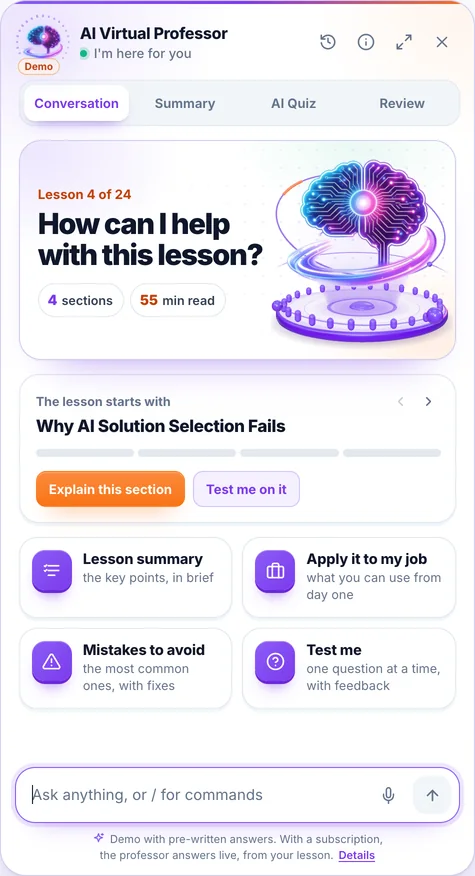
The demo opens on a lesson from the course “AI for Business Leaders”, with prepared answers; voice is off in the demo.
It is an artificial intelligence system, not a human teacher; its answers may contain errors. Details in the Terms & Conditions.
Prompting got you this far, but it will not take you further. You can write the most elegant instruction in the world and still watch helplessly as a model that no longer answers a single message, but runs as an agent across dozens of steps, calls tools, and accumulates history, begins to forget, contradict itself, and make mistakes — not because the prompt is bad, but because the prompt has stopped being the problem. This is where context engineering comes in: the discipline of curating and managing the entire set of tokens that enters an inference window, not just the prompt you write yourself.
From a good question to a well-managed state
In 2023–2024, "being good at AI" essentially meant formulating clever prompts. You knew a few techniques — few-shot, chain-of-thought, instruction delimiting — and you got results well above average. That skill set remains valid and is taught in detail in the course The Complete Prompt Engineering Masterclass. But it describes a single act: composing one input message.
The problem is that real applications in 2026 no longer send a single message. An assistant resolving a support ticket, an agent navigating a codebase, or a system planning a trip executes a loop: it thinks, calls a tool, receives a result, thinks again, calls another tool, and so on. At every iteration, the context window fills with new material — API responses, search results, intermediate messages, reasoning traces. Your initial prompt becomes an ever smaller fraction of a whole you no longer control directly.
This is where the conceptual break happens. Prompting optimizes one message. Context engineering optimizes everything the model sees at the moment of each inference. The two are not in competition; the second contains the first. The system prompt remains an essential component — but it is one component within a token budget that also includes conversational history, tool definitions, retrieved documents, persistent memory, and execution results.
What "context" means in this discipline
When we say context, we mean the complete set of tokens present in the inference window at a given moment. According to the official Anthropic post "Effective context engineering for AI agents" (anthropic.com/engineering), this set typically includes:
- The system prompt — the persistent instructions, the role, the rules of behavior.
- Tool definitions — the schemas of the functions the agent can call.
- Conversational history — the previous messages from the user and the model.
- Tool call results — outputs that can be large and noisy.
- Retrieved information — document fragments brought in through retrieval.
- Persistent memory — facts and preferences kept across sessions.
Context engineering is the art and engineering of deciding, for each of these components, what goes in, how much goes in, in what form, and at what moment — so that the model receives exactly the signal it needs, without the noise that degrades its performance.
Context is a finite resource, not a bottomless basket
The natural temptation of any engineer who discovers large context windows is to "throw everything in." If the model accepts a million tokens, why not give it all the documentation, the entire history, every file? The Anthropic post confronts this intuition head-on: context is a finite resource with diminishing marginal returns. Every added token has a cost — not just financial, but attentional.
Pick up exactly where you left off
Pick the option that fits you; your account is created at checkout in under a minute:
What's next in this lesson
- A useful analogy: attention as limited working memory
- How "pure" prompting fails in the world of agents
- Where this course sits on your skills map
- What you will be able to do by the end of the course
- Four signals that you have crossed from the world of prompting into the world of context engineering
- A brief history of the transition: 2023–2026
- Summary
Everything you'll learn in this course
1 Why Context Engineering: Beyond Prompting 3 lessons
- The Limits of Prompting and Context as a New Discipline in 2026 Reading now 52 min
- The Context Window as a Finite Resource: Context Rot, Attention, and Budgeting 54 min
- What "Context" Means in 2026: From Static Prompt to Dynamic Agent State 50 min
2 The Anatomy of Context: The Components of the Inference Window 3 lessons
- System Prompt and Instructions: The Stable Layer of the Context 52 min
- Examples, Conversation History, and Messages: The Accumulated Context 52 min
- Tool Results and Retrieved Data: Dynamic Context at Runtime 54 min
3 Memory Types for AI Agents 3 lessons
- Working/Short-Term Memory vs Long-Term: The Taxonomy of Agent Memory 52 min
- Semantic Memory: Facts, Profiles, and Persistent Knowledge 52 min
- Episodic and Procedural Memory: Experiences and Learned Behavior 52 min
4 Memory Managers and Persistence: Extraction, Consolidation, Store 3 lessons
- Memory Stores and Persistence: Where and How Memory Lives 54 min
- Extraction: How to Turn Conversations into Durable Memories 52 min
- Consolidation: Deduplication, Updating, and Resolving Memory Conflicts 52 min
5 Retrieval Strategies for Context: Vector, Graph, Relational, Hybrid 3 lessons
- Retrieval for Memory: What You Bring Into Context, and When 52 min
- Vector vs Graph vs Relational: Three Memory Models and Their Trade-offs 54 min
- The Hybrid Approach: Combining Strategies for Robust Memory 52 min
6 Compaction and Context Window Management 2 lessons
- Summarization and Pruning: Compressing History Without Losing Signal 52 min
- Sliding Window, Context Offloading, and External Notes 54 min
7 Context Engineering for Multi-Step and Multi-Agent Systems 2 lessons
- Multi-Step Agents: Context on Long-Horizon Tasks 54 min
- Multi-Agent Systems: Context Isolation, Sub-Agents, and Handoff 54 min
8 Evaluating and Debugging Context and Memory 2 lessons
- How to Measure Whether Memory and Context Improve Reliability 52 min
- Context Debugging: Observability, Traces, and Failure Modes 52 min
9 Cost, Latency, Optimization and the Capstone Project 3 lessons
- Token Economics of Context: Cost, Latency, and Prompt Caching 54 min
- Optimization Strategies: Token Budgeting and Trade-offs in Production 52 min
- Capstone: An End-to-End Agent with Persistent Memory, Evaluated for Reliability 56 min
10 Appendix: Official Resources, 2026 Updates and Learning Paths 1 lessons
- Official Resources, 2026 Updates, and Learning Paths 34 min
Everything you need to learn effectively
Interactive quizzes
Check your knowledge at the end of every lesson with scored quizzes and feedback.
Personal notes
Save notes on every lesson, accessible anytime from your dashboard.
Scheduled reviews
Revisit lessons exactly when it matters, at the right intervals — so you remember for the long term.
Progress & Achievements
Track your progress, unlock achievements, and visualize what you've learned.
Bookmarks
Save the lessons that matter and find them instantly when you need them.
Questions & Answers
Ask questions right on the lesson and get answers from our team.
Good to know before you start
How do I get access to the course?
You can read the beginning of the first lesson for free, right on this page. For the course you create an account, pick the subscription that fits — a single course or a bundle — and get access immediately after your payment is confirmed. Everything happens 100% online.
Can I cancel my subscription anytime?
Yes. Cancel anytime, straight from your account, in just a few clicks. Your access stays active until the end of the period you have already paid for.
What does the subscription for this course include?
All 25 lessons in the course, interactive quizzes, the AI Professor built into every lesson (select a passage and choose “Explain this to me”), within a fair-use limit, personal notes, automatically saved progress, and content updates included.
Is there a fixed learning schedule?
No. You learn at your own pace, on any device. Lessons are structured step by step, and the platform saves your progress automatically, so you can pick up right where you left off — anytime.
Ready to unlock all the content?
Just this course — €99 / month, VAT included — or every IT Pro course, with smart quizzes and the AI Professor included, in the bundle at €399 / month, VAT included.