Cursuri AI.ro International — AI e-learning for professionals

Try the platform before you pay

Explore the interactive account demo and read the first lesson of Cursor as a Pro: AI-Native IDE, Composer and Multi-Agent 2026 (Enterprise Edition) for free, in full — no account, no card.

AI Professor in every lesson Quizzes with feedback Cancel anytime
cursuri-ai.ro/app/courses/cursor-as-a-pro Interactive demo · sample account
Cursuri AI.ro International — AI e-learning for professionals

Welcome! 👋

Welcome to Cursuri AI International — AI e-learning for professionals, now in English. Activate your subscription and start learning.

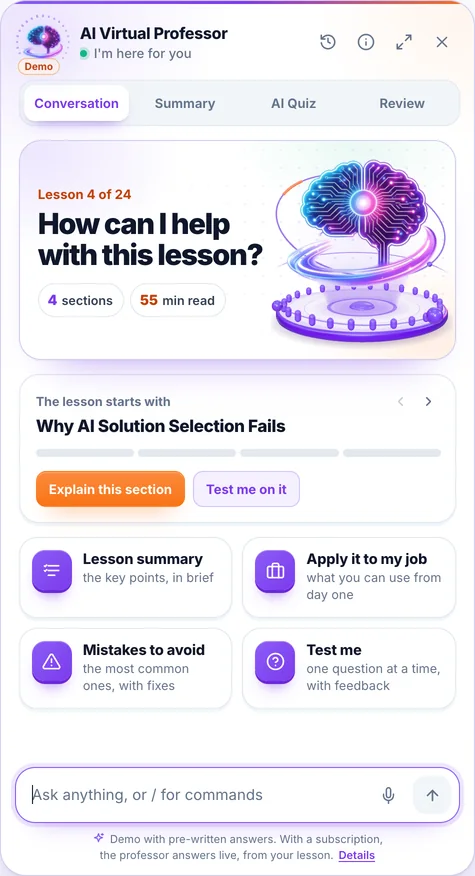
AI virtual professor Exclusive to Cursuri AI

A mentor who knows every lesson in detail and guides you personally.

Included in your subscription

Everything you get with a single subscription

Full access to the entire platform, with no hidden limits or extra costs.

20 premium courses Practical content created by specialists, constantly updated with the latest in AI
24/7 AI virtual professor A personal mentor built into every lesson — ask any question and get an instant answer
555 hands-on lessons Short, structured lessons with practical exercises you can apply at work right away
Smart AI quizzes Automatically generated questions, tailored to your weak spots, with detailed feedback
Save and organize Bookmarks, personal notes and a spaced-repetition system for maximum retention
Progress and analytics Streaks, weekly goals and personalized insights into your growth

Start learning AI today

Pick the right plan and get instant access to premium courses, an AI virtual professor, smart quizzes and hands-on exercises.

No long-term commitment Cancel anytime, no penalties Instant access after payment
This is a preview with sample data. Activate your subscription to save your conversations with the AI Professor.

AI Conversations

The complete history of your dialogues with the AI Virtual Professor

4 Conversations
36 Messages
2 Courses
AI Fundamentals 2 conversations
You

Can you explain how an artificial neuron works?...

AI Professor
AI Professor

An artificial neuron simulates how a biological neuron works: 1. Inputs — it receives multiple numeric values 2. Weights — each input has a weight that determ...

You

What is the ReLU activation function?...

AI Professor
AI Professor

ReLU (Rectified Linear Unit) is the most popular activation function: - Formula: f(x) = max(0, x) - If the input is positive → it passes through unchanged - If the input is negative → it turns it into ...

Prompt Engineering Masterclass 2 conversations
This is sample data Activate a subscription to save and export your real conversations with the AI Professor.
See plans
This is a preview with sample data. Activate a subscription to see your real scores.

Scores

Your performance across 5 assessed courses

79% Overall average
Very good
5
Courses assessed
4 / 5
Passed (≥70%)
22
Quizzes completed
168 / 220
Total points
Score distribution
4 courses ≥70% 1 course 40-69%
Best result Prompt Engineering Masterclass — 92%

Performance by course

92
Prompt Engineering Masterclass Passed
46 / 50 points 5 quizzes 92%
85
Introduction to AI Engineering Passed
34 / 40 points 4 quizzes 85%
76
AI for Digital Marketing Passed
38 / 50 points 5 quizzes 76%
71
RAG — Retrieval Augmented Generation Passed
21 / 30 points 3 quizzes 71%
58
AI Agents & Automation Not passed
29 / 50 points 5 quizzes 58%
This is sample data Activate a subscription to see your real quiz scores.
See plans
Structured learning paths

From zero to expert,
step by step

Career paths and specializations with a clear structure, from fundamentals to advanced level. Each course prepares you for the next — no guessing what to learn next, the platform guides you.

20 Premium courses
555 Hands-on lessons
24/7 AI Professor

How a learning path works

Four simple steps from your first lesson to expert level

01

Choose the right path

Two complete career paths plus focused specializations — for engineers, managers, marketers, or professionals in specialized fields.

02

Complete the stages in order

Each path is divided into clear stages. Each course prepares you for the next — no skipped steps, no lost context.

03

The AI Professor guides you

Ask anything in every lesson. You get explanations, practical examples, and personalized quizzes.

04

Track your progress

Progress per stage and per path, quiz scores, and automatic recommendations for your next step.

AI Virtual Professor Exclusive

Built into every lesson of every path

Throughout your entire path, you have access to an AI professor that knows the content of every lesson. Ask anything — you get detailed explanations, industry examples, and quizzes adapted to your level.

AI chat included in your subscription Answers tailored to the lesson you're studying
Automatic summaries Key points intelligently extracted
Personalized quizzes Unique questions, calibrated to you

Start your first learning path today

Choose the right plan and get instant access to the AI Professor, smart quizzes, and all premium courses.

Instant access Cancel anytime AI Professor included
Individual courses

Choose the courses you're interested in

Subscribe to each course individually. €49 + VAT / month per course, cancel anytime.

IT PRO Expert Popular

Cursor as a Pro: AI-Native IDE, Composer and Multi-Agent 2026 (Enterprise Edition)

Cursor 3 Pro: from Composer to Background Agents and Enterprise — April 2026

30 lessons ~25h
BUSINESS Beginner

Microsoft 365 Copilot for Office Work: Role-Based Productivity

Turn Word, Excel, Outlook, Teams and PowerPoint into AI assistants — real productivity for your role, not generic tricks.

32 lessons ~24h
BUSINESS Intermediate Popular

SEO and AEO/GEO in the AI Era: Optimizing for Google, AI Overviews and Generative Engines

Modern SEO plus end-to-end AEO/GEO: how to appear in Google and AI Overviews and get cited by ChatGPT, Perplexity, Gemini

30 lessons ~26h
BUSINESS Intermediate

Manager in the AI Era: Leading Your Team Through the AI Transformation

Lead your team through the AI transformation with proven frameworks: ADKAR, Kotter and the psychology of adoption

30 lessons ~24h
BUSINESS Intermediate Popular

AI Image Generation: The Complete Guide from Prompt to Publishing

Premium course: visual prompt engineering, AI platforms, production at scale, legal, ROI and hands-on tutorials — updated for 2026

26 lessons ~27h
BUSINESS Beginner

No-Code Data Analysis with AI: ChatGPT, Excel and SQL for Non-Programmers

Analyze data with conversational AI, no code: ChatGPT, Excel and SQL for non-programmers, with verification and GDPR.

27 lessons ~24h
BUSINESS Intermediate Popular

AI for Entrepreneurs and Startups: The Complete Guide

Premium course: idea validation, no-code MVP, go-to-market, finance, scaling and the startup ecosystem with AI — updated for 2026

30 lessons ~28h
BUSINESS Intermediate Popular

AI for Sales and CRM

The complete AI masterclass for sales and intelligent CRM — updated for 2026

28 lessons ~25h
BUSINESS Intermediate Popular

AI for Content Creation and Copywriting

Premium course: copywriting, editorial strategy, social media, video, audio, brand voice, SEO, KPIs and scaling with AI — updated for 2025-2026

29 lessons ~29h
BUSINESS Beginner Popular

AI for Digital Marketing

The complete AI masterclass for digital marketers — updated for 2026

31 lessons ~27h
IT PRO Advanced Popular

Context Engineering and Memory for AI Agents: Beyond Prompting

Engineer AI agents' context and memory for reliability at scale: context anatomy, memory types, retrieval, compaction, cost.

25 lessons ~24h
BUSINESS Intermediate Popular

AI for Business Leaders

The complete AI masterclass for leaders and management — updated for 2026

24 lessons ~22h
IT PRO Advanced Popular

Claude Code Mastery: Agentic Coding from the Terminal (multi-file, git, CI, MCP)

Terminal-first agentic coding with Claude Code: multi-file, git, headless, subagents, hooks, CI/CD, MCP, security and routing across the 2026 Anthropic lineup (including Claude Fable 5).

28 lessons ~25h
IT PRO Beginner

Vibe Coding: From Prompt to Application with Lovable, v0, Bolt and Replit Agent

Build full-stack applications from prompts and ship them safely, legally and responsibly — without writing code.

22 lessons ~24h
IT PRO Advanced Popular

MCP (Model Context Protocol) — Building Servers and Integrations (Enterprise Edition)

The complete MCP guide: from architecture to production servers — Python, TypeScript, security, deployment

22 lessons ~25h
IT PRO Advanced Popular

AI Agents: Architecting and Automating Autonomous Systems

The complete AI Agents and Automation masterclass for engineers — updated for 2026

30 lessons ~26h
IT PRO Advanced Popular

Advanced LLM Integration in Production Applications

The complete masterclass on LLM integration in production — updated for 2026

24 lessons ~26h
IT PRO Advanced Popular

RAG: Retrieval-Augmented Generation in Practice

The complete RAG masterclass for AI Engineers — updated for 2026

27 lessons ~24h
IT PRO Intermediate Popular

The Complete Prompt Engineering Masterclass

Advanced prompting techniques for professionals — updated for 2026

32 lessons ~27h
IT PRO Beginner Popular

Introduction to AI Engineering

The complete AI Engineering masterclass for developers — updated for 2026

28 lessons ~25h
This is a preview with sample data. Activate a subscription to save your lessons and notes.

Saved & Notes

Your saved lessons and personal notes, organized by course.

5 saved lessons 3 notes
Prompt Engineering Masterclass 3
Chain-of-Thought Prompting — The Complete Guide Mar 18
Few-Shot vs Zero-Shot — When to Use Each Mar 16
Advanced System Prompts for GPT-5.5 and Claude Mar 14
AI for Digital Marketing 2
Generating Ad Copy with AI — Meta & Google Ads Mar 12
Automating Campaigns with AI Agents Mar 10
This is sample data Activate a subscription to save your own lessons and personal notes.
View plans
This is a preview with sample data. Activate a subscription to generate personalized review flashcards.

Review

Key concepts from your lessons, generated by the AI Virtual Professor

3 Lessons
10 Cards
2 Courses
AI Fundamentals 7 cards
Prompt Engineering Masterclass 3 cards
This is sample data Activate a subscription to generate personalized review flashcards for every lesson.
View plans
This is a preview with demo data. Activate a subscription to see your real statistics.

Learning Insights

Your learning statistics

15h 30m total time 7 achievements
12/7 Lessons 175/180 Minutes 14/21 Streak
12
Lessons completed
175
Minutes invested
59%
5
Quizzes taken
14
Day streak

Personal records

21 days Longest streak
175m Most active week
45 days Total active days
22m/day Daily average
This is demo data Activate a subscription to see your real statistics and achievements.
See plans

Saved articles

The blog articles you saved for later, all in one place.

0 saved articles

No saved articles yet

When you read an article on the blog, hit the “Save” button to find it again quickly right here.

My account

Welcome

The premium AI education platform. Manage your account, subscription and progress.

Demo data. Activate a subscription to see your real progress.

Your progress

See courses
3
Courses in progress
5
Courses completed
47
Lessons completed
14
Day streak

You don't have an active subscription.

Choose a plan
Premium feature

Available with an account

This section becomes active once you create an account.

See available plans
20 premium courses 555 hands-on lessons 24/7 AI Professor Secure payments with Stripe Cancel anytime
Full lesson, free Module 1 · Lesson 1

Cursor 3 in April 2026: The AI-Native IDE Paradigm and the Agent Revolution

From the course Cursor as a Pro: AI-Native IDE, Composer and Multi-Agent 2026 (Enterprise Edition)

55 min read Expert Quiz included + 29 lessons with a subscription
Tip: select any passage in the lesson and hit “Ask the AI Professor” — that's exactly how it works inside the platform.

Built-in AI Professor Exclusive

Ask anything about the lesson and get an instant answer. The AI Professor knows the course content and helps you learn more effectively.

Select a passage in the lesson → it explains it on the spot Interactive chat — answers any question Automatic summaries with key points Personalized AI-generated quizzes

Most developers think an AI-powered IDE means an editor that autocompletes their lines of code better. On April 2, 2026, the Cursor team released version 3 and demolished exactly that assumption: a complete rebuild of the interface and architecture that does not add AI on top of an editor, but rebuilds the editor around AI. It is not an incremental upgrade, nor a feature bolted onto an existing foundation — it is a ground-up reimagining of what an IDE means in the era of generative artificial intelligence, the shift from "IDE with an AI plugin" to "AI-native IDE". For the professional developer, the question is no longer whether you adopt the change, but how fast you do it without compromising code quality.

From Traditional IDE to AI-Native IDE: A Paradigm Shift

To understand the magnitude of the change Cursor 3 brings, we first need to look at the evolution of development environments. For decades, IDEs evolved incrementally: from simple text editors, to editors with syntax highlighting, then to integrated environments with autocompletion, debugging, and refactoring. Each step added features on top of a fundamentally unchanged paradigm — the developer writes code, line by line, file by file.

The arrival of GitHub Copilot in 2021 introduced the concept of an "AI assistant" inside the IDE. But the model stayed the same: the developer writes code, and the AI suggests completions. It is like having a colleague who reads over your shoulder and finishes your sentences. Useful, but not transformative.

VS Code with AI extensions, JetBrains with AI Assistant, Neovim with plugins — they all follow the same pattern: a traditional IDE with a layer of AI glued on top. The underlying architecture remains centered on files, on manual editing, on granular control over every line of code.

Cursor 3 abandons this approach entirely. Instead of adding AI on top of a code editor, Cursor 3 builds the code editor around AI. The primary interface is no longer the text editor — it is the Agents Window, a dedicated window for orchestrating AI agents that work in parallel on different aspects of your project.

The difference is fundamental and worth underlining: in a traditional IDE with AI, you write code and the AI helps you. In Cursor 3, you describe what you want to happen and orchestrate the agents that implement it. Your role transforms from code writer into architect and orchestrator.

Agents Window: The Primary Interface of Cursor 3

The Agents Window is the heart of Cursor 3. Where previous versions gave you a side chat panel to converse with the AI, you now have a full interface dedicated to managing multiple simultaneous workstreams.

The Concept of an Agent in Cursor 3

An agent in Cursor 3 is not a simple chatbot that answers questions about code. It is an autonomous entity that can:

  • Navigate the project structure and understand the context
  • Read files, documentation, configuration
  • Write code across multiple files simultaneously
  • Execute commands in the terminal (compilation, tests, linting)
  • Analyze the results and iterate until it reaches a correct solution
  • Create Git branches, commits, and pull requests

Each agent operates in its own context, with its own conversation memory and access to the tools it needs. You can have one agent working on implementing a new feature, another refactoring an existing module, and a third writing tests — all simultaneously, without interfering with each other.

Agent Tabs: Multiple Views

Agent Tabs let you view several agent conversations at once. You can arrange the tabs:

  • Side-by-side — two or more conversations next to each other, ideal for comparing different approaches
  • Grid layout — a matrix of conversations, useful when you orchestrate 4-6 agents on independent tasks
  • Stacked — overlapping tabs with quick switching, for when you work sequentially but want fast access to all contexts

This capability eliminates one of the biggest frustrations of working with AI in earlier IDEs: losing context. When you had a single chat panel, you had to choose between continuing an existing conversation (and polluting its context) or starting a new one (and losing the history). With Agent Tabs, each task has its own dedicated space.

Types of Agents in Cursor 3

Cursor 3 introduces a clear taxonomy of the available agents:

Local agents — run on your machine, with direct access to the file system, the local terminal, and all installed tooling. They are fast, have no network latency, and can access local resources (databases, development servers, configuration files with credentials).

Agents on Git worktrees — run on isolated branches of your repository. The /worktree command automatically creates a separate Git worktree, letting the agent make changes without affecting your current branch. This is a critical innovation: the agent can experiment freely, and you decide what gets integrated.

Cloud agents — run in remote environments provided by Cursor. They are useful for tasks that require significant computational resources or to avoid tying up your local machine.

Background Agents — initially introduced in May 2025 and refined in Cursor 3 (April 2026), these clone the repository into the cloud, work autonomously, and deliver a Pull Request. You can run up to 8 Background Agents in parallel. They are ideal for well-defined tasks that do not require constant supervision.

"IDE with an AI Plugin" versus "AI-Native IDE": A Comparative Analysis

To crystallize the difference, let us examine the same scenarios in both paradigms:

Scenario 1: Adding a New Feature

IDE with an AI plugin (VS Code + Copilot):

  1. You open the relevant file
  2. You start writing the code
  3. Copilot suggests completions that you accept or reject
  4. You manually navigate between the files that need changes
  5. You manually run the tests
  6. You manually fix the errors
  7. You commit manually

AI-native IDE (Cursor 3):

  1. You describe the desired feature in Composer (Cmd+I)
  2. You activate Agent Mode (Cmd+.)
  3. The agent analyzes the project structure and identifies the relevant files
  4. The agent generates changes across all required files simultaneously
  5. The agent runs the tests and iterates if anything fails
  6. You review the complete diff and accept/reject
  7. The agent can create the commit with a descriptive message

Scenario 2: Debugging a Complex Bug

IDE with an AI plugin:

  1. You manually identify the symptom
  2. You copy the stack trace into the AI chat
  3. The AI suggests possible causes
  4. You manually navigate through the code to verify
  5. You manually apply the suggested fix
  6. You test manually

AI-native IDE (Cursor 3):

  1. You describe the symptom and provide the context (logs, stack trace)
  2. The agent autonomously navigates the source code
  3. The agent identifies the root cause by analyzing the execution flow
  4. The agent proposes a minimal patch
  5. The agent runs the tests to verify the fix
  6. The agent checks that no regressions were introduced
  7. You review and approve

The productivity difference is significant: not only do you save time, you also eliminate a whole class of cognitive errors caused by constant context switching between editing, navigation, terminal, and chat.

From Code Writer to Agent Orchestrator

This transformation of the developer's role is the most profound implication of Cursor 3. Let us look at what it means concretely.

The Orchestrator's Skill Set

A developer who uses Cursor 3 effectively must excel at:

Problem decomposition — The ability to break a complex requirement into atomic, well-defined tasks that agents can execute independently. This is a software architecture skill, not a programming skill.

Writing specifications — The ability to describe precisely what needs to be implemented, including edge cases, performance constraints, and compatibility requirements. The clearer the specification, the better the agent's output.

Critical review — The ability to quickly evaluate AI-generated code, spotting subtle problems: race conditions, memory leaks, security vulnerabilities, violations of SOLID principles. AI-generated code should be treated like a draft from a junior colleague — potentially correct, but requiring careful review.

Parallel orchestration — The skill of managing multiple workstreams simultaneously, assigning tasks to agents, monitoring progress, and integrating the results.

The Cursor 3 Philosophy: Speed without Regressions

The Cursor team has clearly articulated the philosophy behind version 3: the developer must be able to work at maximum speed without introducing regressions. This translates into a few practical principles:

AI code is a draft, not a finished product. No matter how impressive an agent's output looks, it must be treated with the same rigor as any pull request from a colleague. Automated tests, linting, review — all remain mandatory.

Testable specifications prevent ambiguity. Before asking an agent to implement something, define the success criteria as tests. The agent can then iterate automatically until all tests pass.

Incremental patches reduce risk. Instead of asking the agent to rewrite an entire module, ask it to make incremental changes, each independently verifiable. This dramatically reduces the risk of regressions.

Rigorous review is non-negotiable. Cursor 3 provides excellent review tools: colored diffs, inline comments, per-chunk revert. Use them. Every AI-generated line must be understood by the developer.

The Working Methodology in Cursor 3

Based on the principles above, we can define a structured methodology for working effectively with Cursor 3:

Step 1: Specification and Planning

Before opening Cursor, clearly define:

  • What needs to be implemented (the functional requirement)
  • Why (the business context)
  • The constraints (performance, security, compatibility)
  • The acceptance criteria (concrete tests)

Step 2: Decomposition into Tasks

Break the requirement into atomic tasks. Each task must be:

  • Independent — it can be implemented without depending on other in-progress tasks
  • Verifiable — it has clear success criteria
  • Atomic — small enough to be reviewed easily

Step 3: Assignment and Execution

Assign tasks to agents. Use:

  • A local agent for quick tasks that need access to local resources
  • A Git worktree for experimental or risky tasks
  • A Background Agent for well-defined tasks that do not require interaction

Step 4: Monitoring and Iteration

Monitor the agents' progress through Agent Tabs. Step in when:

  • An agent gets stuck or heads in the wrong direction
  • Conflicts appear between changes made by different agents
  • An architectural decision is needed

Step 5: Review and Integration

Review each set of changes. Check:

  • Logical correctness
  • Adherence to project conventions
  • Absence of regressions (automated tests)
  • Code quality (linting, static analysis)

Step 6: Consolidation

Integrate the approved changes, resolve any conflicts, and run the full test suite.

The Cursor 3 Ecosystem: Over 35 AI Models

Cursor 3 also differentiates itself through access to a vast ecosystem of AI models. As of mid-2026, the platform offers access to more than 35 models (the model list is continuously updated as providers release new versions), including:

The Claude family (Anthropic): Claude Fable 5 (GA June 9, 2026, the most capable Anthropic model as of this update — July 2026, $10/$50 per MTok, 1M context) for cases where maximum quality justifies the premium price; Claude Opus 4.8 (released May 28, 2026, the top of the Opus family — very strong at reasoning and agentic coding, 1M context, 128K output, stable tool use across dozens of consecutive turns — directly relevant for Cursor Agent Mode) for complex reasoning and architectural analysis; Claude Sonnet 5 (released June 30, 2026, "the most agentic Sonnet", 1M context, introductory pricing $2/$10 until August 31, 2026, then $3/$15) as the new balanced tier; Claude Sonnet 4.6 (the previous Sonnet generation) for pipelines that are already calibrated; Claude Haiku 4.5 for fast tasks and completions (optimal latency for Tab Completion). The previous Opus generation (4.7, released in April 2026) remains available as a legacy alternative.

The GPT family (OpenAI): GPT-5.5 (released in April 2026, omnimodal, ~1M context) for high-quality code generation, plus the Mini and Nano variants for fast operations with low token consumption. GPT-5.5 is OpenAI's current flagship model.

Other models: Gemini 3.1 Pro and Gemini 3.5 Flash (Google), Grok (xAI), Mistral Large 3 (Mistral AI), DeepSeek models, plus Cursor's proprietary models — Composer 1, 1.5, and 2.

Auto Mode — one of the most elegant features of Cursor 3 — automatically selects the optimal model based on the complexity of the request. A simple code completion can use a fast, cheap model, while a complex architectural analysis is automatically routed to a frontier model.

This flexibility means the developer does not need to be an expert in each model's capabilities. Cursor 3 automatically optimizes the quality/cost/speed trade-off.

Pricing Plans and Enterprise Positioning

Cursor 3 offers a range of plans covering everyone from hobbyists to enterprise teams:

  • Hobby ($0/month) — limited access, ideal for evaluation
  • Pro ($20/month) — for individual developers, access to all models
  • Pro+ ($60/month) — extended usage, Background Agents
  • Ultra ($200/month) — very generous usage, maximum priority
  • Teams ($40/user/month) — centralized management, security policies
  • Enterprise (custom pricing) — SSO, audit logs, compliance, dedicated support

Note for buyers: the prices above are shown excluding VAT; the VAT rate applicable in your country will be added at billing where required.

For enterprise teams, the Teams and Enterprise plans provide critical capabilities: control over which models are accessible, data retention policies, integration with identity management systems, and a full audit trail.

Integration with the Development Ecosystem

Cursor 3 does not operate in isolation. It integrates deeply with the tools teams already use:

Git — native support for branching, merging, and code review. Background Agents can create Pull Requests directly.

JetBrains — starting in March 2026, Cursor supports IntelliJ, PyCharm, and WebStorm through the Agent Client Protocol. Developers who prefer the JetBrains ecosystem can benefit from Cursor's agents without giving up their familiar IDE.

Slack — Background Agents can be triggered directly from Slack via @Cursor. This integration lets teams assign AI tasks straight from their communication flow.

MCP (Model Context Protocol) — support for the current specification (date-versioned, e.g. 2025-11-25) and for thousands of community servers that extend agents' capabilities with access to databases, APIs, documentation, and other external resources. Supported transports: stdio, SSE, and Streamable HTTP.

Implications for the Developer's Career

Cursor 3 and the AI-native IDE paradigm have profound implications for the software development profession:

Skills that grow in value: software architecture, system design, code review, writing specifications, business domain understanding, security, performance.

Skills that are transforming: writing boilerplate code (automated), manually navigating large codebases (AI-assisted), debugging via print statements (replaced by AI analysis).

New skills required: prompt engineering for developers, orchestrating AI agents, critically evaluating generated code, managing AI context.

The developer who masters Cursor 3 is not replaced by AI — they are amplified by AI. Productivity can increase 3-5x for repetitive tasks and 1.5-2x for creative tasks, but only if the developer understands both the limitations and the capabilities of the tool.

Conclusion: The Beginning of a New Era

Cursor 3 marks an inflection point in the evolution of software development tools. This is not just about a better editor or a more capable AI — it is about a fundamental reimagining of how software is created.

But understanding why Cursor 3 changes the rules of the game is not the same as mastering it. The 3-5x gain does not come to whoever opens the Agents Window and hopes — it comes to whoever knows how to configure the working environment optimally, write Cursor Rules in the .mdc format, and orchestrate multiple agents in parallel without losing control of quality. These are exactly the pieces we will assemble, one by one, in the lessons ahead — until it is no longer you keeping up with the tool, but the tool keeping up with you.

Welcome to the era of the AI-native IDE. Welcome to Cursor 3.

Real quiz · from Lesson 1

[Easy] When was Cursor 3 released?

First lesson — read in full, for free

Enjoyed it? All 30 lessons look like this.

You just read a complete lesson, exactly as it appears in the platform. Create your account in under a minute and pick the option that fits you best:

Just this course €49+ VAT / month All 30 lessons + AI Professor (fair-use limit)
Recommended IT Pro bundle €399+ VAT / month Every IT Pro course + smart quizzes + full AI Professor
Instant access to Lesson 2 All 30 lessons in the course Interactive quizzes with feedback AI Professor built into every lesson Notes & progress saved automatically Access from any device
Instant access Cancel anytime Secure payment via Stripe

Up next in the course

  • 2 Professional Cursor 3 Setup: Configuration, Profiles, and Context Architecture 50 min
  • 3 Cursor Rules with .mdc: Standardizing AI Behavior at the Project Level 55 min
  • 4 Composer 2: Multi-File Editing, Agent Mode, and Cursor's Frontier Model 55 min
Unlock all 30 lessons
Course curriculum

Everything you'll learn in this course

11 modules
30 lessons
~26h of content
Expert level
1 Cursor 3 Fundamentals 3 lessons
  • Cursor 3 in April 2026: The AI-Native IDE Paradigm and the Agent Revolution Reading now 55 min
  • Professional Cursor 3 Setup: Configuration, Profiles, and Context Architecture 50 min
  • Cursor Rules with .mdc: Standardizing AI Behavior at the Project Level 55 min
2 Composer Mastery 3 lessons
  • Composer 2: Multi-File Editing, Agent Mode, and Cursor's Frontier Model 55 min
  • Large-Scale Refactoring with Composer: Strategies for Zero Regressions 55 min
  • Expert Bug Fixing with Composer: Root Cause Analysis and Verification Loops 50 min
3 Model Selection and Intelligent Routing 3 lessons
  • The 35+ Models in Cursor: The Complete Guide to Selection and Capabilities 55 min
  • Auto Mode vs Manual: Model Routing Strategies for Maximum Productivity 50 min
  • Composer 1, 1.5, and 2: Cursor's Proprietary Models — Advantages and Limitations 50 min
4 Background Agents and Cloud 3 lessons
  • Background Agents: Autonomous Development in the Cloud with PR Delivery 55 min
  • Cloud Agents and Automations: Triggers, Scheduled Execution, and Computer Use 55 min
  • Git Worktrees and /best-of-n: Agent Isolation and Multi-Model Comparison 55 min
5 Design Mode and Terminal-Driven Development 3 lessons
  • Design Mode (Cmd+Shift+D): AI-Directed Visual Editing 50 min
  • Terminal-Driven Development: The Agent's Autonomous Feedback Loop 55 min
  • Keyboard Shortcuts and Maximum Productivity: Cursor 3 Masterclass 50 min
6 MCP and the Cursor Ecosystem 3 lessons
  • MCP in Cursor: Model Context Protocol — Setup, Configuration, and Servers 55 min
  • MCP Apps, Team Marketplace, and the Ecosystem of Thousands of Servers 55 min
  • Integrations and Extensions: JetBrains, Slack, Web App, and CLI 50 min
7 Code Quality and Security 3 lessons
  • Validation Stack: Lint, Tests, Static Analysis and Runtime Checks 55 min
  • Prompt Patterns for Enterprise Code: Architectures That Guide the AI 55 min
  • Sandbox Security: Permissions, Network, and Agent Protection 55 min
8 Team Productivity and Enterprise 3 lessons
  • Team Standardization: Shared Rules, Prompts, and Playbooks 55 min
  • Teams and Enterprise: Admin, SSO, Analytics and Compliance 55 min
  • Impact Metrics: How to Really Measure AI Efficiency in Your Team 55 min
9 Cursor vs the Competition 3 lessons
  • Cursor vs GitHub Copilot vs Windsurf: AI IDEs Compared in Detail 55 min
  • Cursor vs Claude Code vs OpenAI Codex: IDE vs Terminal Agent 55 min
  • Adoption Strategies: How to Choose and Combine AI Tools for Your Team 50 min
10 Advanced Workflows and the Future 2 lessons
  • Power User Workflows: Advanced Patterns for 10x Productivity 55 min
  • Roadmap 2026-2027: From IDE to AI Development Platform 55 min
11 Appendix: Resources, 2026 Updates and Learning Paths 1 lessons
  • Official Resources, 2026 Updates, and Learning Paths 32 min
What you get on the platform

Everything you need to learn effectively

Interactive quizzes

Check your knowledge at the end of every lesson with scored quizzes and feedback.

Personal notes

Save notes on every lesson, accessible anytime from your dashboard.

Scheduled reviews

Revisit lessons exactly when it matters, at the right intervals — so you remember for the long term.

Progress & Achievements

Track your progress, unlock achievements, and visualize what you've learned.

Bookmarks

Save the lessons that matter and find them instantly when you need them.

Questions & Answers

Ask questions right on the lesson and get answers from our team.

Frequently asked questions

Good to know before you start

How do I get access to the course?

You can read the first lesson in full for free, right on this page — no account needed. For the rest of the course you create an account, pick the subscription that fits — a single course or a bundle — and get access immediately after your payment is confirmed. Everything happens 100% online.

Can I cancel my subscription anytime?

Yes. Cancel anytime, straight from your account, in just a few clicks. Your access stays active until the end of the period you have already paid for.

What does the subscription for this course include?

All 30 lessons in the course, interactive quizzes, the AI professor built into every lesson (select any passage and it explains it on the spot), personal notes, automatically saved progress, and content updates included.

Is there a fixed learning schedule?

No. You learn at your own pace, on any device. Lessons are structured step by step, and the platform saves your progress automatically, so you can pick up right where you left off — anytime.

Ready to unlock all the content?

Just this course — €49 + VAT / month — or every IT Pro course, with smart quizzes and the full AI Professor, in the bundle at €399 + VAT / month.

Instant access Cancel anytime Secure payment via Stripe
From €49 + VAT / month · Cancel anytime
Read the free lesson