Cursuri AI.ro International — AI e-learning for professionals

Try the platform before you pay

Explore the interactive account demo and read the first lesson of Introduction to AI Engineering for free, in full — no account, no card.

AI Professor in every lesson Quizzes with feedback Cancel anytime
cursuri-ai.ro/app/courses/introduction-to-ai-engineering Interactive demo · sample account
Cursuri AI.ro International — AI e-learning for professionals

Welcome! 👋

Welcome to Cursuri AI International — AI e-learning for professionals, now in English. Activate your subscription and start learning.

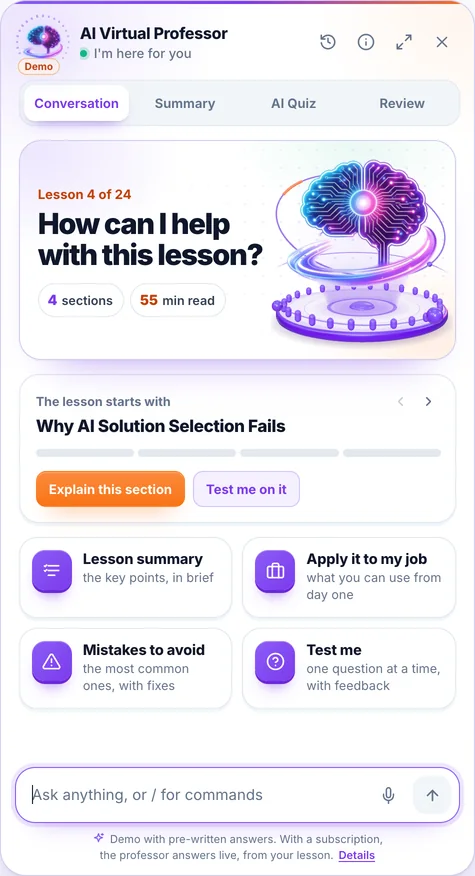
AI virtual professor Exclusive to Cursuri AI

A mentor who knows every lesson in detail and guides you personally.

Included in your subscription

Everything you get with a single subscription

Full access to the entire platform, with no hidden limits or extra costs.

20 premium courses Practical content created by specialists, constantly updated with the latest in AI
24/7 AI virtual professor A personal mentor built into every lesson — ask any question and get an instant answer
555 hands-on lessons Short, structured lessons with practical exercises you can apply at work right away
Smart AI quizzes Automatically generated questions, tailored to your weak spots, with detailed feedback
Save and organize Bookmarks, personal notes and a spaced-repetition system for maximum retention
Progress and analytics Streaks, weekly goals and personalized insights into your growth

Start learning AI today

Pick the right plan and get instant access to premium courses, an AI virtual professor, smart quizzes and hands-on exercises.

No long-term commitment Cancel anytime, no penalties Instant access after payment
This is a preview with sample data. Activate your subscription to save your conversations with the AI Professor.

AI Conversations

The complete history of your dialogues with the AI Virtual Professor

4 Conversations
36 Messages
2 Courses
AI Fundamentals 2 conversations
You

Can you explain how an artificial neuron works?...

AI Professor
AI Professor

An artificial neuron simulates how a biological neuron works: 1. Inputs — it receives multiple numeric values 2. Weights — each input has a weight that determ...

You

What is the ReLU activation function?...

AI Professor
AI Professor

ReLU (Rectified Linear Unit) is the most popular activation function: - Formula: f(x) = max(0, x) - If the input is positive → it passes through unchanged - If the input is negative → it turns it into ...

Prompt Engineering Masterclass 2 conversations
This is sample data Activate a subscription to save and export your real conversations with the AI Professor.
See plans
This is a preview with sample data. Activate a subscription to see your real scores.

Scores

Your performance across 5 assessed courses

79% Overall average
Very good
5
Courses assessed
4 / 5
Passed (≥70%)
22
Quizzes completed
168 / 220
Total points
Score distribution
4 courses ≥70% 1 course 40-69%
Best result Prompt Engineering Masterclass — 92%

Performance by course

92
Prompt Engineering Masterclass Passed
46 / 50 points 5 quizzes 92%
85
Introduction to AI Engineering Passed
34 / 40 points 4 quizzes 85%
76
AI for Digital Marketing Passed
38 / 50 points 5 quizzes 76%
71
RAG — Retrieval Augmented Generation Passed
21 / 30 points 3 quizzes 71%
58
AI Agents & Automation Not passed
29 / 50 points 5 quizzes 58%
This is sample data Activate a subscription to see your real quiz scores.
See plans
Structured learning paths

From zero to expert,
step by step

Career paths and specializations with a clear structure, from fundamentals to advanced level. Each course prepares you for the next — no guessing what to learn next, the platform guides you.

20 Premium courses
555 Hands-on lessons
24/7 AI Professor

How a learning path works

Four simple steps from your first lesson to expert level

01

Choose the right path

Two complete career paths plus focused specializations — for engineers, managers, marketers, or professionals in specialized fields.

02

Complete the stages in order

Each path is divided into clear stages. Each course prepares you for the next — no skipped steps, no lost context.

03

The AI Professor guides you

Ask anything in every lesson. You get explanations, practical examples, and personalized quizzes.

04

Track your progress

Progress per stage and per path, quiz scores, and automatic recommendations for your next step.

AI Virtual Professor Exclusive

Built into every lesson of every path

Throughout your entire path, you have access to an AI professor that knows the content of every lesson. Ask anything — you get detailed explanations, industry examples, and quizzes adapted to your level.

AI chat included in your subscription Answers tailored to the lesson you're studying
Automatic summaries Key points intelligently extracted
Personalized quizzes Unique questions, calibrated to you

Start your first learning path today

Choose the right plan and get instant access to the AI Professor, smart quizzes, and all premium courses.

Instant access Cancel anytime AI Professor included
Individual courses

Choose the courses you're interested in

Subscribe to each course individually. €49 + VAT / month per course, cancel anytime.

IT PRO Beginner Popular

Introduction to AI Engineering

The complete AI Engineering masterclass for developers — updated for 2026

28 lessons ~25h
BUSINESS Beginner

Microsoft 365 Copilot for Office Work: Role-Based Productivity

Turn Word, Excel, Outlook, Teams and PowerPoint into AI assistants — real productivity for your role, not generic tricks.

32 lessons ~24h
BUSINESS Intermediate Popular

SEO and AEO/GEO in the AI Era: Optimizing for Google, AI Overviews and Generative Engines

Modern SEO plus end-to-end AEO/GEO: how to appear in Google and AI Overviews and get cited by ChatGPT, Perplexity, Gemini

30 lessons ~26h
BUSINESS Intermediate

Manager in the AI Era: Leading Your Team Through the AI Transformation

Lead your team through the AI transformation with proven frameworks: ADKAR, Kotter and the psychology of adoption

30 lessons ~24h
BUSINESS Intermediate Popular

AI Image Generation: The Complete Guide from Prompt to Publishing

Premium course: visual prompt engineering, AI platforms, production at scale, legal, ROI and hands-on tutorials — updated for 2026

26 lessons ~27h
BUSINESS Beginner

No-Code Data Analysis with AI: ChatGPT, Excel and SQL for Non-Programmers

Analyze data with conversational AI, no code: ChatGPT, Excel and SQL for non-programmers, with verification and GDPR.

27 lessons ~24h
BUSINESS Intermediate Popular

AI for Entrepreneurs and Startups: The Complete Guide

Premium course: idea validation, no-code MVP, go-to-market, finance, scaling and the startup ecosystem with AI — updated for 2026

30 lessons ~28h
BUSINESS Intermediate Popular

AI for Sales and CRM

The complete AI masterclass for sales and intelligent CRM — updated for 2026

28 lessons ~25h
BUSINESS Intermediate Popular

AI for Content Creation and Copywriting

Premium course: copywriting, editorial strategy, social media, video, audio, brand voice, SEO, KPIs and scaling with AI — updated for 2025-2026

29 lessons ~29h
BUSINESS Beginner Popular

AI for Digital Marketing

The complete AI masterclass for digital marketers — updated for 2026

31 lessons ~27h
IT PRO Advanced Popular

Context Engineering and Memory for AI Agents: Beyond Prompting

Engineer AI agents' context and memory for reliability at scale: context anatomy, memory types, retrieval, compaction, cost.

25 lessons ~24h
BUSINESS Intermediate Popular

AI for Business Leaders

The complete AI masterclass for leaders and management — updated for 2026

24 lessons ~22h
IT PRO Advanced Popular

Claude Code Mastery: Agentic Coding from the Terminal (multi-file, git, CI, MCP)

Terminal-first agentic coding with Claude Code: multi-file, git, headless, subagents, hooks, CI/CD, MCP, security and routing across the 2026 Anthropic lineup (including Claude Fable 5).

28 lessons ~25h
IT PRO Beginner

Vibe Coding: From Prompt to Application with Lovable, v0, Bolt and Replit Agent

Build full-stack applications from prompts and ship them safely, legally and responsibly — without writing code.

22 lessons ~24h
IT PRO Expert Popular

Cursor as a Pro: AI-Native IDE, Composer and Multi-Agent 2026 (Enterprise Edition)

Cursor 3 Pro: from Composer to Background Agents and Enterprise — April 2026

30 lessons ~25h
IT PRO Advanced Popular

MCP (Model Context Protocol) — Building Servers and Integrations (Enterprise Edition)

The complete MCP guide: from architecture to production servers — Python, TypeScript, security, deployment

22 lessons ~25h
IT PRO Advanced Popular

AI Agents: Architecting and Automating Autonomous Systems

The complete AI Agents and Automation masterclass for engineers — updated for 2026

30 lessons ~26h
IT PRO Advanced Popular

Advanced LLM Integration in Production Applications

The complete masterclass on LLM integration in production — updated for 2026

24 lessons ~26h
IT PRO Advanced Popular

RAG: Retrieval-Augmented Generation in Practice

The complete RAG masterclass for AI Engineers — updated for 2026

27 lessons ~24h
IT PRO Intermediate Popular

The Complete Prompt Engineering Masterclass

Advanced prompting techniques for professionals — updated for 2026

32 lessons ~27h
This is a preview with sample data. Activate a subscription to save your lessons and notes.

Saved & Notes

Your saved lessons and personal notes, organized by course.

5 saved lessons 3 notes
Prompt Engineering Masterclass 3
Chain-of-Thought Prompting — The Complete Guide Mar 18
Few-Shot vs Zero-Shot — When to Use Each Mar 16
Advanced System Prompts for GPT-5.5 and Claude Mar 14
AI for Digital Marketing 2
Generating Ad Copy with AI — Meta & Google Ads Mar 12
Automating Campaigns with AI Agents Mar 10
This is sample data Activate a subscription to save your own lessons and personal notes.
View plans
This is a preview with sample data. Activate a subscription to generate personalized review flashcards.

Review

Key concepts from your lessons, generated by the AI Virtual Professor

3 Lessons
10 Cards
2 Courses
AI Fundamentals 7 cards
Prompt Engineering Masterclass 3 cards
This is sample data Activate a subscription to generate personalized review flashcards for every lesson.
View plans
This is a preview with demo data. Activate a subscription to see your real statistics.

Learning Insights

Your learning statistics

15h 30m total time 7 achievements
12/7 Lessons 175/180 Minutes 14/21 Streak
12
Lessons completed
175
Minutes invested
59%
5
Quizzes taken
14
Day streak

Personal records

21 days Longest streak
175m Most active week
45 days Total active days
22m/day Daily average
This is demo data Activate a subscription to see your real statistics and achievements.
See plans

Saved articles

The blog articles you saved for later, all in one place.

0 saved articles

No saved articles yet

When you read an article on the blog, hit the “Save” button to find it again quickly right here.

My account

Welcome

The premium AI education platform. Manage your account, subscription and progress.

Demo data. Activate a subscription to see your real progress.

Your progress

See courses
3
Courses in progress
5
Courses completed
47
Lessons completed
14
Day streak

You don't have an active subscription.

Choose a plan
Premium feature

Available with an account

This section becomes active once you create an account.

See available plans
20 premium courses 555 hands-on lessons 24/7 AI Professor Secure payments with Stripe Cancel anytime
Full lesson, free Module 1 · Lesson 1

What Artificial Intelligence Is in the Real World

From the course Introduction to AI Engineering

55 min read Beginner Quiz included + 27 lessons with a subscription
Tip: select any passage in the lesson and hit “Ask the AI Professor” — that's exactly how it works inside the platform.

Built-in AI Professor Exclusive

Ask anything about the lesson and get an instant answer. The AI Professor knows the course content and helps you learn more effectively.

Select a passage in the lesson → it explains it on the spot Interactive chat — answers any question Automatic summaries with key points Personalized AI-generated quizzes

An AI demo that impresses in a Friday meeting and an AI system that survives months in production are two completely different things — and the distance between them separates the engineer who "plays with AI" from the one who builds with it. In 2026, AI is no longer a laboratory concept or a science fiction topic: it is infrastructure processing billions of requests daily — from coding assistants like Claude Code and GitHub Copilot, to medical diagnosis and Level 4 autonomous vehicles. The question is no longer whether you work with AI, but whether you know how to take it from "it works on my laptop" to a governed system with quality, cost, and risk under control. That transition is exactly where this begins — and where the entire course lives.

The Engineering Definition of Artificial Intelligence

In the classic academic context, AI is defined as the field of computer science that studies the creation of agents capable of perceiving their environment, reasoning, and acting to achieve goals. But for a software engineer in 2026, this definition is insufficient. A more useful operational definition is:

AI engineering = designing, building, and operating software systems that use statistical or neural models to make decisions or generate output under conditions of uncertainty, with measurable metrics for quality, cost, and risk.

The critical difference from traditional software is non-determinism. A classic REST endpoint, given the same input, will return the same output. An AI system can return different answers for the same input, depending on the sampling temperature, the state of the context, or the model version. This non-determinism is not a bug — it is a fundamental property you must manage explicitly:

# Traditional software: deterministic
def calculate_tax(amount: float, rate: float = 0.21) -> float:
    return round(amount * rate, 2)  # Same input → same output, always

# AI system: non-deterministic — requires statistical evaluation
def classify_intent(user_message: str, model: str = "gpt-5.5") -> dict:
    response = llm_client.chat(
        model=model,
        messages=[{"role": "user", "content": user_message}],
        temperature=0.3  # Even at low temperature, the output varies
    )
    return {
        "intent": response.choices[0].message.content,
        "confidence": response.choices[0].logprobs,  # Essential for downstream decisions
        "model_version": model,
        "timestamp": datetime.utcnow()
    }

This distinction has profound consequences: you cannot test an AI system with classic assertEqual-style unit tests. You need statistical evaluation, on representative datasets, with acceptance thresholds defined before launch.

Narrow AI vs. AGI: The Clarification That Matters for Engineers

All Artificial Intelligence in production in 2026 is Narrow AI (or Weak AI) — systems optimized for specific tasks or families of related tasks. A language model like GPT-5.5 or Claude Opus 4.8 may seem "general" because it tackles many types of linguistic tasks, but it remains narrow in the sense that it does not possess autonomous understanding, self-awareness, or the ability to set its own goals.

AGI (Artificial General Intelligence) — a system that would match or exceed human cognitive capabilities across any domain — remains a research goal. As an engineer, the distinction is pragmatic:

Criterion Narrow AI (2026) AGI (hypothetical)
Scope Defined tasks or families of tasks Any cognitive task
Training Specific data, explicit objective General autonomous learning
Evaluation Per-task metrics (F1, BLEU, latency) Impossible to define completely
Deployment Real production systems No implementations exist
Risks Hallucinations, bias, cost, drift Speculative, existential

Do not waste time on debates about "how close we are to AGI" when you are building a product. Focus on: what task I am solving, how I measure quality, and how I control cost.

The AI Taxonomy: Machine Learning, Deep Learning, Generative AI, Reinforcement Learning

Artificial Intelligence is an umbrella term. Under it, several subfields are organized, each with distinct paradigms, algorithms, and use cases:

┌─────────────────────────────────────────────┐
│           Artificial Intelligence            │
│  ┌───────────────────────────────────────┐   │
│  │         Machine Learning              │   │
│  │  ┌─────────────────────────────────┐  │   │
│  │  │       Deep Learning             │  │   │
│  │  │  ┌───────────────────────────┐  │  │   │
│  │  │  │  Generative AI (GenAI)   │  │  │   │
│  │  │  │  - LLMs (GPT-5.5, Opus 4.8)│  │  │ │
│  │  │  │  - Diffusion (images)    │  │  │   │
│  │  │  │  - Multimodal            │  │  │   │
│  │  │  └───────────────────────────┘  │  │   │
│  │  │  Reinforcement Learning         │  │   │
│  │  └─────────────────────────────────┘  │   │
│  │  Classic ML (Random Forest, SVM, XGB) │   │
│  └───────────────────────────────────────┘   │
│  Symbolic AI (Expert Systems, Logic)         │
└─────────────────────────────────────────────┘

Machine Learning (ML) — systems that learn from data without being explicitly programmed for every case. It includes classic algorithms (Random Forest, Gradient Boosting, SVM) and neural networks.

Deep Learning (DL) — a subset of ML that uses neural networks with many layers (deep neural networks). It shines on unstructured data: images, text, audio, video.

Generative AI (GenAI) — models that generate new content (text, code, images, audio). Based on Transformer architectures (LLMs) or diffusion (image models). This is the fastest-evolving area in 2024-2026.

Reinforcement Learning (RL) — the agent learns by interacting with its environment, receiving rewards or penalties. Used in robotics, games, portfolio optimization and — more relevant to us — in RLHF (Reinforcement Learning from Human Feedback), the technique through which language models are aligned with human preferences.

AI Systems in Production in 2026: Real Cases

AI is no longer an experiment. Here are real systems operating at scale:

Autonomous vehicles (Level 4): Operators such as Waymo run vehicles without a human driver in defined urban areas. The system combines visual perception (computer vision), sensor fusion (LiDAR + radar + cameras), route planning, and vehicle control — all with latencies under 100ms.

Medical imaging: FDA/CE-approved models detect tumors in mammograms and X-rays with sensitivity above 95%. They do not replace the physician — they work as a "second pair of eyes" in the diagnostic pipeline.

Coding assistants: Claude Code, GitHub Copilot, and Cursor are transforming software development. A controlled experiment (Peng et al., 2023, arXiv:2302.06590) showed that developers using GitHub Copilot completed a specific task 55.8% faster (implementing an HTTP server in JavaScript) — a result on a well-scoped task, not a universal promise of productivity. These systems are not simple autocompletion — they implement agents that understand the project context, execute commands, and iterate on feedback.

Recommendation systems: Netflix, Spotify, YouTube, TikTok — each uses ML/DL models for personalization. The architectures have evolved from simple collaborative filtering to hybrid systems with transformers and retrieval augmented generation.

AI agents for customer support: Klarna reported that their AI agent handles 2/3 of support conversations, with satisfaction equivalent to a human agent and a resolution time of 2 minutes vs. 11 minutes previously.

AI in Production vs. Research: Critical Differences

A research AI system and a production one differ fundamentally. Every engineer must understand this distinction:

# Research mindset
research_metrics = {
    "focus": "accuracy on a benchmark",
    "data": "clean, static dataset",
    "evaluation": "offline, on a test set",
    "cost": "irrelevant (research grant)",
    "latency": "irrelevant (batch processing)",
    "monitoring": "nonexistent",
    "rollback": "nonexistent"
}

# Production mindset
production_metrics = {
    "focus": "usefulness on real data + controlled cost",
    "data": "continuous stream, noisy, variable",
    "evaluation": "online + offline, continuous",
    "cost": "critical — budget per request, per month",
    "latency": "strict SLA (p50 < 500ms, p95 < 2s)",
    "monitoring": "alerting, dashboards, anomaly detection",
    "rollback": "mandatory — canary + feature flags"
}

Key Metrics for Production AI Systems

As an engineer, you must think in operational metrics, not just model metrics:

Category Metric Typical 2026 target
Quality Task success rate ≥ 85%
Quality Factual error rate ≤ 3%
Quality Hallucination rate ≤ 2%
Performance p50 latency < 500ms
Performance p95 latency < 2s
Performance Throughput > 100 req/s
Cost Cost per request < $0.05 (simple task)
Cost Monthly model spend Defined budget
Reliability Uptime 99.9%
Reliability Error rate (5xx) < 0.1%
Safety Policy violation rate < 0.5%

These metrics form the "execution contract" of an AI system. Without them, you do not have a product — you have a demo.

The European AI Ecosystem in 2026

Europe has a growing AI ecosystem, though still at a distance from the leading hubs in the United States and China:

Companies and startups: UiPath (RPA + AI, founded in Romania and listed on the NYSE), Mistral AI (foundation models, France), DeepL (machine translation, Germany), Synthesia (AI video, UK), and a wave of new startups focused on generative AI applied to specific industries: legal tech, fintech, and health tech.

Academia: Leading technical universities across Europe — from ETH Zurich and TU Munich to strong programs in Central and Eastern Europe — run research programs in ML/NLP. European teams contribute publications in NLP, computer vision, and reinforcement learning.

Industry adoption: Recent industry studies (e.g., McKinsey's annual State of AI surveys) indicate rapidly growing adoption of AI systems in large companies, including in Central and Eastern Europe. Adoption is concentrated in fintech, telecom, and e-commerce.

Job market: Demand for AI/ML engineer roles has grown strongly across European markets in recent years. Salaries for senior AI engineers in major tech hubs are among the most competitive in the local software industry, though they vary significantly by company and seniority.

When to Use AI and When Not To

This is perhaps the most important decision an engineer makes:

Use AI when:

  • Data is abundant and the problem is hard to define through explicit rules
  • Input variability is high (natural language, images, audio)
  • A "good enough" answer in 80-90% of cases delivers real value
  • The cost of an error is manageable (a human fallback is available)
  • The manual alternative is expensive or slow at scale

Do NOT use AI when:

  • The business rules are clear and deterministic (use code logic)
  • Error tolerance is zero (exact financial calculations, strict legal compliance)
  • The data is insufficient or unrepresentative
  • The cost of implementing AI exceeds the cost of the classic solution
  • You have no evaluation and monitoring infrastructure
def should_use_ai(problem: dict) -> str:
    if problem["rules_are_deterministic"] and problem["error_tolerance"] == 0:
        return "NO — use classic logic"
    if problem["data_volume"] < 100:
        return "PROBABLY NOT — insufficient data for ML"
    if problem["input_variability"] == "high" and problem["manual_cost_at_scale"] == "high":
        return "YES — a good candidate for AI"
    if not problem["has_evaluation_pipeline"]:
        return "NOT YET — build the evaluation first"
    return "EVALUATE — run a proof of concept with clear metrics"

Adoption Statistics and Trends in 2026

The industry's reference reports (the Stanford AI Index, McKinsey's State of AI surveys, Gartner analyses) converge on a few clear trends, even if the exact figures differ from one source to another:

  • Generative AI adoption in large companies has become widespread — most large organizations run at least one use case in production
  • Global AI investment has continued to grow strongly year over year, in both infrastructure and applications
  • The cost of inference has dropped dramatically compared to 2023, thanks to hardware and software optimizations — fundamentally changing the economics of many use cases
  • Open-weight models (Llama 4, Mistral Large 3, DeepSeek V4, Qwen3) have reached performance competitive with closed-source models on many benchmarks
  • Multimodality is the norm: GPT-5.5 (natively omnimodal end-to-end), Claude Opus 4.8, and Gemini 3.1 Pro natively process text, images, audio, and video
  • AI agents — systems that plan, execute actions, and iterate autonomously — are the hottest topic in the industry

Essential External References

Conclusion

Artificial Intelligence becomes valuable to a software engineer the moment it moves from "impressive demo" to a governed operational capability — a system that delivers repeatable usefulness, with clear quality metrics, controlled cost, explicitly owned risk, and a robust fallback mechanism. When you can explain that mechanism to a product manager, a compliance auditor, and a fellow engineer in the same sentence, you have moved from technical enthusiasm to professional maturity.

But knowing what a mature AI system means is not the same as knowing how to build one — and that is where everything is decided. From here on, the course descends into the mechanics: what a prompt that survives production looks like, how you measure the quality of a non-deterministic output, and how you keep cost and risk under control when the model changes underneath you. The next lesson starts exactly at the point where most engineers get stuck — and every lesson after it adds one more piece to the system that, by the end, you will be able to stand behind in front of anyone.

Real quiz · from Lesson 1

[Easy] Which of the following best describes AI engineering in production?

First lesson — read in full, for free

Enjoyed it? All 28 lessons look like this.

You just read a complete lesson, exactly as it appears in the platform. Create your account in under a minute and pick the option that fits you best:

Just this course €49+ VAT / month All 28 lessons + AI Professor (fair-use limit)
Recommended IT Pro bundle €399+ VAT / month Every IT Pro course + smart quizzes + full AI Professor
Instant access to Lesson 2 All 28 lessons in the course Interactive quizzes with feedback AI Professor built into every lesson Notes & progress saved automatically Access from any device
Instant access Cancel anytime Secure payment via Stripe

Up next in the course

  • 2 The History and Evolution of AI: From Turing to GPT-5.5 55 min
  • 3 Key AI Concepts for Software Engineers 55 min
  • 4 Supervised Learning: Classification and Regression 55 min
Unlock all 28 lessons
Course curriculum

Everything you'll learn in this course

11 modules
28 lessons
~25h of content
Beginner level
1 Fundamentals of Artificial Intelligence 3 lessons
  • What Artificial Intelligence Is in the Real World Reading now 55 min
  • The History and Evolution of AI: From Turing to GPT-5.5 55 min
  • Key AI Concepts for Software Engineers 55 min
2 Machine Learning Essentials 3 lessons
  • Supervised Learning: Classification and Regression 55 min
  • Unsupervised and Reward-Based Learning 55 min
  • Neural Networks and Deep Learning 55 min
3 Large Language Models and Modern Architectures 3 lessons
  • What Are Large Language Models 55 min
  • Tokenization and Text Processing 55 min
  • Transformer Architectures and State-of-the-Art Models in 2026 55 min
4 Working with LLM APIs and Integrations 3 lessons
  • Working with LLM APIs: OpenAI, Anthropic and Google 55 min
  • Prompt Engineering Fundamentals for Developers 55 min
  • Streaming, Function Calling, and Tool Use 55 min
5 AI Tools for Developers 3 lessons
  • Cursor, GitHub Copilot, and Claude Code: AI-Native IDEs in 2026 55 min
  • AI Code Generation: From Prototype to Production 55 min
  • Debugging, Refactoring, and Code Review with AI 55 min
6 RAG, Embeddings and Vector Databases 3 lessons
  • Introduction to RAG and Embeddings 55 min
  • Vector Databases and Semantic Indexing 55 min
  • Building a Complete RAG System 55 min
7 AI Agents and Automation 2 lessons
  • AI Agents Fundamentals: From Chatbot to Autonomous Agent 55 min
  • Building Agents with Tool Use and MCP 55 min
8 Evaluation, Testing and AI Security 3 lessons
  • Evaluating and Testing AI Applications 55 min
  • AI Security: Prompt Injection, Jailbreaking, and Protection 55 min
  • Cost Control and Optimization in Production 55 min
9 Case Studies and Hands-On Projects 2 lessons
  • Case Study: Building an AI Chatbot for a European SaaS Company 55 min
  • Hands-On Project: Build Your First AI Application 60 min
10 Appendix: Official Resources, 2026 Updates and Learning Paths 2 lessons
  • Official Resources, 2026 Updates, and Learning Paths 40 min
  • EU AI Act Compliance for Engineers: Transparency, Literacy, and Risk Frameworks 35 min
11 Final Quiz — Introduction to AI Engineering 1 lessons
  • Final Assessment — Introduction to AI Engineering 60 min
What you get on the platform

Everything you need to learn effectively

Interactive quizzes

Check your knowledge at the end of every lesson with scored quizzes and feedback.

Personal notes

Save notes on every lesson, accessible anytime from your dashboard.

Scheduled reviews

Revisit lessons exactly when it matters, at the right intervals — so you remember for the long term.

Progress & Achievements

Track your progress, unlock achievements, and visualize what you've learned.

Bookmarks

Save the lessons that matter and find them instantly when you need them.

Questions & Answers

Ask questions right on the lesson and get answers from our team.

Frequently asked questions

Good to know before you start

How do I get access to the course?

You can read the first lesson in full for free, right on this page — no account needed. For the rest of the course you create an account, pick the subscription that fits — a single course or a bundle — and get access immediately after your payment is confirmed. Everything happens 100% online.

Can I cancel my subscription anytime?

Yes. Cancel anytime, straight from your account, in just a few clicks. Your access stays active until the end of the period you have already paid for.

What does the subscription for this course include?

All 28 lessons in the course, interactive quizzes, the AI professor built into every lesson (select any passage and it explains it on the spot), personal notes, automatically saved progress, and content updates included.

Is there a fixed learning schedule?

No. You learn at your own pace, on any device. Lessons are structured step by step, and the platform saves your progress automatically, so you can pick up right where you left off — anytime.

Ready to unlock all the content?

Just this course — €49 + VAT / month — or every IT Pro course, with smart quizzes and the full AI Professor, in the bundle at €399 + VAT / month.

Instant access Cancel anytime Secure payment via Stripe
From €49 + VAT / month · Cancel anytime
Read the free lesson