
From Information-Gateway Manager to Human-Machine Orchestrator
From the course Manager in the AI Era: Leading Your Team Through the AI Transformation
In every lesson
The AI Professor starts from the lesson you have open
You ask it in writing or by voice, right from the lesson, and you can listen to the answer on request. Where needed, it fills in from general knowledge. When you select a passage, a bar appears with “Explain this to me”, “Give me an example”, “Why does it matter?” and “My own question”.
Its panel has four tabs:
- Conversation: you ask, it answers starting from the lesson
- Summary: the key ideas of the lesson, point by point
- AI Quiz: 3, 5 or 10 new questions from the lesson, with explanations
- Review: flashcards made from the lesson
Included in every subscription and in single-course access, within a fair-use limit.
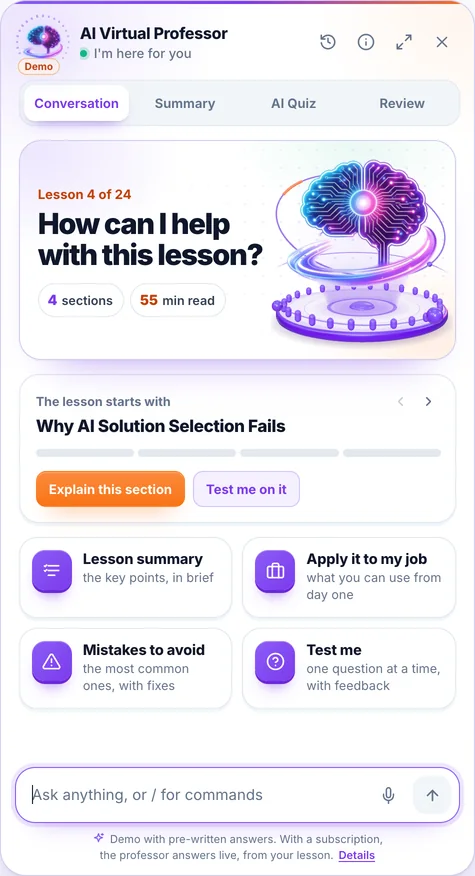
The demo opens on a lesson from the course “AI for Business Leaders”, with prepared answers; voice is off in the demo.
It is an artificial intelligence system, not a human teacher; its answers may contain errors. Details in the Terms & Conditions.
Leadership announced that "we are adopting AI." Licenses were purchased, a few generic training sessions were held. Three months later, a handful of enthusiasts are experimenting, the rest of the team uses the tools superficially or ignores them, and leadership wonders why it isn't seeing the promised impact. If this pattern sounds familiar, you have already found the exact spot where AI adoption dies — and it is neither the technology nor the training. It is the link between the decision made at the top and the people below: the direct team manager. That is, you. And before any change management technique, before ADKAR or handling resistance, we need to clarify what this manager actually becomes — because the answer is not "a supervisor who uses a new tool."
Over the next 55 minutes we will define precisely who you are, the reader of this course, what problem you solve, and why your level — the direct team manager — is exactly the link where AI adoption either succeeds or fails. We will build the shared vocabulary we will use throughout all the modules that follow.
Who this course is for: the team manager, not the C-level
There is a persistent confusion in the market between "leadership in the AI era" at board level and "people management" at the operational team level. This course is addressed exclusively to the second level.
If you are a chief executive, a board member, or a division head who decides the organization's AI budget, the investment portfolio, and the competitive strategy, then your primary interest is capital allocation, portfolio-level ROI, and market positioning. For that perspective there is a separate course on Cursuri-AI.ro, "AI for Business Leaders," which covers strategy at board level.
This course is for you if you are:
- A team manager with between three and fifteen direct reports, responsible for their daily deliverables.
- A middle manager caught between pressure from leadership (which demands AI adoption) and the anxiety of your people (who fear AI will take their jobs).
- A team lead, coordinator, or head of an operational department who does not decide whether the organization adopts AI, but is responsible for making sure their team actually uses it and delivers results.
The difference is not one of prestige, but of the nature of the work. The business leader answers the question "what do we invest in and why." The team manager answers the question "how do I get my nine people to adopt these tools without panicking, sabotaging, or leaving." The first is strategy. The second is execution — and execution is where most transformations die.
The core problem: the team is anxious and is not adopting
Modern AI technology — models such as OpenAI GPT-6 Sol, Anthropic Claude Opus 5.5, Google Gemini 3.1 Pro, or the integrated assistant Microsoft 365 Copilot — is, from a technical standpoint, ready to use. The organization can buy licenses within a week. And yet, in practice, we observe a pattern that keeps repeating:
- Leadership announces "we are adopting AI."
- Licenses are purchased, a few generic training sessions are held.
- Three months in, actual usage is marginal. A few enthusiasts experiment; the rest of the team ignores the tools or uses them superficially.
- Leadership wonders why it isn't seeing the promised impact.
Pick up exactly where you left off
Pick the option that fits you; your account is created at checkout in under a minute:
What's next in this lesson
- The first mutation: from "information gateway" to orchestrator
- The conceptual anchor: Josh Bersin's "Superworker"
- Why your level is where adoption actually happens
- What we do and do not do in this course
- Conclusion of the gateway lesson
Everything you'll learn in this course
1 The Manager's New Role in the AI Era: From Control to Orchestration 3 lessons
- From Information-Gateway Manager to Human-Machine Orchestrator Reading now 55 min
- The New Manager's Competency Map: Orchestration, Context, Mentoring 50 min
- The Local Context: Why AI Adoption Is Slower and What It Means for the Local Manager 50 min
2 The Psychology of Adoption: Why Teams Resist and How You Address Fears 3 lessons
- The Anatomy of Resistance: Why People Oppose Change 55 min
- Your Team's Real Fears: Mapping and Differentiation 50 min
- The Difficult Conversation: How to Address Fears Face to Face 50 min
3 The ADKAR Framework (Prosci) Applied to AI Adoption 3 lessons
- ADKAR: The Individual Model of Change and Why It Matters for AI 55 min
- Awareness and Desire: Building the Awareness and the Desire for AI Adoption 55 min
- Knowledge, Ability, and Reinforcement: From Knowing to Doing Consistently 55 min
4 The Kotter 8-Step Framework: Leading Change at the Team Level 3 lessons
- The Kotter 8-Step Model: From Urgency to Institutionalization 55 min
- Urgency, Coalition, and Vision: The First Steps That Launch Momentum 55 min
- Quick Wins and Sustaining Change: From Momentum to Culture 50 min
5 Building Trust: Transparent Communication About AI's Impact 3 lessons
- Trust as the Foundation: Why Transparency Decides Adoption 55 min
- Honest Communication about Jobs and Roles: What You Say, What You Don't Promise 55 min
- Crisis Communication and Rumor Management 50 min
6 Leading Practical Adoption: Pilots, Champions and Measuring Progress 3 lessons
- Smart Piloting: How You Start Small and Learn Fast 55 min
- Internal Champions: Identify, Empower, and Multiply 50 min
- Measuring Progress Without Toxic Pressure 55 min
7 Middle Management as the Link: From C-Level Strategy to Execution 2 lessons
- Translating Strategy: How to Turn C-Level Direction into Team Action 55 min
- Managing Up and Across: Alignment, Resources, and Conflict 50 min
8 AI Productivity for Your Team: Integrating Tools into the Daily Flow 3 lessons
- Integrating AI into the Daily Workflow: From Chaos to Routine 55 min
- Team Norms and AI Hygiene: Shared Rules Without Bureaucracy 50 min
- The Human Balance: Avoiding Overload and AI Dependence 50 min
9 Limits and Compliance: Labor Law, Monitoring and GDPR 3 lessons
- The Manager's Red Line: When to Refer to HR and Legal 55 min
- Employee Monitoring with AI and GDPR: Principles and Pitfalls 55 min
- The Ethics of AI-Assisted Decisions: Bias, Fairness, and Accountability 50 min
10 Applied Project: Your Change Management Plan for an AI Initiative 2 lessons
- Building the Plan: From Diagnosis to Adoption Roadmap 55 min
- Execution, Measurement, and Adjustment: Putting the Plan in Motion 55 min
11 Appendix: Official Resources, 2026 Updates and Learning Paths 2 lessons
- Official Resources, 2026 Updates, and Learning Paths 30 min
- The AI Literacy Obligation (EU AI Act, Art. 4): What It Means for the Team Manager 22 min
Everything you need to learn effectively
Interactive quizzes
Check your knowledge at the end of every lesson with scored quizzes and feedback.
Personal notes
Save notes on every lesson, accessible anytime from your dashboard.
Scheduled reviews
Revisit lessons exactly when it matters, at the right intervals — so you remember for the long term.
Progress & Achievements
Track your progress, unlock achievements, and visualize what you've learned.
Bookmarks
Save the lessons that matter and find them instantly when you need them.
Questions & Answers
Ask questions right on the lesson and get answers from our team.
Good to know before you start
How do I get access to the course?
You can read the beginning of the first lesson for free, right on this page. For the course you create an account, pick the subscription that fits — a single course or a bundle — and get access immediately after your payment is confirmed. Everything happens 100% online.
Can I cancel my subscription anytime?
Yes. Cancel anytime, straight from your account, in just a few clicks. Your access stays active until the end of the period you have already paid for.
What does the subscription for this course include?
All 30 lessons in the course, interactive quizzes, the AI Professor built into every lesson (select a passage and choose “Explain this to me”), within a fair-use limit, personal notes, automatically saved progress, and content updates included.
Is there a fixed learning schedule?
No. You learn at your own pace, on any device. Lessons are structured step by step, and the platform saves your progress automatically, so you can pick up right where you left off — anytime.
Ready to unlock all the content?
Just this course — €99 / month, VAT included — or every Business course, with smart quizzes and the AI Professor included, in the bundle at €299 / month, VAT included.