
What Conversational AI Can and Cannot Do With Your Data
From the course No-Code Data Analysis with AI: ChatGPT, Excel and SQL for Non-Programmers
In every lesson
The AI Professor starts from the lesson you have open
You ask it in writing or by voice, right from the lesson, and you can listen to the answer on request. Where needed, it fills in from general knowledge. When you select a passage, a bar appears with “Explain this to me”, “Give me an example”, “Why does it matter?” and “My own question”.
Its panel has four tabs:
- Conversation: you ask, it answers starting from the lesson
- Summary: the key ideas of the lesson, point by point
- AI Quiz: 3, 5 or 10 new questions from the lesson, with explanations
- Review: flashcards made from the lesson
Included in every subscription and in single-course access, within a fair-use limit.
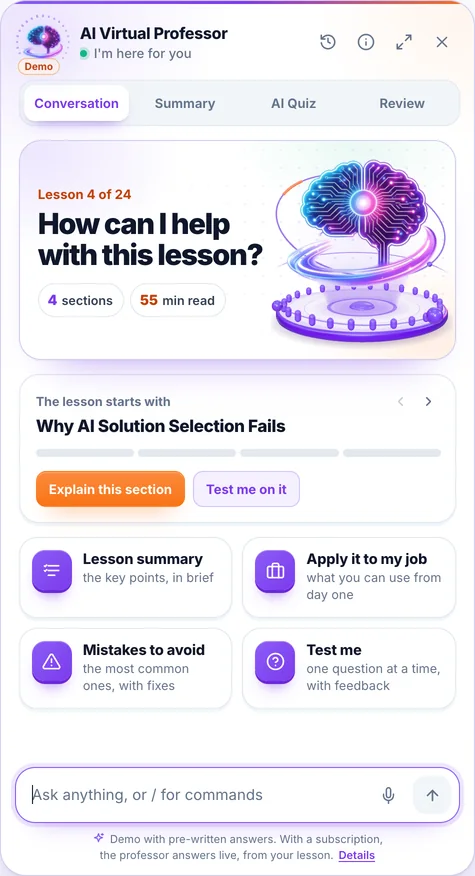
The demo opens on a lesson from the course “AI for Business Leaders”, with prepared answers; voice is off in the demo.
It is an artificial intelligence system, not a human teacher; its answers may contain errors. Details in the Terms & Conditions.
A chart can look impeccable and, at the same time, be completely wrong. You get it in a few seconds by asking the AI for a visualization, you drop it into a presentation for leadership, and if a faulty aggregation sits behind it, nobody will challenge it anymore — because it looks convincing. This is the real stake of data analysis with AI: not the speed at which you reach a result, but the ability to know whether that result is true. The very same tool that can make you several times more productive can also lead you, with utter serenity, to a wrong conclusion. The difference between the two lies in what you know to ask of it and what you know to verify — exactly what we build in this course.
Why this lesson comes first
Most materials about "data analysis with AI" start with an impressive trick: you upload a file, ask for a chart, get a chart, applause. The problem is that the initial enthusiasm masks precisely the risks that matter in a professional context. A beautiful chart generated from a wrong aggregation is more dangerous than no chart at all, because it looks convincing and ends up in a presentation for leadership, where nobody has time to challenge it anymore.
So our pedagogical contract is simple and firm:
- AI accelerates the mechanical work of cleaning, describing, and visualizing data.
- AI does not guarantee the correctness of the results it produces.
- The final responsibility for the numbers remains yours, no matter how articulate the answer sounds.
You will notice throughout the course that we work exclusively with synthetic data — invented datasets, with no real people — precisely so we can experiment freely, without exposing confidential information. This is not a cosmetic detail, but a professional rule, as you will see in the section about GDPR. All the example files in this course (for instance synthetic_orders.csv) are fabricated specifically for learning and do not correspond to any real person or company.
Who this course is for
The course is built for non-programmers: people who work with data every day — in sales, marketing, operations, administration, operational finance — but who do not write code and do not want to learn a programming language just to do their job. You do not need knowledge of Python, R, or advanced SQL. You need two things: curiosity about what your data says and the discipline to verify what the AI answers. The first one you already have, since you are here; the second one we build together.
What conversational AI does WELL
There is a clear category of tasks where an AI assistant like ChatGPT (with the GPT-6 Sol model in 2026) saves you entire hours of repetitive work. We group them into four zones of real competence.
1. Fast data cleaning
Real-world data is dirty: extra spaces, inconsistent date formats, values written as "YES/Yes/yes", chaotically named columns, numbers stored as text. AI excels at proposing and executing cleaning transformations, especially when you describe the problem in natural language.
Example prompt (synthetic data):
"I uploaded a CSV file with 1,200 synthetic orders. The
'payment_status' column contains the values: 'paid', 'Paid', 'PAID',
'settled', 'unpaid', 'Unpaid'. Normalize these values into exactly two
categories: 'Paid' and 'Unpaid'. Show me the mapping table before you
apply it and tell me how many rows fall into each category."
Pick up exactly where you left off
Pick the option that fits you; your account is created at checkout in under a minute:
What's next in this lesson
- 2. Descriptive statistics
- 3. Visualizations from a prompt
- 4. Formulating queries
- What AI does POORLY or RISKILY
- 1. Complex calculations "in its head"
- 2. Aggregations on large datasets
- 3. Causal inferences
- 4. Confidential and personal data
Everything you'll learn in this course
1 Fundamentals: What AI Can and Cannot Do with Your Data 3 lessons
- What Conversational AI Can and Cannot Do With Your Data Reading now 50 min
- The Verification Mindset: Why You Never Blindly Trust AI Output 50 min
- The 2026 Tool Landscape: ChatGPT, Copilot, Gemini, and When to Use Each 50 min
2 ChatGPT Advanced Data Analysis: Upload, Cleaning, Statistics and Charts 3 lessons
- Your First File in ChatGPT: Upload, What the Model "Sees", and the Real Limits 56 min
- Cleaning data with prompts: missing values, duplicates, inconsistent formats 57 min
- Descriptive statistics and charts from prompts: mean, distributions, trends 58 min
3 From Business Question to Insight: Formulating Requests on Tabular Data 3 lessons
- The Good-Question Framework: From "How's the Business Doing" to an Analyzable Request 55 min
- Data Prompts That Work: Structure, Context, Anti-Ambiguity 53 min
- Iteration and follow-up: refine the result in dialogue, without starting over 51 min
4 Copilot in Excel: The COPILOT() Function, Natural-Language Formulas and Pivots 3 lessons
- Copilot in Excel, honestly: what it is, what it does and why it is NOT free 54 min
- The COPILOT() Function in a Cell: Summaries, Classifications, and Extractions from Natural Language 56 min
- Natural-Language Formulas, Pivots, and Insights with Copilot — and What You Always Verify 55 min
5 The Accessible Alternative: Excel Analysis Directly in ChatGPT (No Copilot License) 2 lessons
- No Copilot license? Analyze the same Excel file directly in ChatGPT 54 min
- The Excel ↔ ChatGPT workflow in practice: export, analyze, reimport, and reuse 53 min
6 Introduction to Text-to-SQL for Non-Programmers 3 lessons
- What a Database Is and Why SQL Matters (Even If You Never Write It) 53 min
- Text-to-SQL: How a Natural-Language Question Becomes a Query 57 min
- When Text-to-SQL Is Reliable and When It Is NOT: Pitfalls, Ambiguity, and Verification 54 min
7 Verifying AI Output: How to Catch Invented Columns and Wrong Calculations 3 lessons
- Anatomy of a Data Hallucination: Invented Columns, Aggregations, and Hidden Assumptions 56 min
- The 5-step verification protocol: sanity check, sample, recalculation, counter-question 57 min
- The limits of the models and human responsibility: when NOT to use AI on data 52 min
8 Confidentiality and Compliance: What Data NOT to Put in Cloud Tools 3 lessons
- GDPR in a nutshell for AI data analysis: what personal data is and why it matters 54 min
- Public tier vs Enterprise: DPAs, data retention, and how NOT to train the vendor's model "for free" 55 min
- Synthetic Data and Anonymization in Practice: Work Safely, Anytime 53 min
9 Applied Project: A Complete Mini Business Report, from Raw Data to Verified Insight 3 lessons
- The Project Brief and Synthetic Data: Preparing an "Orders + Clients" Dataset 54 min
- Executing the Analysis: Cleaning, Statistics, Segmentation, and Charts End-to-End 58 min
- Verification, the Final Report, and the Course Recap: A Trustworthy Deliverable 56 min
10 Appendix: Official Resources, 2026 Updates and Learning Paths 1 lessons
- Official Resources, 2026 Updates, and Learning Paths 35 min
Everything you need to learn effectively
Interactive quizzes
Check your knowledge at the end of every lesson with scored quizzes and feedback.
Personal notes
Save notes on every lesson, accessible anytime from your dashboard.
Scheduled reviews
Revisit lessons exactly when it matters, at the right intervals — so you remember for the long term.
Progress & Achievements
Track your progress, unlock achievements, and visualize what you've learned.
Bookmarks
Save the lessons that matter and find them instantly when you need them.
Questions & Answers
Ask questions right on the lesson and get answers from our team.
Good to know before you start
How do I get access to the course?
You can read the beginning of the first lesson for free, right on this page. For the course you create an account, pick the subscription that fits — a single course or a bundle — and get access immediately after your payment is confirmed. Everything happens 100% online.
Can I cancel my subscription anytime?
Yes. Cancel anytime, straight from your account, in just a few clicks. Your access stays active until the end of the period you have already paid for.
What does the subscription for this course include?
All 27 lessons in the course, interactive quizzes, the AI Professor built into every lesson (select a passage and choose “Explain this to me”), within a fair-use limit, personal notes, automatically saved progress, and content updates included.
Is there a fixed learning schedule?
No. You learn at your own pace, on any device. Lessons are structured step by step, and the platform saves your progress automatically, so you can pick up right where you left off — anytime.
Ready to unlock all the content?
Just this course — €99 / month, VAT included — or every Business course, with smart quizzes and the AI Professor included, in the bundle at €299 / month, VAT included.