
What Changed: AI Overviews, Zero-Click Search, and the CTR Decline
From the course SEO and AEO/GEO in the AI Era: Optimizing for Google, AI Overviews and Generative Engines
In every lesson
The AI Professor starts from the lesson you have open
You ask it in writing or by voice, right from the lesson, and you can listen to the answer on request. Where needed, it fills in from general knowledge. When you select a passage, a bar appears with “Explain this to me”, “Give me an example”, “Why does it matter?” and “My own question”.
Its panel has four tabs:
- Conversation: you ask, it answers starting from the lesson
- Summary: the key ideas of the lesson, point by point
- AI Quiz: 3, 5 or 10 new questions from the lesson, with explanations
- Review: flashcards made from the lesson
Included in every subscription and in single-course access, within a fair-use limit.
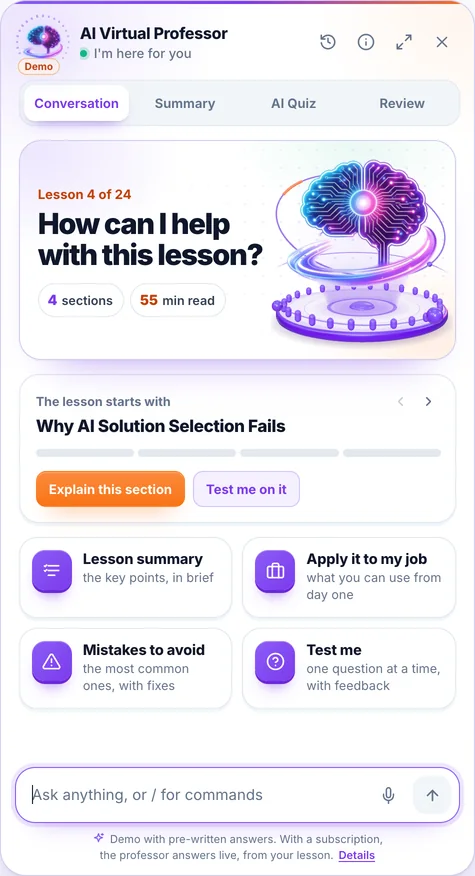
The demo opens on a lesson from the course “AI for Business Leaders”, with prepared answers; voice is off in the demo.
It is an artificial intelligence system, not a human teacher; its answers may contain errors. Details in the Terms & Conditions.
For nearly two decades, the game of search had a single rule: you climb the list of results, you get clicks, clicks bring traffic, traffic brings conversions. Simple, predictable, exploitable. Over the past two years, however, Google's results page has transformed more than in the entire previous decade — and the chain that so many businesses rest on has quietly begun to break. An AI-generated answer has risen above the links, and users increasingly get what they are looking for without ever clicking. This lesson establishes, with real and dated data rather than impressions, exactly what has changed — and why it concerns you directly.
Useful prerequisite: if you arrive without context on the role of artificial intelligence in marketing, first work through the introductory lessons in the AI for Digital Marketing course to build your basic vocabulary. This course assumes you are familiar with the general idea that AI has entered the search flow.
From the "ten blue links" to the SERP with a generative layer
For nearly two decades, the search results page (SERP — Search Engine Results Page) had a stable, predictable structure: a search box, possibly a few paid ads, then a list of roughly ten organic results — the famous "ten blue links". The mental model of optimization was simple to describe: you climb this list, you get clicks, clicks bring traffic, traffic brings conversions.
This model has not disappeared, but it no longer describes reality on its own. Above the organic results, a generative layer has appeared: an answer synthesized by artificial intelligence, built from multiple sources, displayed before the user sees any classic link. At Google, this layer has two main manifestations:
- AI Overviews — an automatically generated summary that appears at the top of the SERP for certain queries, with a few source links attached.
- AI Mode — a separate conversational experience, in which the user holds a dialogue with the engine, asks follow-up questions, and receives synthesized answers, without necessarily going through a list of links.
The structural consequence is profound: the answer has risen above the links. Where the engine used to send you to a page to find the answer, it now increasingly tries to give you the answer directly, on the spot.
Pick up exactly where you left off
Pick the option that fits you; your account is created at checkout in under a minute:
What's next in this lesson
- Anatomy of a modern SERP
- Zero-click search: what it is and why it has grown
- The CTR decline: what the real data says (and why it is volatile)
- The Ahrefs study, December 2025
- Why the earlier study from April 2025 matters
- Corroboration with other sources
- What we will NOT do in this lesson
- Recap
Everything you'll learn in this course
1 The 2026 SEO Landscape: From Classic SEO to AEO/GEO 3 lessons
- What Changed: AI Overviews, Zero-Click Search, and the CTR Decline Reading now 55 min
- The New Vocabulary: SEO, AEO, GEO, AI Overviews, and AI Mode — Clear Definitions 50 min
- The map of modern strategy: durable principles vs. volatile tactics 50 min
2 Durable Fundamentals That Do Not Age 3 lessons
- E-E-A-T in practice: experience, expertise, authoritativeness, trust 55 min
- Search intent: informational, navigational, transactional, commercial 50 min
- Site architecture and structured data: the foundation that never goes out of style 55 min
3 AI-Assisted Technical SEO 4 lessons
- Crawlability and indexing: how search engines find and understand you 50 min
- Commercial control of AI crawlers: block-by-default, pay-per-crawl, and content licensing 42 min
- Core Web Vitals and Performance: Experience as a Durable Signal 50 min
- Schema Markup in Practice: Implementation, Validation and Maintenance with AI 50 min
4 Keyword and Intent Research at Scale with AI 2 lessons
- From Keywords to Topics: Modern Research with AI 50 min
- Real Questions and SERP Analysis: What the User Actually Wants 50 min
5 Content SEO: Topical Authority That Ranks 2 lessons
- Topic clusters and pillar pages: the architecture of topical authority 55 min
- Content that ranks: structure, freshness, and updates 50 min
6 AEO and GEO: Visibility in AI Overviews and Citations in Generative Engines 3 lessons
- How to Appear in Google AI Overviews and AI Mode 55 min
- How You Get Cited by ChatGPT, Perplexity, Gemini, and Claude 55 min
- Mentions, sources, and off-site: how to become a source AI consults 50 min
7 Measuring AI Citations and Analytics in the Zero-Click Era 3 lessons
- Share-of-voice in AI engines: what you measure and why 50 min
- AI citation monitoring tools: Profound, Otterly, and the ecosystem 50 min
- Analytics in the zero-click era: what you can still measure and what you report honestly 50 min
8 Programmatic SEO and Responsible Scaling with AI 2 lessons
- Programmatic SEO: Volume at Scale Without Falling into Spam 50 min
- Responsible AI Scaling Workflows: Human-in-the-Loop and QA 50 min
9 Anti-Snake-Oil, Ethics, Consumer Protection and Re-Verification 4 lessons
- Debunk: llms.txt, special schema for AI Overviews, and other myths 50 min
- Black-hat to avoid: cloaking, link schemes, PBNs and content abuse 50 min
- Consumer protection, fair advertising and promises: what you CAN and CANNOT guarantee 50 min
- How to re-verify when the algorithm changes: a durable process 50 min
10 Applied Project: An End-to-End SEO + GEO Strategy 4 lessons
- The Audit: Technical, Content, and AI Visibility Diagnosis of a Real Website 55 min
- Strategy and Execution: A Prioritized SEO + GEO Roadmap 50 min
- Measurement and Iteration: Dashboard, Honest Reporting and Continuous Re-Verification 50 min
- Official Resources, 2026 Updates and Learning Paths 48 min
Everything you need to learn effectively
Interactive quizzes
Check your knowledge at the end of every lesson with scored quizzes and feedback.
Personal notes
Save notes on every lesson, accessible anytime from your dashboard.
Scheduled reviews
Revisit lessons exactly when it matters, at the right intervals — so you remember for the long term.
Progress & Achievements
Track your progress, unlock achievements, and visualize what you've learned.
Bookmarks
Save the lessons that matter and find them instantly when you need them.
Questions & Answers
Ask questions right on the lesson and get answers from our team.
Good to know before you start
How do I get access to the course?
You can read the beginning of the first lesson for free, right on this page. For the course you create an account, pick the subscription that fits — a single course or a bundle — and get access immediately after your payment is confirmed. Everything happens 100% online.
Can I cancel my subscription anytime?
Yes. Cancel anytime, straight from your account, in just a few clicks. Your access stays active until the end of the period you have already paid for.
What does the subscription for this course include?
All 30 lessons in the course, interactive quizzes, the AI Professor built into every lesson (select a passage and choose “Explain this to me”), within a fair-use limit, personal notes, automatically saved progress, and content updates included.
Is there a fixed learning schedule?
No. You learn at your own pace, on any device. Lessons are structured step by step, and the platform saves your progress automatically, so you can pick up right where you left off — anytime.
Ready to unlock all the content?
Just this course — €99 / month, VAT included — or every Business course, with smart quizzes and the AI Professor included, in the bundle at €299 / month, VAT included.