Cursuri AI.ro International — AI e-learning for professionals

Try the platform before you pay

Explore the interactive account demo and read the first lesson of Vibe Coding: From Prompt to Application with Lovable, v0, Bolt and Replit Agent for free, in full — no account, no card.

AI Professor in every lesson Quizzes with feedback Cancel anytime
cursuri-ai.ro/app/courses/vibe-coding-from-prompt-to-app Interactive demo · sample account
Cursuri AI.ro International — AI e-learning for professionals

Welcome! 👋

Welcome to Cursuri AI International — AI e-learning for professionals, now in English. Activate your subscription and start learning.

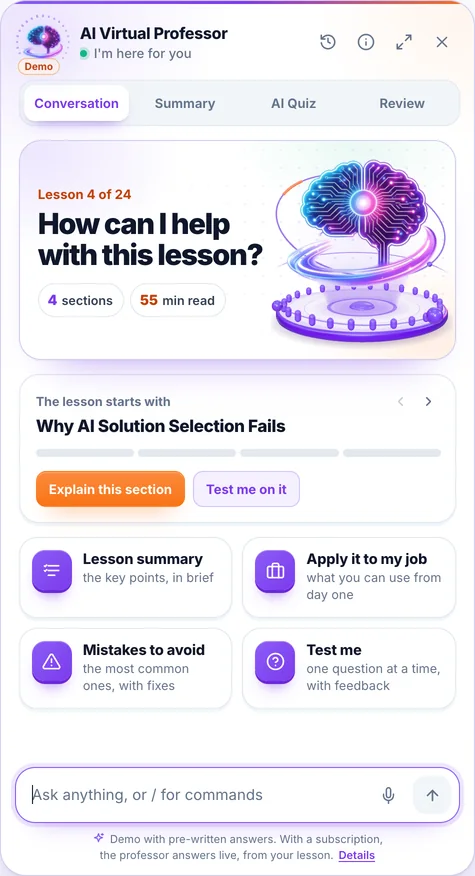
AI virtual professor Exclusive to Cursuri AI

A mentor who knows every lesson in detail and guides you personally.

Included in your subscription

Everything you get with a single subscription

Full access to the entire platform, with no hidden limits or extra costs.

20 premium courses Practical content created by specialists, constantly updated with the latest in AI
24/7 AI virtual professor A personal mentor built into every lesson — ask any question and get an instant answer
555 hands-on lessons Short, structured lessons with practical exercises you can apply at work right away
Smart AI quizzes Automatically generated questions, tailored to your weak spots, with detailed feedback
Save and organize Bookmarks, personal notes and a spaced-repetition system for maximum retention
Progress and analytics Streaks, weekly goals and personalized insights into your growth

Start learning AI today

Pick the right plan and get instant access to premium courses, an AI virtual professor, smart quizzes and hands-on exercises.

No long-term commitment Cancel anytime, no penalties Instant access after payment
This is a preview with sample data. Activate your subscription to save your conversations with the AI Professor.

AI Conversations

The complete history of your dialogues with the AI Virtual Professor

4 Conversations
36 Messages
2 Courses
AI Fundamentals 2 conversations
You

Can you explain how an artificial neuron works?...

AI Professor
AI Professor

An artificial neuron simulates how a biological neuron works: 1. Inputs — it receives multiple numeric values 2. Weights — each input has a weight that determ...

You

What is the ReLU activation function?...

AI Professor
AI Professor

ReLU (Rectified Linear Unit) is the most popular activation function: - Formula: f(x) = max(0, x) - If the input is positive → it passes through unchanged - If the input is negative → it turns it into ...

Prompt Engineering Masterclass 2 conversations
This is sample data Activate a subscription to save and export your real conversations with the AI Professor.
See plans
This is a preview with sample data. Activate a subscription to see your real scores.

Scores

Your performance across 5 assessed courses

79% Overall average
Very good
5
Courses assessed
4 / 5
Passed (≥70%)
22
Quizzes completed
168 / 220
Total points
Score distribution
4 courses ≥70% 1 course 40-69%
Best result Prompt Engineering Masterclass — 92%

Performance by course

92
Prompt Engineering Masterclass Passed
46 / 50 points 5 quizzes 92%
85
Introduction to AI Engineering Passed
34 / 40 points 4 quizzes 85%
76
AI for Digital Marketing Passed
38 / 50 points 5 quizzes 76%
71
RAG — Retrieval Augmented Generation Passed
21 / 30 points 3 quizzes 71%
58
AI Agents & Automation Not passed
29 / 50 points 5 quizzes 58%
This is sample data Activate a subscription to see your real quiz scores.
See plans
Structured learning paths

From zero to expert,
step by step

Career paths and specializations with a clear structure, from fundamentals to advanced level. Each course prepares you for the next — no guessing what to learn next, the platform guides you.

20 Premium courses
555 Hands-on lessons
24/7 AI Professor

How a learning path works

Four simple steps from your first lesson to expert level

01

Choose the right path

Two complete career paths plus focused specializations — for engineers, managers, marketers, or professionals in specialized fields.

02

Complete the stages in order

Each path is divided into clear stages. Each course prepares you for the next — no skipped steps, no lost context.

03

The AI Professor guides you

Ask anything in every lesson. You get explanations, practical examples, and personalized quizzes.

04

Track your progress

Progress per stage and per path, quiz scores, and automatic recommendations for your next step.

AI Virtual Professor Exclusive

Built into every lesson of every path

Throughout your entire path, you have access to an AI professor that knows the content of every lesson. Ask anything — you get detailed explanations, industry examples, and quizzes adapted to your level.

AI chat included in your subscription Answers tailored to the lesson you're studying
Automatic summaries Key points intelligently extracted
Personalized quizzes Unique questions, calibrated to you

Start your first learning path today

Choose the right plan and get instant access to the AI Professor, smart quizzes, and all premium courses.

Instant access Cancel anytime AI Professor included
Individual courses

Choose the courses you're interested in

Subscribe to each course individually. €49 + VAT / month per course, cancel anytime.

IT PRO Beginner

Vibe Coding: From Prompt to Application with Lovable, v0, Bolt and Replit Agent

Build full-stack applications from prompts and ship them safely, legally and responsibly — without writing code.

22 lessons ~24h
BUSINESS Beginner

Microsoft 365 Copilot for Office Work: Role-Based Productivity

Turn Word, Excel, Outlook, Teams and PowerPoint into AI assistants — real productivity for your role, not generic tricks.

32 lessons ~24h
BUSINESS Intermediate Popular

SEO and AEO/GEO in the AI Era: Optimizing for Google, AI Overviews and Generative Engines

Modern SEO plus end-to-end AEO/GEO: how to appear in Google and AI Overviews and get cited by ChatGPT, Perplexity, Gemini

30 lessons ~26h
BUSINESS Intermediate

Manager in the AI Era: Leading Your Team Through the AI Transformation

Lead your team through the AI transformation with proven frameworks: ADKAR, Kotter and the psychology of adoption

30 lessons ~24h
BUSINESS Intermediate Popular

AI Image Generation: The Complete Guide from Prompt to Publishing

Premium course: visual prompt engineering, AI platforms, production at scale, legal, ROI and hands-on tutorials — updated for 2026

26 lessons ~27h
BUSINESS Beginner

No-Code Data Analysis with AI: ChatGPT, Excel and SQL for Non-Programmers

Analyze data with conversational AI, no code: ChatGPT, Excel and SQL for non-programmers, with verification and GDPR.

27 lessons ~24h
BUSINESS Intermediate Popular

AI for Entrepreneurs and Startups: The Complete Guide

Premium course: idea validation, no-code MVP, go-to-market, finance, scaling and the startup ecosystem with AI — updated for 2026

30 lessons ~28h
BUSINESS Intermediate Popular

AI for Sales and CRM

The complete AI masterclass for sales and intelligent CRM — updated for 2026

28 lessons ~25h
BUSINESS Intermediate Popular

AI for Content Creation and Copywriting

Premium course: copywriting, editorial strategy, social media, video, audio, brand voice, SEO, KPIs and scaling with AI — updated for 2025-2026

29 lessons ~29h
BUSINESS Beginner Popular

AI for Digital Marketing

The complete AI masterclass for digital marketers — updated for 2026

31 lessons ~27h
IT PRO Advanced Popular

Context Engineering and Memory for AI Agents: Beyond Prompting

Engineer AI agents' context and memory for reliability at scale: context anatomy, memory types, retrieval, compaction, cost.

25 lessons ~24h
BUSINESS Intermediate Popular

AI for Business Leaders

The complete AI masterclass for leaders and management — updated for 2026

24 lessons ~22h
IT PRO Advanced Popular

Claude Code Mastery: Agentic Coding from the Terminal (multi-file, git, CI, MCP)

Terminal-first agentic coding with Claude Code: multi-file, git, headless, subagents, hooks, CI/CD, MCP, security and routing across the 2026 Anthropic lineup (including Claude Fable 5).

28 lessons ~25h
IT PRO Expert Popular

Cursor as a Pro: AI-Native IDE, Composer and Multi-Agent 2026 (Enterprise Edition)

Cursor 3 Pro: from Composer to Background Agents and Enterprise — April 2026

30 lessons ~25h
IT PRO Advanced Popular

MCP (Model Context Protocol) — Building Servers and Integrations (Enterprise Edition)

The complete MCP guide: from architecture to production servers — Python, TypeScript, security, deployment

22 lessons ~25h
IT PRO Advanced Popular

AI Agents: Architecting and Automating Autonomous Systems

The complete AI Agents and Automation masterclass for engineers — updated for 2026

30 lessons ~26h
IT PRO Advanced Popular

Advanced LLM Integration in Production Applications

The complete masterclass on LLM integration in production — updated for 2026

24 lessons ~26h
IT PRO Advanced Popular

RAG: Retrieval-Augmented Generation in Practice

The complete RAG masterclass for AI Engineers — updated for 2026

27 lessons ~24h
IT PRO Intermediate Popular

The Complete Prompt Engineering Masterclass

Advanced prompting techniques for professionals — updated for 2026

32 lessons ~27h
IT PRO Beginner Popular

Introduction to AI Engineering

The complete AI Engineering masterclass for developers — updated for 2026

28 lessons ~25h
This is a preview with sample data. Activate a subscription to save your lessons and notes.

Saved & Notes

Your saved lessons and personal notes, organized by course.

5 saved lessons 3 notes
Prompt Engineering Masterclass 3
Chain-of-Thought Prompting — The Complete Guide Mar 18
Few-Shot vs Zero-Shot — When to Use Each Mar 16
Advanced System Prompts for GPT-5.5 and Claude Mar 14
AI for Digital Marketing 2
Generating Ad Copy with AI — Meta & Google Ads Mar 12
Automating Campaigns with AI Agents Mar 10
This is sample data Activate a subscription to save your own lessons and personal notes.
View plans
This is a preview with sample data. Activate a subscription to generate personalized review flashcards.

Review

Key concepts from your lessons, generated by the AI Virtual Professor

3 Lessons
10 Cards
2 Courses
AI Fundamentals 7 cards
Prompt Engineering Masterclass 3 cards
This is sample data Activate a subscription to generate personalized review flashcards for every lesson.
View plans
This is a preview with demo data. Activate a subscription to see your real statistics.

Learning Insights

Your learning statistics

15h 30m total time 7 achievements
12/7 Lessons 175/180 Minutes 14/21 Streak
12
Lessons completed
175
Minutes invested
59%
5
Quizzes taken
14
Day streak

Personal records

21 days Longest streak
175m Most active week
45 days Total active days
22m/day Daily average
This is demo data Activate a subscription to see your real statistics and achievements.
See plans

Saved articles

The blog articles you saved for later, all in one place.

0 saved articles

No saved articles yet

When you read an article on the blog, hit the “Save” button to find it again quickly right here.

My account

Welcome

The premium AI education platform. Manage your account, subscription and progress.

Demo data. Activate a subscription to see your real progress.

Your progress

See courses
3
Courses in progress
5
Courses completed
47
Lessons completed
14
Day streak

You don't have an active subscription.

Choose a plan
Premium feature

Available with an account

This section becomes active once you create an account.

See available plans
20 premium courses 555 hands-on lessons 24/7 AI Professor Secure payments with Stripe Cancel anytime
Full lesson, free Module 1 · Lesson 1

Vibe Coding in 2026: Definition, Strengths, and the "From Prompt to App" Promise

From the course Vibe Coding: From Prompt to Application with Lovable, v0, Bolt and Replit Agent

52 min read Beginner Quiz included + 21 lessons with a subscription
Tip: select any passage in the lesson and hit “Ask the AI Professor” — that's exactly how it works inside the platform.

Built-in AI Professor Exclusive

Ask anything about the lesson and get an instant answer. The AI Professor knows the course content and helps you learn more effectively.

Select a passage in the lesson → it explains it on the spot Interactive chat — answers any question Automatic summaries with key points Personalized AI-generated quizzes

You describe the application you want in a single sentence, hit enter, and within a few minutes you have a frontend, a database, an authentication flow, and a live URL. What used to be days of work for a junior developer yesterday is now a working draft generated in minutes. This is exactly where both the strength and the trap of the prompt-to-app paradigm hide: a draft that "works" in a demo is not a production application, and the distance between the two is greater — and more dangerous — than it seems at first glance. This entire course is built around that distance, and around a single principle that governs it — you ship it, you own it.

Where the term "vibe coding" comes from

The term was publicly introduced by Andrej Karpathy (co-founder of OpenAI, former Director of AI at Tesla) in a post from February 2025. His phrasing described a practice in which the developer "gives in to the vibes", accepts the code generated by the AI model without reading it rigorously, and interacts with the environment almost exclusively through natural language. The idea went viral quickly and was later consolidated into a more sober definition.

The reference sources for the definition used in this course are the Wikipedia article on "vibe coding" and the analyses published by Contrast Security. Synthesized, they converge on the following working formulation:

Vibe coding = you describe the intent of an application in natural language, an AI model generates the code, and you focus on the observable result (what the application does), not on the syntax or internal structure of the code.

This definition has three elements worth isolating:

  1. Intent in natural language is the primary interface. You don't write functions; you describe behaviors.
  2. The AI model writes the code. You remain the architect of the intent, not of the line-by-line implementation.
  3. The focus is on the result. The question "does it work as I asked?" becomes more important than "what does the code look like?".

A critical nuance from the start

Karpathy himself described vibe coding as suitable for weekend projects, prototypes, experiments — not as a method for shipping critical production software without oversight. This nuance is essential. Many superficial interpretations have turned "vibe coding" into a promise that "anyone can build anything without knowing how to program". Our course firmly rejects this caricature. Mature vibe coding means using AI as a speed multiplier while keeping human responsibility over what you ship.

The "from prompt to app" promise (prompt-to-app)

The central promise of the tools we study is the following: a verbal specification results in a functional full-stack application. Concretely, this means that from a prompt like:

"I want a task management application for a small team, with authentication, shared lists, labels, and a dashboard showing weekly progress."

the tool can generate, in a few minutes:

  • a frontend (the visible interface, usually React or a similar framework);
  • a database and a persistence layer (often through integration with a managed backend);
  • the authentication logic and the application's routes;
  • a preliminary deployment accessible through a URL.

What used to be days of work for a junior developer yesterday becomes a working draft generated in minutes today. Here lies the real strength, but also the trap: a working draft is not a production application. The distance between the two is the recurring theme of the entire course.

Table: what a prompt typically delivers and what remains your job

Application layer What the tool can generate from a prompt What remains your responsibility
Interface (UI) Layout, components, basic navigation Visual coherence, accessibility, edge cases
Data and persistence Initial schema, CRUD operations Access rules, integrity, safe migrations
Authentication Standard login/registration flow Security policies, sessions, account recovery
Business logic Simple, verbally describable rules Complex validations, compliance, rare cases
Deployment Preliminary URL, basic hosting Domain, monitoring, scaling, real costs

The global market: why it matters now

The real value of the paradigm is not deduced from enthusiasm, but from market signals. Here we use only global orders of magnitude, reported by credible sources, without inventing local figures.

  • TechCrunch has repeatedly documented the rapid rise of prompt-to-app tools, framing them within a broader wave of "AI app builders" that attracted significant funding and attention in 2024-2025.
  • The official Lovable blog and the private-company data platform Sacra have reported accelerated growth in annual recurring revenue for tools in this category — a signal that we are not talking about a niche toy, but about a segment with real commercial traction.
  • Adoption shows up both among non-engineers (founders, marketers, designers building their own MVPs) and among technical teams using the tools for rapid prototyping.

We retain the order of magnitude, not the exact figure: the prompt-to-app segment has gone, within a few years, from experiment to a product category with substantial recurring revenue and rapid growth. For you, the learner, this means that a durable skill in operating these tools has real economic value in the global market.

Note on figures: we deliberately avoid country-specific percentages or amounts for the adoption of these tools, because there is no solid public data we can cite honestly. Any local figure you might encounter without a verifiable source should be treated with suspicion.

The course's four tools, at the concept level

The course works with four representative tools. In this lesson we present them at the level of concept and positioning, not interface — because buttons change, but the logic of each product remains relatively stable.

Tool Conceptual positioning Typical strength
Lovable Prompt-to-app builder oriented toward complete applications with an integrated backend Fast generation of full-stack applications starting from a description
v0.app (from Vercel) Generation of interfaces and components, tightly linked to the Vercel/Next.js ecosystem UI quality and integration into the Vercel deploy flow
Bolt (StackBlitz) In-browser development environment with an AI agent that builds and runs the project Live editing and running of code directly in the browser
Replit Agent AI agent inside a complete cloud development environment (Replit) Building, running, and hosting integrated into the same platform

Remember: none of these descriptions is an absolute recommendation of "the best" tool. The right choice depends on the use case — a theme we will develop in the following modules. For now, it is enough to understand that all four turn natural language into a functional application, but with different emphases (UI, full-stack, development environment, autonomous agent).

What makes generation possible, under the hood

These tools are not magic; they are interfaces on top of 2026-generation language models. Behind them we find models such as GPT-5.5 (OpenAI), Claude Opus 4.8 and 4.7 (Anthropic), or Gemini 3.1 Pro (Google) — models with large context windows and solid code generation capabilities. The output quality of a prompt-to-app tool depends directly on the model used and on how well that model is "orchestrated" behind the scenes. We will return to this aspect in detail in the next lesson.

The course's central philosophy: "you ship it, you own it"

If you retain a single principle from the entire course, let it be this:

You ship it, you own it. You are responsible for what you ship.

The fact that an AI model wrote the code does not transfer responsibility to the AI or to the platform. If your application leaks personal data, you are the one who answers for it. If the financial logic produces an error, you are the one who bears the consequences. If a customer uses your product, you are the vendor.

This principle translates into three operational rules we will keep repeating:

  1. Generated code ≠ verified code. Any code produced by AI requires human review and security scanning before it reaches production. This rule is non-negotiable in this course and has a dedicated module (limits, security, shadow IT).
  2. Compliance liability remains with you. Under the GDPR, you are usually the data controller, not the platform that generated your application. The platform is, at best, a processor for the infrastructure.
  3. Delivery responsibility remains with you. The quality, availability, and correctness of the product delivered to the customer are your obligation, regardless of who wrote the code.

A firm disclaimer (read carefully)

This course teaches you durable workflows for building applications with prompt-to-app tools. It is NOT:

  • professional security consulting — for a system that processes sensitive data or money, you need a real security specialist;
  • professional legal advice — for compliance questions (GDPR, contracts, liability, intellectual property), you need a lawyer;
  • a promise that AI completely replaces engineers — it does not, and the course will show you exactly where this illusion collapses.

Everything related to copyright, security, or the law in this course is offered as informative context, not as professional advice applicable to your specific case.

How this course differs from the Cursor and Claude Code courses

The platform already offers serious courses on AI tools for programming. It is important to understand the difference in audience and purpose, so you can choose correctly:

Aspect The Cursor / Claude Code courses (it-13, it-16) This course (vibe coding / prompt-to-app)
Target audience Software engineers, developers Non-engineers and teams that want fast MVPs
Working environment IDE (code editor) / terminal Prompt-to-app web builder
Premise You already know how to read and write code You don't need to be a professional programmer
Result Code in your repo, under your complete control A generated application, ready to iterate on and ship
Core skill AI-assisted engineering Use-case selection judgment + orchestration through prompts

In short: Cursor and Claude Code are tools for engineers who want to program faster. Vibe coding, as we teach it here, is for anyone who wants to turn an idea into a functional application without first becoming a software engineer. Both approaches are legitimate; they serve different people and purposes.

Three misconceptions we correct from the start

Before going further, we dismantle three myths circulating around vibe coding. We correct them now so that the rest of the course is built on an honest foundation.

Myth 1: "AI completely replaces software engineers"

It does not. Prompt-to-app tools shift the boundary of who can build what, but they do not eliminate the need for engineering expertise once the product becomes serious. A non-engineer can get much further than in the past — up to a functional MVP, sometimes up to a product that generates revenue. But the transition to a mature, secure, scalable system that complies with regulations demands the same competencies as always. The practical reality of 2026 is one of collaboration: AI accelerates, the human decides and verifies.

Myth 2: "If the demo works, the application is done"

This is perhaps the most dangerous myth, because it seems true. An application that "works" in a demo can hide serious gaps: missing access control, insecure configurations, superficial validations, lack of testing on real cases. The fact that a happy path works says nothing about the application's behavior when someone enters unexpected data, tries to access what they shouldn't, or uses it at scale. "It works" is not equivalent to "it is correct and secure".

Myth 3: "Generated code is free to maintain"

Any code, regardless of who wrote it, has a maintenance cost. The more code you generate without understanding it, the higher the risk of getting stuck when something stops working. One of the disciplines we teach in this course is to understand enough of what the tool produces so that you can debug, adjust, and evolve the application — even without being an engineer. Mature vibe coding does not mean total ignorance of the code; it means not having to write it from scratch, while still being able to collaborate with it intelligently.

What you will be able to do at the end of the course

To anchor expectations correctly, here is what this course concretely proposes you will be able to do — and what it does not:

You will be able to We do NOT promise you
Turn an idea into a functional MVP with prompt-to-app tools That you will become a certified software engineer
Judge whether a case is suitable or not for vibe coding That you can build any critical system without expertise
Formulate effective prompts for full-stack applications That AI will guarantee you code free of vulnerabilities
Recognize security risks and the need for review Professional legal or security consulting
Iterate quickly from feedback to a new version That your product is automatically GDPR compliant

This contract of expectations is part of the course's honesty. Exaggerated promises produce disappointment and, worse, insecure products shipped with false confidence.

Recap and what comes next

We have established the fundamentals:

  • Definition (Karpathy, Feb. 2025; consolidated on Wikipedia and Contrast Security): you describe the intent in natural language, the AI writes the code, you focus on the result.
  • The prompt-to-app promise: a verbal specification results in a full-stack application — but a working draft is not production.
  • The global market: a segment with real traction (TechCrunch, Lovable, Sacra), without invented local figures.
  • The four tools: Lovable, v0.app, Bolt, Replit Agent — concept, not UI.
  • The philosophy: you ship it, you own it. Generated code requires human review + security scanning.
  • Disclaimer: this is not professional security or legal consulting.

You now have the definition, the map of the tools, and the principle that holds everything together: you ship it, you own it. What you don't have yet is the most valuable thing in a mature vibe coder — the judgment to know when the paradigm truly accelerates and when, on the contrary, you shouldn't touch prompt-to-app at all. In the next lesson we build exactly this honest decision framework, where the concept of the tools' "ceiling" enters the stage along with the first serious look at the security weaknesses of generated code — the moment when the illusion "the demo works, so it's done" collapses before your eyes.

Real quiz · from Lesson 1

[Easy] Who publicly introduced the term "vibe coding" and approximately when?

First lesson — read in full, for free

Enjoyed it? All 22 lessons look like this.

You just read a complete lesson, exactly as it appears in the platform. Create your account in under a minute and pick the option that fits you best:

Just this course €49+ VAT / month All 22 lessons + AI Professor (fair-use limit)
Recommended IT Pro bundle €399+ VAT / month Every IT Pro course + smart quizzes + full AI Professor
Instant access to Lesson 2 All 22 lessons in the course Interactive quizzes with feedback AI Professor built into every lesson Notes & progress saved automatically Access from any device
Instant access Cancel anytime Secure payment via Stripe

Up next in the course

  • 2 Real Strengths and Limits: When Vibe Coding Makes Sense and When NOT to Use Prompt-to-App 53 min
  • 3 From Specification to Structured Request: How to Describe an App So You Get It Right 52 min
  • 4 Prompt Iteration: The Refinement Loop, Conversational Debugging, and Scope Control 51 min
Unlock all 22 lessons
Course curriculum

Everything you'll learn in this course

11 modules
22 lessons
~19h of content
Beginner level
1 What Vibe Coding Is and Where It Makes Sense 2 lessons
  • Vibe Coding in 2026: Definition, Strengths, and the "From Prompt to App" Promise Reading now 52 min
  • Real Strengths and Limits: When Vibe Coding Makes Sense and When NOT to Use Prompt-to-App 53 min
2 The Anatomy of Prompt-to-App: From Specification to Application 2 lessons
  • From Specification to Structured Request: How to Describe an App So You Get It Right 52 min
  • Prompt Iteration: The Refinement Loop, Conversational Debugging, and Scope Control 51 min
3 A Comparative Tour of the Tools: Lovable, v0, Bolt, Replit Agent 2 lessons
  • Lovable and v0.app: Full-Stack Generation vs. Interface Generation — Strengths and Use Cases 50 min
  • Bolt and Replit Agent: Agentic Browser IDE vs. Complete Cloud Environment — Choosing by Use Case 50 min
4 Essential Integrations: Database, Auth, Versioning, Payments and Deployment 2 lessons
  • Database and Authentication with Supabase: The Data Model, Auth, and the Critical Role of RLS 53 min
  • Version Control with GitHub, Payments with Stripe, and Deployment: How You Go from Preview to Live 52 min
5 From MVP to Something Usable: Production Limits 2 lessons
  • The Production Limits of Generated Code: Performance, Scaling, and Invisible Technical Debt 52 min
  • Real User Data: From Test Data to Production Safely 50 min
6 Security for Non-Engineers: The Weaknesses of AI Code 3 lessons
  • How Insecure Is AI-Generated Code: The Veracode 2025 Report and Typical Vulnerabilities (OWASP) 53 min
  • Case Study: The 2025 Lovable Incident (CVE-2025-48757) and What It Teaches Us About RLS 51 min
  • Pre-Production Security Review Checklist: What You Check, Manually and with Tools 50 min
7 Shadow IT and Sensitive Data 2 lessons
  • Shadow IT and Vibe Coding: The Risk of Applications Built Outside the Organization's Control 51 min
  • What You NEVER Put in a Vibe-Coded App Without Controls: Sensitive Data and Red Lines 50 min
8 Ownership, Licenses and Liability 2 lessons
  • Who Owns AI-Generated Code: Copyright, Thaler v. Perlmutter, and Licenses 52 min
  • Delivery Liability and GDPR: Who Is the Controller and Who Is Liable When You Hand Off to the Client 53 min
9 Practical Compliance: The EU AI Act and Responsible Delivery in the EU 2 lessons
  • EU AI Act Art. 50 and Transparency: What It Means for Applications with AI-Generated Content 52 min
  • Responsible Delivery to EU Clients: A Legal and Compliance Checklist for Handover 51 min
10 Capstone Project: An MVP Shipped with a Security Checklist and Legal Review 2 lessons
  • Build the MVP: From Specification to a Working Application with Integrations 53 min
  • Ship It Responsibly: Security Checklist Walkthrough and Legal Review 53 min
11 Appendix: Official Resources, 2026 Updates and Learning Paths 1 lessons
  • Official Resources, What Changed in 2026, and Learning Paths 26 min
What you get on the platform

Everything you need to learn effectively

Interactive quizzes

Check your knowledge at the end of every lesson with scored quizzes and feedback.

Personal notes

Save notes on every lesson, accessible anytime from your dashboard.

Scheduled reviews

Revisit lessons exactly when it matters, at the right intervals — so you remember for the long term.

Progress & Achievements

Track your progress, unlock achievements, and visualize what you've learned.

Bookmarks

Save the lessons that matter and find them instantly when you need them.

Questions & Answers

Ask questions right on the lesson and get answers from our team.

Frequently asked questions

Good to know before you start

How do I get access to the course?

You can read the first lesson in full for free, right on this page — no account needed. For the rest of the course you create an account, pick the subscription that fits — a single course or a bundle — and get access immediately after your payment is confirmed. Everything happens 100% online.

Can I cancel my subscription anytime?

Yes. Cancel anytime, straight from your account, in just a few clicks. Your access stays active until the end of the period you have already paid for.

What does the subscription for this course include?

All 22 lessons in the course, interactive quizzes, the AI professor built into every lesson (select any passage and it explains it on the spot), personal notes, automatically saved progress, and content updates included.

Is there a fixed learning schedule?

No. You learn at your own pace, on any device. Lessons are structured step by step, and the platform saves your progress automatically, so you can pick up right where you left off — anytime.

Ready to unlock all the content?

Just this course — €49 + VAT / month — or every IT Pro course, with smart quizzes and the full AI Professor, in the bundle at €399 + VAT / month.

Instant access Cancel anytime Secure payment via Stripe
From €49 + VAT / month · Cancel anytime
Read the free lesson