
The 2026 Compliance Landscape for AI
From the course AI Data Privacy and EU AI Act Compliance for Professionals
In every lesson
The AI Professor starts from the lesson you have open
You ask it in writing or by voice, right from the lesson, and you can listen to the answer on request. Where needed, it fills in from general knowledge. When you select a passage, a bar appears with “Explain this to me”, “Give me an example”, “Why does it matter?” and “My own question”.
Its panel has four tabs:
- Conversation: you ask, it answers starting from the lesson
- Summary: the key ideas of the lesson, point by point
- AI Quiz: 3, 5 or 10 new questions from the lesson, with explanations
- Review: flashcards made from the lesson
Included in every subscription and in single-course access, within a fair-use limit.
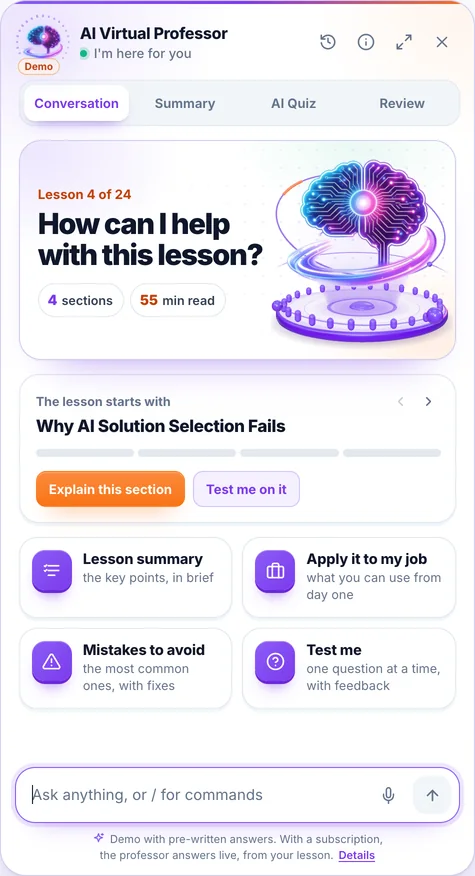
The demo opens on a lesson from the course “AI for Business Leaders”, with prepared answers; voice is off in the demo.
It is an artificial intelligence system, not a human teacher; its answers may contain errors. Details in the Terms & Conditions.
By 2026, artificial intelligence has moved from pilot projects into the core of how European organizations work. Marketing teams draft campaigns with generative models, HR teams screen applications, customer support runs on AI assistants, and analysts summarize sensitive documents in seconds. That shift has produced enormous value — and a new layer of legal responsibility that every professional now shares. This course is about carrying that responsibility competently.
Two regulations dominate the European landscape and they work together: the General Data Protection Regulation (GDPR, Regulation (EU) 2016/679), which governs how personal data is processed, and the EU AI Act (Regulation (EU) 2024/1689), the world's first comprehensive law dedicated to artificial intelligence. If your AI touches information about people, you are almost always doing two things at once: processing personal data (GDPR) and operating an AI system (AI Act). Understanding how these overlap is the single most useful skill this course builds.
A note you will see throughout: this is an educational course, not legal advice. Regulations are interpreted through official guidance, national authorities and case law that evolve over time. For decisions that carry legal or financial consequence, consult a qualified data protection officer or legal professional.
Why this matters now, not later
Three forces make 2026 the year compliance stopped being optional.
First, the law is arriving on a fixed schedule. The AI Act entered into force on 1 August 2024, but its obligations phase in over several years. The prohibitions on unacceptable-risk AI have applied since 2 February 2025. Obligations for general-purpose AI (GPAI) models began on 2 August 2025. The transparency rules of Article 50 have applied since 2 August 2026 and were not postponed; only providers of generative AI systems placed on the market before that date have until 2 December 2026 to comply with the Article 50(2) marking obligation. Regulation (EU) 2026/1744 (the Digital Omnibus on AI), published in the Official Journal on 24 July 2026 and in force since 27 July 2026, postponed the high-risk obligations to 2 December 2027 (Annex III) and 2 August 2028 (Annex I, regulated products). Knowing exactly what applies today versus soon is a core competence, and this course dates everything precisely.
Second, enforcement of GDPR is mature. Data protection authorities across the EU have spent years building expertise and have issued significant fines against AI-related processing — from unlawful scraping of biometric data to chatbots that mishandled personal information. AI does not get a pass simply because it is new technology. The same principles that governed a spreadsheet of customer data in 2018 govern a large language model prompt in 2026.
Third, expectations have risen. Clients, employees and business partners increasingly ask how you govern AI. A credible answer — "here is our AI policy, our register of systems, our human-oversight process" — has become a commercial advantage. The absence of one is a red flag that stalls deals in procurement and security reviews.
Pick up exactly where you left off
Pick the option that fits you; your account is created at checkout in under a minute:
What's next in this lesson
- The mental model: two regimes, one project
- A worked example: one tool, two regimes
- What "compliance" actually means in practice
- Who this course is for
- The cost of getting it wrong — and the upside of getting it right
- A short glossary you will lean on
- Common early mistakes
- Where compliance questions actually surface
Everything you'll learn in this course
1 Module 0 — Why AI Privacy and Compliance Matter in 2026 2 lessons
- The 2026 Compliance Landscape for AI Reading now 50 min
- The Regulatory Map: GDPR Meets the EU AI Act 50 min
2 Module 1 — GDPR Foundations for AI 4 lessons
- The Core Data-Protection Principles (Article 5) 50 min
- Lawful Basis and Special-Category Data (Articles 6 and 9) 50 min
- Consent, Transparency and Information Duties (Articles 7, 13 and 14) 50 min
- Purpose Limitation and Data Minimization in Practice 50 min
3 Module 2 — Rights, Automated Decisions and DPIAs 4 lessons
- Data-Subject Rights in the Age of AI 50 min
- Article 22: Automated Decisions About People 50 min
- Data Protection Impact Assessments (Article 35) 50 min
- Fundamental Rights Impact Assessments (FRIA, Article 27) 50 min
4 Module 3 — The EU AI Act: Structure and Timeline 3 lessons
- Anatomy of the EU AI Act (Regulation (EU) 2024/1689) 50 min
- The Four Risk Tiers 50 min
- The Exact Compliance Timeline 50 min
5 Module 4 — Prohibited and High-Risk AI 2 lessons
- Prohibited AI Practices (Article 5) 50 min
- High-Risk Systems and Their Obligations (Annex III) 50 min
6 Module 5 — Transparency, GPAI and AI Literacy 3 lessons
- Transparency and AI-Content Labeling (Article 50) 50 min
- General-Purpose AI (GPAI) Obligations 50 min
- AI Literacy (Article 4) 50 min
7 Module 6 — Roles and Responsibilities 3 lessons
- Provider, Deployer and the Other Roles 50 min
- Deployer Obligations in Practice 50 min
- Controllers, Processors and Data Processing Agreements (Articles 28 and 30) 50 min
8 Module 7 — Training Data, Copyright and International Transfers 2 lessons
- Training Data, Copyright and Text-and-Data-Mining 50 min
- International Data Transfers 50 min
9 Module 8 — Security, Breaches and AI Governance 3 lessons
- Security and Personal Data Breaches 50 min
- Building Internal AI Governance 50 min
- Penalties, Enforcement and Oversight 50 min
10 Module 9 — Compliance in Practice 3 lessons
- Where GDPR and the AI Act Intersect 50 min
- AI in Recruitment and Hiring: An Applied Case Study 50 min
- A Practical Compliance Roadmap and Checklist 50 min
11 Module 10 — Final Assessment 1 lessons
- Final Quiz: AI Privacy and EU AI Act Compliance 40 min
Everything you need to learn effectively
Interactive quizzes
Check your knowledge at the end of every lesson with scored quizzes and feedback.
Personal notes
Save notes on every lesson, accessible anytime from your dashboard.
Scheduled reviews
Revisit lessons exactly when it matters, at the right intervals — so you remember for the long term.
Progress & Achievements
Track your progress, unlock achievements, and visualize what you've learned.
Bookmarks
Save the lessons that matter and find them instantly when you need them.
Questions & Answers
Ask questions right on the lesson and get answers from our team.
Good to know before you start
How do I get access to the course?
You can read the beginning of the first lesson for free, right on this page. For the course you create an account, pick the subscription that fits — a single course or a bundle — and get access immediately after your payment is confirmed. Everything happens 100% online.
Can I cancel my subscription anytime?
Yes. Cancel anytime, straight from your account, in just a few clicks. Your access stays active until the end of the period you have already paid for.
What does the subscription for this course include?
All 30 lessons in the course, interactive quizzes, the AI Professor built into every lesson (select a passage and choose “Explain this to me”), within a fair-use limit, personal notes, automatically saved progress, and content updates included.
Is there a fixed learning schedule?
No. You learn at your own pace, on any device. Lessons are structured step by step, and the platform saves your progress automatically, so you can pick up right where you left off — anytime.
Ready to unlock all the content?
Just this course — €99 / month, VAT included — or every Business course, with smart quizzes and the AI Professor included, in the bundle at €299 / month, VAT included.