
What Support Leaders Need to Know About AI in 2026
From the course AI for Customer Support and Service
In every lesson
The AI Professor starts from the lesson you have open
You ask it in writing or by voice, right from the lesson, and you can listen to the answer on request. Where needed, it fills in from general knowledge. When you select a passage, a bar appears with “Explain this to me”, “Give me an example”, “Why does it matter?” and “My own question”.
Its panel has four tabs:
- Conversation: you ask, it answers starting from the lesson
- Summary: the key ideas of the lesson, point by point
- AI Quiz: 3, 5 or 10 new questions from the lesson, with explanations
- Review: flashcards made from the lesson
Included in every subscription and in single-course access, within a fair-use limit.
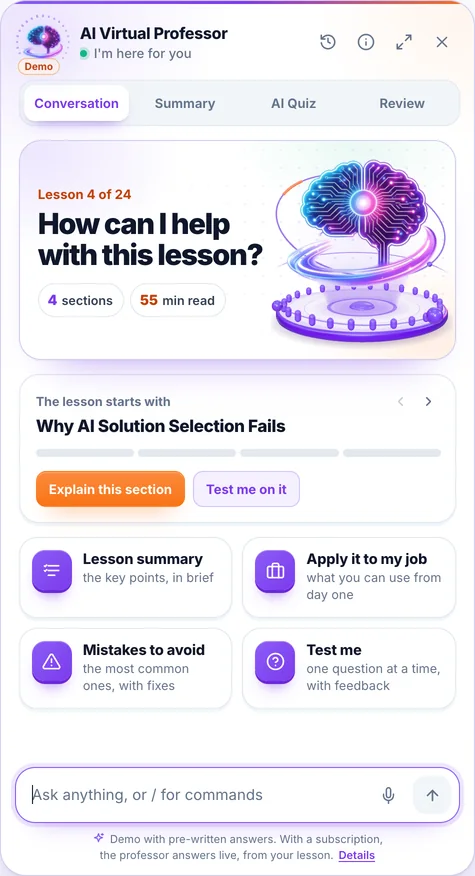
The demo opens on a lesson from the course “AI for Business Leaders”, with prepared answers; voice is off in the demo.
It is an artificial intelligence system, not a human teacher; its answers may contain errors. Details in the Terms & Conditions.
By 2026, artificial intelligence is no longer a pilot project tucked away in one corner of the customer support team. It sits in the middle of the daily workflow: it answers a share of incoming questions on its own, it drafts replies for human agents, it summarizes long tickets, it routes work to the right queue, and it listens to phone calls in real time. But there is a wide gap between support teams that deploy AI thoughtfully and teams that switch it on and hope. This course closes that gap. It teaches you to use AI to handle volume and produce drafts, while humans keep ownership of judgment and of the customer relationship.
This first lesson is your map of the landscape: where AI genuinely helps in support, where it does not, and the single principle that will keep you out of trouble operationally, legally, and reputationally.
The one-sentence summary of this whole course
AI handles the volume; humans own the relationship.
Everything else — the chatbots, the knowledge base, the copilot, the triage rules — hangs off that sentence. Customer support is where your brand meets a frustrated, confused, or angry human being at exactly the moment they need help. AI can absorb an enormous amount of repetitive load and give your agents superpowers, but the moment a case turns sensitive — a serious complaint, a large refund, a vulnerable customer, a legal threat — a competent human must be in control. We will cover the operational and legal detail across the course, but the mindset starts now.
Where AI genuinely helps in customer support
The honest answer in 2026 is that AI is excellent at scale, speed, and the first draft, and weak at judgment, empathy under pressure, and the exception. Here is where it delivers real value.
Deflection and self-service
- Answering routine, repetitive questions ("Where is my order?", "How do I reset my password?") instantly, at any hour, in any language.
- Powering a smarter help center search that understands intent, not just keywords.
- Guiding customers through simple self-service flows before a ticket is ever created.
Chatbots and AI agents
- A front-line assistant that resolves common issues end to end and hands off cleanly to a human when it cannot.
- Consistent, on-brand answers grounded in your real documentation.
Copilot for human agents
- Drafting a reply the agent reviews, edits, and sends.
- Summarizing a 40-message ticket into three lines so a new agent picks it up instantly.
- Suggesting relevant knowledge-base articles and next actions.
Triage and routing
- Reading an incoming email or ticket, detecting intent and urgency, and routing it to the right team.
- Tagging and prioritizing so the queue reflects real business impact.
Voice and quality
- Transcribing and summarizing calls, so agents stop typing notes and start listening.
- Analyzing sentiment to flag an escalating conversation before it boils over.
- Reviewing conversations for quality at a scale no human QA team could match.
Notice what is not on that list: making the final call on a serious complaint, approving a large goodwill payment alone, or deciding to close a vulnerable customer's account. Those are human decisions.
Pick up exactly where you left off
Pick the option that fits you; your account is created at checkout in under a minute:
What's next in this lesson
- What AI cannot (and must not) do in support
- The 2026 model landscape, briefly
- Transparency is not optional
- A first practical prompt you can use today
- The decision template: "Should AI answer this on its own?"
- What to carry into the rest of the course
- The two jobs of support, and why AI fits only one of them cleanly
- A practical suitability scorecard
Everything you'll learn in this course
1 Module 0 — The AI and Customer Support Landscape in 2026 3 lessons
- What Support Leaders Need to Know About AI in 2026 Reading now 52 min
- The Modern Support Tech Stack: Helpdesk, CRM and the AI Layer 50 min
- The AI Support Maturity Model and the Golden Rule 50 min
2 Module 1 — Ticket Deflection and Self-Service 3 lessons
- The Economics of Deflection and Containment 50 min
- Building a Self-Service Experience Customers Actually Like 50 min
- Deflection Done Right: Helping, Not Walling Off 50 min
3 Module 2 — Chatbots and AI Agents for Support 4 lessons
- From Scripts to AI Agents: Designing Support Conversations 50 min
- Escalation and Handoff Design: The Human Path 52 min
- Guardrails, Brand Voice, and AI Act Transparency 50 min
- Multilingual and Global Support with AI 50 min
4 Module 3 — Knowledge Base and RAG for Support 4 lessons
- Why RAG Beats Fine-Tuning for Support Answers 50 min
- Building and Maintaining the Support Knowledge Base 50 min
- Preventing Hallucinations: Citations and Saying "I Do Not Know" 50 min
- Security and Abuse: Prompt Injection, Data Leakage and Safe Tool Use 50 min
5 Module 4 — AI Copilot for Human Agents 3 lessons
- Draft Replies, Tone Adjustment, and Summarization 50 min
- Real-Time Assist, Macros, and Next-Best-Action 48 min
- Agent Adoption, Trust, and Keeping Humans in Control 50 min
6 Module 5 — Email and Ticket Triage and Routing 3 lessons
- Intent Classification and Prioritization 50 min
- Smart Routing, Queues, and SLAs 50 min
- Automation Guardrails in Triage and Routing 50 min
7 Module 6 — Voice and Phone Support with AI 2 lessons
- Voice AI, IVR, and Call Transcription 50 min
- Voice Handoff, Disclosure, and Limits 50 min
8 Module 7 — Sentiment, Quality Assurance, and Measurement 4 lessons
- Sentiment Analysis and Real-Time Escalation 50 min
- Automated Quality Assurance and Conversation Scoring 50 min
- The Metrics That Matter: CSAT, Deflection, AHT, FCR, NPS 52 min
- The Business Case: ROI, Build-versus-Buy and Vendor Selection 50 min
9 Module 8 — Governance, Legal, and Implementation 3 lessons
- GDPR and Customer Data in AI Support 52 min
- EU AI Act Transparency, Human Escalation, and Sensitive Decisions 52 min
- The Implementation Roadmap and Rollout 52 min
10 Final Quiz — AI for Customer Support and Service 1 lessons
- Final Assessment: AI for Customer Support and Service 40 min
Everything you need to learn effectively
Interactive quizzes
Check your knowledge at the end of every lesson with scored quizzes and feedback.
Personal notes
Save notes on every lesson, accessible anytime from your dashboard.
Scheduled reviews
Revisit lessons exactly when it matters, at the right intervals — so you remember for the long term.
Progress & Achievements
Track your progress, unlock achievements, and visualize what you've learned.
Bookmarks
Save the lessons that matter and find them instantly when you need them.
Questions & Answers
Ask questions right on the lesson and get answers from our team.
Good to know before you start
How do I get access to the course?
You can read the beginning of the first lesson for free, right on this page. For the course you create an account, pick the subscription that fits — a single course or a bundle — and get access immediately after your payment is confirmed. Everything happens 100% online.
Can I cancel my subscription anytime?
Yes. Cancel anytime, straight from your account, in just a few clicks. Your access stays active until the end of the period you have already paid for.
What does the subscription for this course include?
All 30 lessons in the course, interactive quizzes, the AI Professor built into every lesson (select a passage and choose “Explain this to me”), within a fair-use limit, personal notes, automatically saved progress, and content updates included.
Is there a fixed learning schedule?
No. You learn at your own pace, on any device. Lessons are structured step by step, and the platform saves your progress automatically, so you can pick up right where you left off — anytime.
Ready to unlock all the content?
Just this course — €99 / month, VAT included — or every Business course, with smart quizzes and the AI Professor included, in the bundle at €299 / month, VAT included.