
What Finance Professionals Need to Know About AI in 2026
From the course AI for Finance and Accounting Professionals
In every lesson
The AI Professor starts from the lesson you have open
You ask it in writing or by voice, right from the lesson, and you can listen to the answer on request. Where needed, it fills in from general knowledge. When you select a passage, a bar appears with “Explain this to me”, “Give me an example”, “Why does it matter?” and “My own question”.
Its panel has four tabs:
- Conversation: you ask, it answers starting from the lesson
- Summary: the key ideas of the lesson, point by point
- AI Quiz: 3, 5 or 10 new questions from the lesson, with explanations
- Review: flashcards made from the lesson
Included in every subscription and in single-course access, within a fair-use limit.
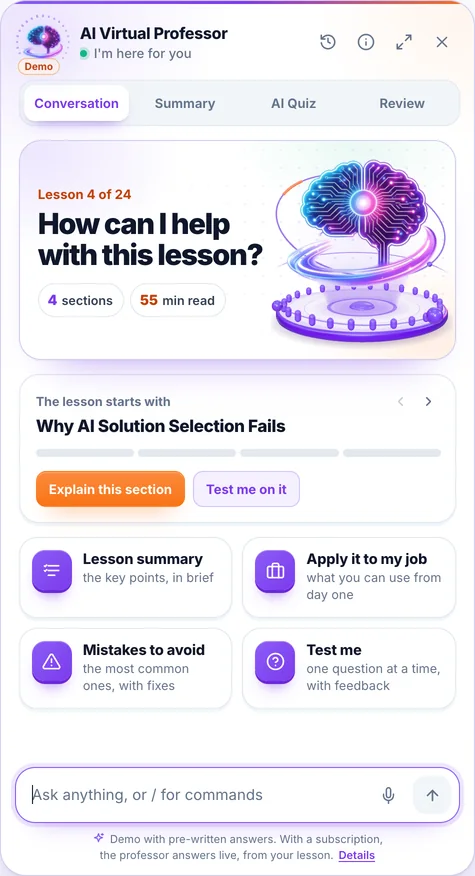
The demo opens on a lesson from the course “AI for Business Leaders”, with prepared answers; voice is off in the demo.
It is an artificial intelligence system, not a human teacher; its answers may contain errors. Details in the Terms & Conditions.
By 2026, artificial intelligence has moved from the innovation slide deck into the daily reality of finance and accounting teams across Europe. Month-end narratives get a first draft in seconds. Invoices are read and coded automatically. Variance explanations that used to eat an afternoon are sketched in a minute. But there is a sharp line between teams that use AI as a disciplined productivity tool and teams that treat it as a magic calculator. This course keeps you firmly on the disciplined side.
The single most important sentence in this whole course is this: AI drafts and accelerates; the qualified professional verifies and decides. Everything else — the prompts, the workflows, the tooling — hangs off that sentence. Read it again, because most of the mistakes finance teams make with AI come from quietly dropping the second half.
An important boundary before we start
This is a course about professional productivity in finance and accounting: reporting, analysis, reconciliation, document processing and automation. It is not a course about investment advice, trading signals, or telling you where to put money. Nothing here is financial, tax, audit or legal advice, and no AI output you generate should be presented as such. When you use AI to explain a variance or draft a note, you are speeding up your professional work — the professional judgment, and the accountability, remain yours and your firm’s.
Keep that boundary in mind whenever a tool markets itself as an "AI CFO" or an "autonomous accountant". In a controlled function like finance, autonomy is not the goal. Traceability, reviewability and control are.
What actually changed by 2026
Three things changed at the same time, and their combination is what makes this moment different from earlier "automation" waves.
- General-purpose reasoning models got good at language work. Modern assistants — Claude (Opus 5.5, Sonnet 5), GPT-6 Sol, Gemini 3.1 Pro — can read a messy trial balance export, follow multi-step instructions, and produce structured, coherent commentary. They are strong at turning numbers you give them into words, and at turning vague requests into organized drafts.
- AI moved inside the tools finance already uses. Microsoft 365 Copilot sits in Excel, Outlook and Teams. Major ERP and accounting platforms (SAP, Oracle NetSuite, Microsoft Dynamics 365, Sage, Xero, QuickBooks and others) have embedded assistants and machine-learning features for coding, matching and anomaly flagging. You increasingly meet AI where the data already lives, which matters enormously for confidentiality.
- The interface became conversational and iterative. You can ask a follow-up, request a different format, or say "show your working". This makes AI feel like a junior analyst you delegate to — which is exactly the right mental model, including the part where you review the junior’s work before it goes out.
What did not change: a language model is not a spreadsheet and not a source of truth. It predicts plausible text. When it does arithmetic in its head, it can be confidently wrong. We will return to this in the next lesson, because it is the foundation of everything.
Pick up exactly where you left off
Pick the option that fits you; your account is created at checkout in under a minute:
What's next in this lesson
- Where AI genuinely lifts finance productivity
- The two failure modes to avoid
- A simple maturity model
- A word on regulation, kept honest
- A realistic first two weeks: three low-risk wins
- What you will be able to do by the end
- Matching the tool to the task
- A concrete picture of the payoff
Everything you'll learn in this course
1 Module 0 — AI in Finance and Accounting: The 2026 Landscape 4 lessons
- What Finance Professionals Need to Know About AI in 2026 Reading now 50 min
- The Golden Rule: AI Drafts, You Verify Every Number 50 min
- Confidentiality, GDPR and Data Governance for Financial Data 50 min
- How to Prompt AI for Finance Work: Patterns, Templates and Verification 50 min
2 Module 1 — Automating Financial Reporting 3 lessons
- Turning Numbers into Narrative: Management Commentary with AI 50 min
- Standardizing Monthly and Board Reporting Packs 50 min
- Variance Analysis and Explanations at Speed 50 min
3 Module 2 — Analyzing and Interpreting Financial Data with AI 3 lessons
- From Raw Ledger to Insight 50 min
- Ratio and Trend Analysis, Verified 50 min
- Asking Good Questions of Your Data 50 min
4 Module 3 — Forecasting and Budgeting, Assisted 3 lessons
- AI-Assisted Forecasting Foundations 50 min
- Driver-Based Budgeting with AI 50 min
- Scenario and Sensitivity Analysis 50 min
5 Module 4 — Reconciliation and AP/AR Automation 3 lessons
- Account Reconciliation with AI 50 min
- Accounts Payable Automation 50 min
- Accounts Receivable and Collections 50 min
6 Module 5 — Expense Management and Document Processing 3 lessons
- Expense Management and Policy Enforcement 50 min
- Invoice and Document Processing: OCR and IDP 50 min
- Contract and Financial Document Review Support 50 min
7 Module 6 — Audit Support and Anomaly Detection 3 lessons
- AI as an Assistive Audit Tool 50 min
- Anomaly and Fraud Detection (Assistive) 50 min
- Internal Controls and Documentation 50 min
8 Module 7 — FP&A and Spreadsheets with AI 3 lessons
- Spreadsheets and Excel with AI 50 min
- FP&A Workflows with AI 50 min
- Dashboards and Self-Service Analytics 50 min
9 Module 8 — Integration, Guardrails and Impact 4 lessons
- Integrating AI with Your ERP 50 min
- Guardrails: Verifying Numbers and Preventing Hallucinations 50 min
- Measuring Impact and Building an AI Finance Policy 50 min
- Capstone: An AI-Assisted Month-End Close, End to End 50 min
10 Final Quiz — AI for Finance and Accounting 1 lessons
- Final Assessment: AI for Finance and Accounting Professionals 44 min
Everything you need to learn effectively
Interactive quizzes
Check your knowledge at the end of every lesson with scored quizzes and feedback.
Personal notes
Save notes on every lesson, accessible anytime from your dashboard.
Scheduled reviews
Revisit lessons exactly when it matters, at the right intervals — so you remember for the long term.
Progress & Achievements
Track your progress, unlock achievements, and visualize what you've learned.
Bookmarks
Save the lessons that matter and find them instantly when you need them.
Questions & Answers
Ask questions right on the lesson and get answers from our team.
Good to know before you start
How do I get access to the course?
You can read the beginning of the first lesson for free, right on this page. For the course you create an account, pick the subscription that fits — a single course or a bundle — and get access immediately after your payment is confirmed. Everything happens 100% online.
Can I cancel my subscription anytime?
Yes. Cancel anytime, straight from your account, in just a few clicks. Your access stays active until the end of the period you have already paid for.
What does the subscription for this course include?
All 30 lessons in the course, interactive quizzes, the AI Professor built into every lesson (select a passage and choose “Explain this to me”), within a fair-use limit, personal notes, automatically saved progress, and content updates included.
Is there a fixed learning schedule?
No. You learn at your own pace, on any device. Lessons are structured step by step, and the platform saves your progress automatically, so you can pick up right where you left off — anytime.
Ready to unlock all the content?
Just this course — €99 / month, VAT included — or every Business course, with smart quizzes and the AI Professor included, in the bundle at €299 / month, VAT included.