What HR Leaders Need to Know About AI in 2026
From the course AI for HR: Recruiting, Onboarding and L&D — Done Compliantly
In every lesson
The AI Professor starts from the lesson you have open
You ask it in writing or by voice, right from the lesson, and you can listen to the answer on request. Where needed, it fills in from general knowledge. When you select a passage, a bar appears with “Explain this to me”, “Give me an example”, “Why does it matter?” and “My own question”.
Its panel has four tabs:
- Conversation: you ask, it answers starting from the lesson
- Summary: the key ideas of the lesson, point by point
- AI Quiz: 3, 5 or 10 new questions from the lesson, with explanations
- Review: flashcards made from the lesson
Included in every subscription and in single-course access, within a fair-use limit.
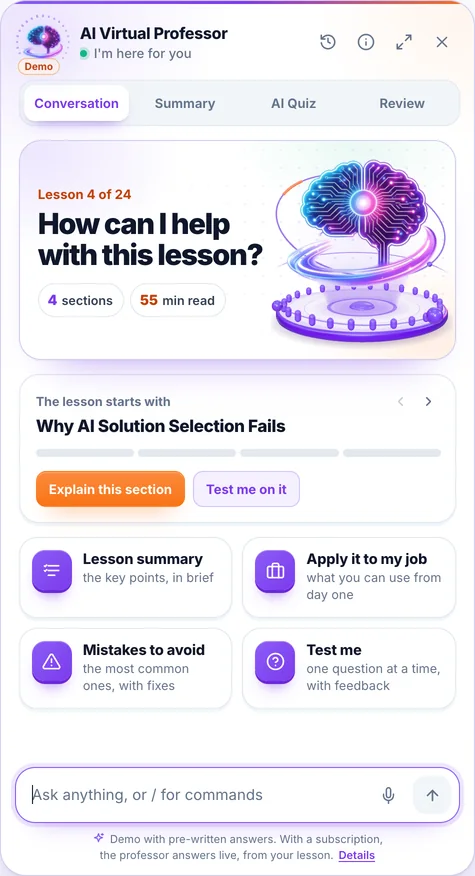
The demo opens on a lesson from the course “AI for Business Leaders”, with prepared answers; voice is off in the demo.
It is an artificial intelligence system, not a human teacher; its answers may contain errors. Details in the Terms & Conditions.
By 2026, artificial intelligence is no longer an experiment sitting in the corner of the HR department. It is woven into the daily workflow of recruiters, people partners, and learning teams across the EU. But there is a wide gap between teams that use AI thoughtfully and compliantly, and teams that treat it as a magic button. This course closes that gap. It teaches you to use AI to assist HR professionals, not to replace human judgment.
This first lesson is your map of the landscape: where AI genuinely helps, where it does not, and the single principle that will keep you out of trouble legally and ethically.
The one-sentence summary of this whole course
AI assists. Humans decide.
Everything else — the prompts, the workflows, the tooling — hangs off that sentence. In the European Union, hiring and HR uses of AI are treated as high-risk under the EU AI Act (Annex III covers employment, worker management, and access to self-employment). That is not a minor detail. It means that when AI touches recruiting, promotion, or termination, you carry real obligations around human oversight, transparency, and data protection. We will cover the legal detail in later modules, but the mindset starts now.
Where AI genuinely helps in HR
The honest answer in 2026 is: AI is excellent at the first draft and the pattern, and weak at the final judgment and the exception. Here is where it delivers real value across the employee lifecycle.
Recruiting
- Drafting job descriptions from a short brief, then flagging biased or exclusionary language.
- Summarizing long CVs and application forms into a consistent, structured brief so a human can compare like with like.
- Generating interview questions tailored to a role and competency framework.
- Drafting candidate communications — invitations, updates, respectful rejections — that a recruiter reviews and personalizes.
Note what is not on that list: deciding who advances. Ranking or auto-rejecting candidates with AI is exactly the high-risk zone regulators are watching.
Onboarding
- Generating personalized 30/60/90-day plans from a role template.
- Answering routine new-hire questions ("How do I book leave?") through a well-governed internal assistant.
- Drafting welcome messages, checklists, and first-week schedules.
Learning and Development (L&D)
- Turning a policy or a subject-matter expert transcript into a first-draft learning module.
- Suggesting personalized learning paths from a skills profile — as a recommendation a human curates.
- Creating knowledge-check questions and practice scenarios.
People analytics
- Summarizing engagement-survey free-text into themes.
- Drafting the narrative around a dashboard a human still interprets.
- Spotting anomalies to investigate, never to act on automatically.
Employee support
- A tier-one internal helpdesk that answers policy questions and escalates anything sensitive to a human.
What AI cannot (and must not) do in HR
Being precise about limits is what separates a professional from an enthusiast.
- It cannot make the final hire, promotion, or termination decision. Under EU AI Act Annex III these are high-risk, and human oversight is mandatory.
- It does not truly understand your context. It predicts plausible text; it does not know your team politics, an individual's circumstances, or an unwritten commitment.
- It can be confidently wrong. Models can fabricate facts, policies, or legal references. Every output touching a person needs a human check.
- It can inherit and amplify bias from training data or from a biased brief you give it.
- It is not a lawyer. Nothing it produces is legal advice. When in doubt, route to compliance or legal counsel.
The 2026 model landscape, briefly
You do not need to memorize model names, but you should know the model families you are likely to meet inside HR tooling in 2026 — Claude, GPT and Gemini (the current generation includes Claude Opus 5.5, Sonnet 5 and Fable 5.1, GPT-6 Sol and Gemini 3.1 Pro) — plus Microsoft 365 Copilot embedded across office suites. Major HR platforms increasingly embed a model from one of these families as an "AI copilot." The important point is not which model — it is how you govern its use.
Pick up exactly where you left off
Pick the option that fits you; your account is created at checkout in under a minute:
What's next in this lesson
- A first practical prompt you can use today
- The decision template: "Should AI touch this task?"
- The economics of "first draft, human final"
- A deeper map: the HR value chain and where AI attaches
- Reading a model's limits in HR terms
- Decision table: should AI touch this HR task?
- Worked scenario: the Monday-morning requisition
- A ready-to-use prompt library
Everything you'll learn in this course
1 Module 0 — The AI and HR Landscape in 2026 3 lessons
- What HR Leaders Need to Know About AI in 2026 Reading now 50 min
- The Modern HR Tech Stack: ATS, HRIS and the AI Layer 50 min
- The Golden Rule of HR AI: AI Assists, Humans Decide 50 min
2 EU AI Act and Compliant HR AI 3 lessons
- Why HR AI Is High-Risk: EU AI Act Annex III Explained 50 min
- Human Oversight, Transparency and Conformity Obligations 50 min
- GDPR, Article 22 and Automated Decisions in HR 50 min
3 AI-Assisted Sourcing and Screening 3 lessons
- Sourcing Candidates with AI — Human-in-the-Loop 50 min
- Screening and Shortlisting Without Discrimination 50 min
- Bias Testing and Mitigation in AI Screening 50 min
4 Writing Job Descriptions and Outreach with AI 3 lessons
- Inclusive, Bias-Aware Job Descriptions with AI 50 min
- Personalized Candidate Outreach at Scale 50 min
- Employer Branding and Recruitment Content with AI 50 min
5 Interviews and Evaluation: Where AI Helps vs Where It Must Not Decide 3 lessons
- Interview Preparation and Structured Questions with AI 50 min
- Interview Notes, Summaries and Scorecards (Assistive Only) 50 min
- The Red Lines: What AI Must Never Decide in Hiring 50 min
6 Automating Onboarding with AI 3 lessons
- Designing an AI-Assisted Onboarding Journey 50 min
- Onboarding Content, Checklists and FAQ Bots 50 min
- Measuring Onboarding Success with AI 50 min
7 Personalized L&D and Upskilling with AI 3 lessons
- Personalized Learning Paths with AI 50 min
- Skills Gap Analysis and Workforce Upskilling 50 min
- AI Tutors, Content Generation and Guardrails 50 min
8 HR Analytics and People Insights 3 lessons
- People Analytics Foundations with AI 50 min
- Retention, Engagement and Attrition Insights — Done Ethically 50 min
- HR Dashboards, Reporting and Explainability 50 min
9 HR Chatbots, Knowledge Base and Employee AI Policy 3 lessons
- Internal HR Chatbots and Knowledge Base 50 min
- AI Usage Guidelines and Policy for Employees 50 min
- Measuring the Impact and ROI of HR AI 50 min
10 Governance and Procurement of HR AI 2 lessons
- Vendor Due Diligence and Deployer Duties: Procuring HR AI 50 min
- Putting It Together: An HR AI Governance Framework 50 min
11 Final Quiz — AI for HR, Done Compliantly 1 lessons
- Final Assessment: AI for HR, Recruiting, Onboarding and L&D 40 min
Everything you need to learn effectively
Interactive quizzes
Check your knowledge at the end of every lesson with scored quizzes and feedback.
Personal notes
Save notes on every lesson, accessible anytime from your dashboard.
Scheduled reviews
Revisit lessons exactly when it matters, at the right intervals — so you remember for the long term.
Progress & Achievements
Track your progress, unlock achievements, and visualize what you've learned.
Bookmarks
Save the lessons that matter and find them instantly when you need them.
Questions & Answers
Ask questions right on the lesson and get answers from our team.
Good to know before you start
How do I get access to the course?
You can read the beginning of the first lesson for free, right on this page. For the course you create an account, pick the subscription that fits — a single course or a bundle — and get access immediately after your payment is confirmed. Everything happens 100% online.
Can I cancel my subscription anytime?
Yes. Cancel anytime, straight from your account, in just a few clicks. Your access stays active until the end of the period you have already paid for.
What does the subscription for this course include?
All 30 lessons in the course, interactive quizzes, the AI Professor built into every lesson (select a passage and choose “Explain this to me”), within a fair-use limit, personal notes, automatically saved progress, and content updates included.
Is there a fixed learning schedule?
No. You learn at your own pace, on any device. Lessons are structured step by step, and the platform saves your progress automatically, so you can pick up right where you left off — anytime.
Ready to unlock all the content?
Just this course — €99 / month, VAT included — or every Business course, with smart quizzes and the AI Professor included, in the bundle at €299 / month, VAT included.