
Why Securing LLM Applications Is Different
From the course AI Security: Defending LLM Applications (OWASP LLM Top 10, Guardrails, Red-Teaming)
In every lesson
The AI Professor starts from the lesson you have open
You ask it in writing or by voice, right from the lesson, and you can listen to the answer on request. Where needed, it fills in from general knowledge. When you select a passage, a bar appears with “Explain this to me”, “Give me an example”, “Why does it matter?” and “My own question”.
Its panel has four tabs:
- Conversation: you ask, it answers starting from the lesson
- Summary: the key ideas of the lesson, point by point
- AI Quiz: 3, 5 or 10 new questions from the lesson, with explanations
- Review: flashcards made from the lesson
Included in every subscription and in single-course access, within a fair-use limit.
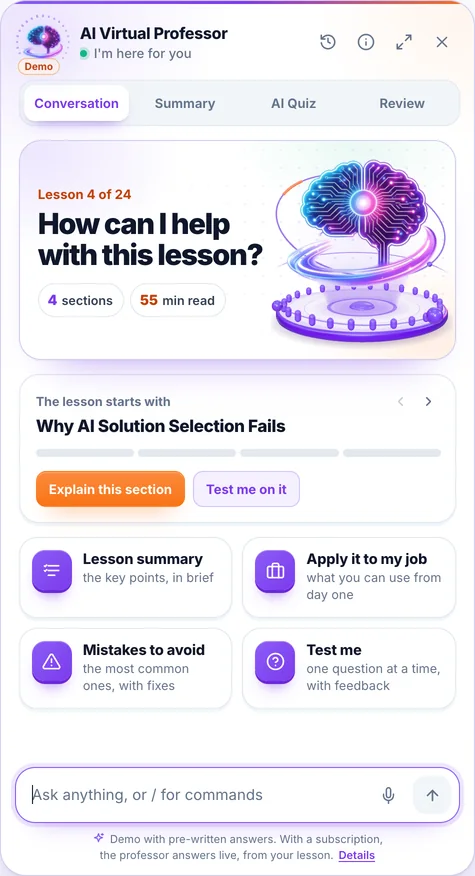
The demo opens on a lesson from the course “AI for Business Leaders”, with prepared answers; voice is off in the demo.
It is an artificial intelligence system, not a human teacher; its answers may contain errors. Details in the Terms & Conditions.
Before you write a single guardrail, you need to internalize why large language model (LLM) applications break the assumptions that classic application security was built on. If you treat an LLM feature like an ordinary web endpoint, you will secure the wrong things and miss the attacks that actually matter. This course is about defending applications you own or are explicitly authorized to test — nothing here is a licence to probe systems that are not yours. With that boundary firmly in place, let us understand the terrain.
The core problem: instructions and data share one channel
In a traditional application, code and user data live in clearly separated lanes. A SQL query is code; the value a user types into a form is data. Decades of security engineering — parameterized queries, output encoding, content security policies — exist to keep those lanes apart. LLMs collapse the separation. The model receives a single stream of tokens, and it cannot reliably tell which tokens are trusted instructions from you and which are untrusted content from the outside world. A support email, a web page fetched by a tool, a PDF uploaded by a user, a row returned from a database — all of it arrives as the same kind of text the model treats as potentially instruction-bearing.
This is the root cause behind the single most important LLM vulnerability class: prompt injection. It is not a bug in one library that a patch will fix. It is a structural property of how current models process language. Your job as a defender is not to make it impossible — no reliable, complete defense against prompt injection exists in 2026 — but to make it hard, to contain the blast radius when it happens, and to detect it fast.
Think of the model as a brilliant but suggestible contractor who reads every note left on their desk and treats any of it as possibly authoritative. You cannot simply tell them "ignore malicious notes," because they cannot always tell which notes are malicious. Instead you control what lands on the desk, what tools the contractor can reach, and who reviews their work before it ships.
Non-determinism defeats classic testing
Traditional security testing leans on determinism: the same input yields the same output, so a fixed test either passes or fails. LLMs are probabilistic. The same prompt can produce different completions across runs, temperatures, and model versions. An attack that fails nine times may succeed on the tenth. A guardrail that blocks a payload today may let a paraphrase through tomorrow. This means your security posture cannot be a one-time checkbox; it must be continuous — repeated red-teaming, monitoring in production, and regression suites that run against every model or prompt change.
There is a second-order consequence. Because outputs vary, a single passing test tells you very little. You need to think in distributions: out of 200 adversarial attempts, how many succeeded? Did a model upgrade move that number in the wrong direction? Security metrics for LLM systems are statistical, not binary, and your reporting has to reflect that.
Pick up exactly where you left off
Pick the option that fits you; your account is created at checkout in under a minute:
What's next in this lesson
- The attack surface is larger than the prompt
- A worked example of the trust confusion
- A defender's mental model
- Where classic AppSec still helps — and where it stops
- Where this maps in the industry
- What "defensive only" means in practice
- The shapes real LLM incidents take
- Your first defensive checklist
Everything you'll learn in this course
1 The LLM Threat Landscape in 2026 3 lessons
- Why Securing LLM Applications Is Different Reading now 50 min
- The OWASP Top 10 for LLM Applications: A Map 50 min
- Threat Modeling LLM Applications 50 min
2 Prompt Injection: The Defining Threat 3 lessons
- Direct Prompt Injection: Anatomy and Mechanics 50 min
- Indirect Prompt Injection: Poisoned Content and RAG 50 min
- A Layered Defense Strategy Against Prompt Injection 50 min
3 Insecure Output Handling and Downstream Exploits 3 lessons
- When Model Output Becomes an Exploit 50 min
- Secure Output: Encoding, Sandboxing, and Least Privilege 50 min
- Structured Output, Schema Validation, and Constrained Decoding 50 min
4 Guardrails: Input and Output Filtering 4 lessons
- Guardrail Architecture: Where and What to Filter 50 min
- Guardrail Tooling: Llama Guard, NeMo Guardrails, Lakera, Rebuff 50 min
- Designing Robust System Prompts 50 min
- Evaluating and Tuning Guardrails: Metrics, False Positives, and Evasion 50 min
5 Securing RAG and Agents: Excessive Agency 4 lessons
- Securing RAG Pipelines 50 min
- Excessive Agency: Tool Abuse and Least Privilege for Agents 50 min
- Human-in-the-Loop, Approvals, and Agent Sandboxing 50 min
- Securing MCP Servers, Tools, and Plugin Ecosystems 50 min
6 Data Protection: PII, Leakage, and Poisoning 3 lessons
- Sensitive Information Disclosure 50 min
- PII Detection, Redaction, and Data Minimization 50 min
- Data and Model Poisoning: Defensive Measures 50 min
7 Supply Chain, Secrets, and Denial of Service 3 lessons
- LLM Supply Chain Security 50 min
- Secrets Management and API Key Hygiene 50 min
- Model Denial of Service and Unbounded Consumption 50 min
8 Red-Teaming Your Own LLM Applications (Authorized) 3 lessons
- Authorized Red-Teaming: Scope, Rules of Engagement, and Ethics 50 min
- Jailbreak Defense 50 min
- Automated and Continuous Red-Teaming 50 min
9 Monitoring, Incident Response, and Compliance 3 lessons
- Observability and Threat Monitoring for LLM Applications 50 min
- Incident Response for AI Systems and Responsible Disclosure 50 min
- Compliance: GDPR, the EU AI Act, and Governance 50 min
10 Final Quiz — Defending LLM Applications 1 lessons
- Final Assessment — AI Security: Defending LLM Applications 45 min
Everything you need to learn effectively
Interactive quizzes
Check your knowledge at the end of every lesson with scored quizzes and feedback.
Personal notes
Save notes on every lesson, accessible anytime from your dashboard.
Scheduled reviews
Revisit lessons exactly when it matters, at the right intervals — so you remember for the long term.
Progress & Achievements
Track your progress, unlock achievements, and visualize what you've learned.
Bookmarks
Save the lessons that matter and find them instantly when you need them.
Questions & Answers
Ask questions right on the lesson and get answers from our team.
Good to know before you start
How do I get access to the course?
You can read the beginning of the first lesson for free, right on this page. For the course you create an account, pick the subscription that fits — a single course or a bundle — and get access immediately after your payment is confirmed. Everything happens 100% online.
Can I cancel my subscription anytime?
Yes. Cancel anytime, straight from your account, in just a few clicks. Your access stays active until the end of the period you have already paid for.
What does the subscription for this course include?
All 30 lessons in the course, interactive quizzes, the AI Professor built into every lesson (select a passage and choose “Explain this to me”), within a fair-use limit, personal notes, automatically saved progress, and content updates included.
Is there a fixed learning schedule?
No. You learn at your own pace, on any device. Lessons are structured step by step, and the platform saves your progress automatically, so you can pick up right where you left off — anytime.
Ready to unlock all the content?
Just this course — €99 / month, VAT included — or every IT Pro course, with smart quizzes and the AI Professor included, in the bundle at €399 / month, VAT included.