
From Problem to AI Product: Validating the Idea
From the course Build and Ship a Production AI SaaS: From Idea to Paying Users
In every lesson
The AI Professor starts from the lesson you have open
You ask it in writing or by voice, right from the lesson, and you can listen to the answer on request. Where needed, it fills in from general knowledge. When you select a passage, a bar appears with “Explain this to me”, “Give me an example”, “Why does it matter?” and “My own question”.
Its panel has four tabs:
- Conversation: you ask, it answers starting from the lesson
- Summary: the key ideas of the lesson, point by point
- AI Quiz: 3, 5 or 10 new questions from the lesson, with explanations
- Review: flashcards made from the lesson
Included in every subscription and in single-course access, within a fair-use limit.
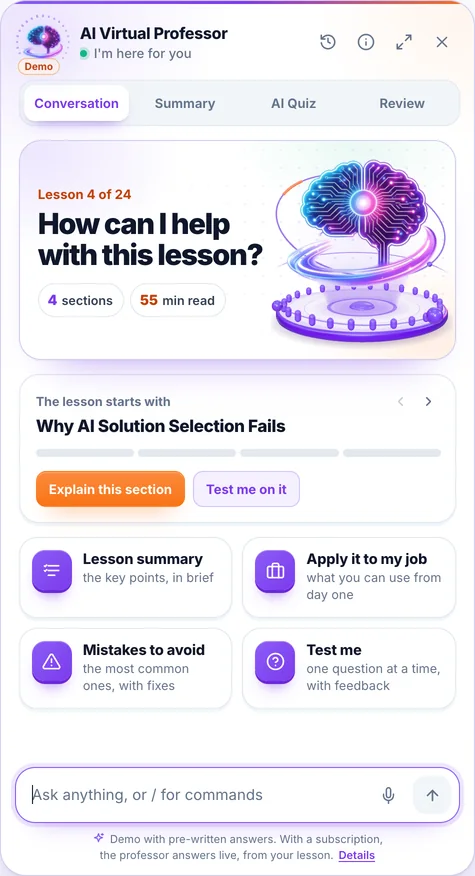
The demo opens on a lesson from the course “AI for Business Leaders”, with prepared answers; voice is off in the demo.
It is an artificial intelligence system, not a human teacher; its answers may contain errors. Details in the Terms & Conditions.
Most AI SaaS products fail long before a single line of production code is a bottleneck. They fail because they solve a problem nobody will pay to solve, or because a large language model was bolted onto a workflow that did not need one. This first lesson is about earning the right to build: validating that there is a real, painful, recurring problem, that AI is genuinely the best tool for it, and that someone will open their wallet. Everything technical in the rest of this course only matters if you clear this bar first.
Start with a problem, not with a model
The single most common failure mode in 2026 is "model-first" thinking: a team is impressed by Claude Opus 5.5 or GPT-6 Sol, decides to "use AI," and then hunts for a problem to attach it to. This gets the causality backwards. Durable products start from a specific, expensive, repeated pain in a specific group of people, and only then ask whether an LLM is the right instrument.
A useful framing is the job to be done. People do not want an "AI assistant"; they want a contract reviewed in ten minutes instead of two hours, a support queue triaged before the morning standup, or a pile of PDFs turned into a searchable answer. Write the job as a sentence a customer would actually say. If you cannot, you do not understand the problem yet.
Where AI genuinely earns its place
LLMs are not a universal upgrade. They add real value where a task is (1) language- or reasoning-heavy, (2) tolerant of some imperfection or has a human in the loop, and (3) previously required expensive human judgment at a scale that made it a bottleneck. Summarization, extraction from messy documents, classification of free text, drafting, code assistance, and natural-language interfaces over structured data are strong fits.
They are a poor fit where you need deterministic correctness with zero tolerance (accounting totals, legal filings without review), where a simple rule or regex already works, or where latency and cost per call would destroy the unit economics. A frequent and costly mistake is using a 200-billion-parameter model to do a job a switch statement or a small classifier would do faster, cheaper, and more reliably. Part of validation is honestly asking: does this need an LLM, or does it just need software?
The validation loop
Validation is a loop you run before building, and keep running after. A practical sequence:
- Interview the pain. Talk to ten to twenty people who have the problem. Do not pitch; ask how they solve it today, how long it takes, what it costs them, and what they have already tried. You are listening for a workaround they hate and pay for in time or money.
- Quantify the pain. Attach numbers: hours per week, dollars per month, error rates, deals lost. A problem worth a SaaS subscription usually costs the customer meaningfully more than your price.
- Prototype the smallest test. Before infrastructure, test the core AI capability in a notebook or a throwaway script against real customer data (with permission). Can the model actually do the hard part at acceptable quality? If not, no amount of engineering saves you.
- Sell before you build. Get a verbal or written commitment, a pre-order, a paid pilot, or a signed letter of intent. Demand is the only validation that counts.
Pick up exactly where you left off
Pick the option that fits you; your account is created at checkout in under a minute:
What's next in this lesson
- Wizard-of-Oz and concierge tests
- Signals that you have real validation
- Anti-signals to respect
- A worked example
- This is not legal advice
- A structured interview script you can reuse
- The value equation: why willingness to pay is not about features
- Decision table: is this worth building?
Everything you'll learn in this course
1 Idea and Product Validation for an AI SaaS 3 lessons
- From Problem to AI Product: Validating the Idea Reading now 50 min
- Scoping the MVP and Where AI Adds Real Value 50 min
- Unit Economics: Cost per User from Day One 50 min
2 Choosing Your Stack: Frontend, Backend, and LLM APIs 3 lessons
- The 2026 AI SaaS Stack: Next.js, Backend, and Data 50 min
- Choosing Your LLM Provider and Models for 2026 51 min
- Data Layer: Postgres, pgvector, and Managed Services 51 min
3 Integrating the LLM: Streaming, Tools, and Cost Control 4 lessons
- Streaming Responses and the Chat UX 50 min
- Function Calling and Tool Use in Production 51 min
- Cost Control: Token Budgets, Caching, and Routing 51 min
- Designing the AI User Experience: Trust, Feedback, and Graceful Failure 50 min
4 Vector Search and RAG for Your Product 3 lessons
- RAG Architecture for a SaaS Product 51 min
- Building the Ingestion and Retrieval Pipeline 51 min
- Multi-Tenant RAG: Isolating Customer Data 51 min
5 Authentication and Multi-Tenancy 3 lessons
- Authentication with Auth.js and Clerk 50 min
- Multi-Tenancy Patterns and Data Isolation 51 min
- Authorization, Roles, and Row-Level Security 51 min
6 Billing with Stripe: Subscriptions, Webhooks, and Usage 3 lessons
- Stripe Subscriptions: Products, Prices, and Checkout 50 min
- Webhooks and Keeping Your Database in Sync 51 min
- Usage-Based Billing and Metering AI Consumption 50 min
7 Rate Limiting and Abuse Prevention 3 lessons
- Rate Limiting Strategies and Implementation 50 min
- Abuse, Fraud, and Prompt-Injection Defense 51 min
- Quotas, Fair Use, and Protecting the Free Tier 50 min
8 Observability and Evaluations in Production 4 lessons
- Logging, Tracing, and LLM Observability 51 min
- Evals: Measuring Quality in Production 52 min
- Incident Response and On-Call for AI Features 50 min
- SaaS Metrics and Analytics: Measuring an AI Business 51 min
9 Deployment, Security, and Go-to-Market 3 lessons
- Deploying: Vercel, Containers, and Cloud 51 min
- Security, Secrets, and Compliance 52 min
- Minimal Go-to-Market and Scaling Costs 51 min
10 Final Quiz — Build and Ship a Production AI SaaS 1 lessons
- Final Assessment — From Idea to Paying Users 45 min
Everything you need to learn effectively
Interactive quizzes
Check your knowledge at the end of every lesson with scored quizzes and feedback.
Personal notes
Save notes on every lesson, accessible anytime from your dashboard.
Scheduled reviews
Revisit lessons exactly when it matters, at the right intervals — so you remember for the long term.
Progress & Achievements
Track your progress, unlock achievements, and visualize what you've learned.
Bookmarks
Save the lessons that matter and find them instantly when you need them.
Questions & Answers
Ask questions right on the lesson and get answers from our team.
Good to know before you start
How do I get access to the course?
You can read the beginning of the first lesson for free, right on this page. For the course you create an account, pick the subscription that fits — a single course or a bundle — and get access immediately after your payment is confirmed. Everything happens 100% online.
Can I cancel my subscription anytime?
Yes. Cancel anytime, straight from your account, in just a few clicks. Your access stays active until the end of the period you have already paid for.
What does the subscription for this course include?
All 30 lessons in the course, interactive quizzes, the AI Professor built into every lesson (select a passage and choose “Explain this to me”), within a fair-use limit, personal notes, automatically saved progress, and content updates included.
Is there a fixed learning schedule?
No. You learn at your own pace, on any device. Lessons are structured step by step, and the platform saves your progress automatically, so you can pick up right where you left off — anytime.
Ready to unlock all the content?
Just this course — €99 / month, VAT included — or every IT Pro course, with smart quizzes and the AI Professor included, in the bundle at €399 / month, VAT included.