
Why AI Belongs in the Modern SOC
From the course AI for Cybersecurity: Threat Detection and SOC Operations
In every lesson
The AI Professor starts from the lesson you have open
You ask it in writing or by voice, right from the lesson, and you can listen to the answer on request. Where needed, it fills in from general knowledge. When you select a passage, a bar appears with “Explain this to me”, “Give me an example”, “Why does it matter?” and “My own question”.
Its panel has four tabs:
- Conversation: you ask, it answers starting from the lesson
- Summary: the key ideas of the lesson, point by point
- AI Quiz: 3, 5 or 10 new questions from the lesson, with explanations
- Review: flashcards made from the lesson
Included in every subscription and in single-course access, within a fair-use limit.
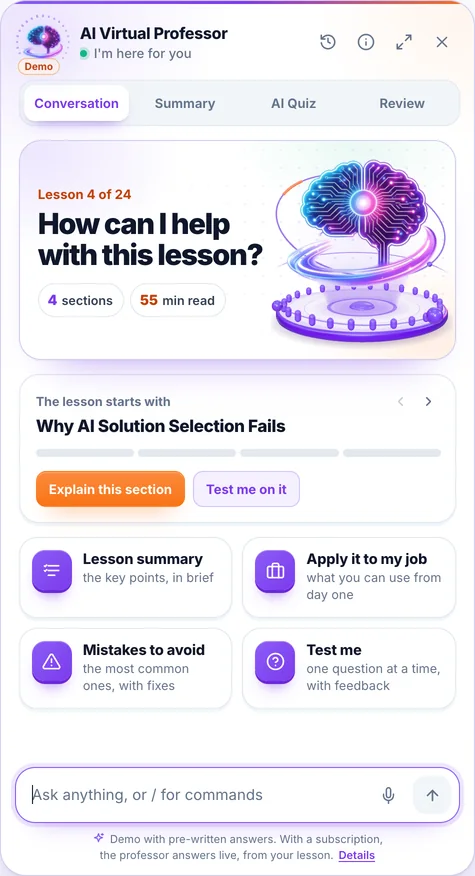
The demo opens on a lesson from the course “AI for Business Leaders”, with prepared answers; voice is off in the demo.
It is an artificial intelligence system, not a human teacher; its answers may contain errors. Details in the Terms & Conditions.
Security Operations Centres in 2026 are drowning in data. A mid-sized enterprise routinely generates tens of billions of log events per day across endpoints, identity providers, cloud control planes, network sensors, SaaS applications and email gateways. No human team can read that. The central problem of defensive security has quietly shifted from collecting telemetry to making sense of it fast enough to matter. That is precisely the gap artificial intelligence is meant to close — and this course is about closing it responsibly, with your eyes open to both the power and the failure modes of the tools involved.
Scope and ethics note: This is a defensive, blue-team course. Everything here is for protecting systems your organisation owns or that you are explicitly authorised to defend. We do not teach unauthorised offensive techniques. We do cover how attackers use AI, but only so you can detect and withstand it. Automated response must always respect human oversight, data-protection law such as the GDPR, and responsible disclosure. This course is educational and is not legal advice.
What a SOC actually does
A Security Operations Centre is the team, process and tooling responsible for detecting, investigating and responding to cyber threats against an organisation. Its core loop is often summarised as detect, triage, investigate, respond, recover, and learn. Analysts watch a stream of alerts produced by detection tooling, decide which are real, dig into the ones that matter, contain and remediate genuine incidents, and feed lessons back into better detections.
SOC teams are usually described in tiers. Tier 1 analysts handle initial triage: they look at incoming alerts and separate obvious noise from things that need a closer look. Tier 2 analysts perform deeper investigation, correlating events across systems and confirming whether an incident is real. Tier 3 covers threat hunting, detection engineering and incident response for the hardest cases. Around the analyst tiers sit supporting roles you will meet throughout this course: detection engineers who write and tune the rules and models that generate alerts, threat intelligence analysts who track adversary behaviour outside the organisation, and SOC managers who own metrics, staffing and process.
Two structural facts shape everything else. First, Tier 1 work is repetitive, high-volume and a leading cause of burnout — the industry has discussed analyst attrition for years, and any tooling that reduces triage toil has direct human value. Second, the pipeline from raw event to confirmed incident is where most organisations lose time they cannot afford. An alert that sits unreviewed in a queue for six hours is, operationally, a detection that took six hours longer than it should have. It is worth knowing that some mature teams now run a "tierless" or engineering-led SOC, where the same people rotate between triage, hunting and detection engineering precisely so that triage pain feeds directly into better automation. AI accelerates that flywheel; it does not replace the need for it.
The problems AI is asked to solve
Three chronic problems define SOC work, and each maps to something AI does well.
- Volume. The sheer number of events far exceeds human capacity. Machine learning can score, cluster and prioritise events at a scale no analyst can match, surfacing the small fraction worth human attention. The point is not that the model is smarter than the analyst — it usually is not — but that it never gets tired and can look at everything.
- Alert fatigue and false positives. Traditional signature and rule-based detections produce enormous numbers of false positives. When analysts face hundreds of low-quality alerts, real threats hide in the noise and get missed. AI-assisted triage and correlation aim to raise signal-to-noise so humans spend their attention where it counts.
- Speed. Attackers move quickly; the time from initial access to serious impact can be short. Reducing dwell time — how long an adversary is present before detection — and shortening detection and response times are the numbers a SOC lives or dies by. Automation and machine-speed enrichment directly attack those metrics.
Pick up exactly where you left off
Pick the option that fits you; your account is created at checkout in under a minute:
What's next in this lesson
- The metrics a SOC lives by
- What "AI in the SOC" concretely means
- A tale of two triages
- Why now, and why it was harder before
- What honest expectations look like
- Common pitfalls when introducing AI to a SOC
- Where this course goes
Everything you'll learn in this course
1 AI in Cybersecurity 2026 and the Threat Landscape 3 lessons
- Why AI Belongs in the Modern SOC Reading now 50 min
- The 2026 Threat Landscape and the Defender Dilemma 50 min
- Where AI Helps and Where It Does Not 50 min
2 The Modern SOC and AI-Augmented SIEM 4 lessons
- Anatomy of a Modern SOC 50 min
- SIEM in 2026: Splunk, Sentinel and Elastic 50 min
- Adding AI to the SIEM Workflow 50 min
- Security Data Engineering: Pipelines, Normalisation and Data Quality 50 min
3 Anomaly Detection and UEBA 3 lessons
- Anomaly Detection Foundations for Security 50 min
- UEBA: User and Entity Behaviour Analytics 50 min
- Baselines, Drift and Keeping Models Honest 50 min
4 Threat Detection and Threat Hunting with AI 4 lessons
- Detection Engineering with MITRE ATT&CK 50 min
- Machine Learning Detection Models in Practice 50 min
- AI-Assisted Threat Hunting 50 min
- Measuring Detection Quality: Metrics, Base Rates and Validation 50 min
5 Alert Triage and Reducing False Positives 3 lessons
- The False Positive Problem and Alert Fatigue 50 min
- AI-Assisted Triage, Correlation and Enrichment 50 min
- Risk-Based Alerting and Prioritisation 50 min
6 SOAR Automation and Safe Response 4 lessons
- SOAR Fundamentals and Playbooks 50 min
- AI in the Response Loop: Enrichment and Decisioning 50 min
- Human Oversight and Safe Automation Guardrails 50 min
- AI-Assisted Incident Response and Reporting 50 min
7 Detecting Threats: Logs, Network, Malware and Phishing 3 lessons
- Log and Network Analysis with AI/ML 50 min
- Malware Detection with Machine Learning 50 min
- Phishing and Business Email Compromise Detection 50 min
8 Threat Intelligence and Vulnerability Management 2 lessons
- AI for Threat Intelligence 50 min
- Risk-Based Vulnerability Management 50 min
9 Copilots, Adversarial AI and Governance 3 lessons
- AI Copilots for Security Analysts 50 min
- Adversarial AI: How Attackers Use AI 50 min
- Governance, Privacy and Guardrails 50 min
10 Final Quiz — AI for Cybersecurity and SOC Operations 1 lessons
- Final Assessment — AI for Cybersecurity: Threat Detection and SOC Operations 55 min
Everything you need to learn effectively
Interactive quizzes
Check your knowledge at the end of every lesson with scored quizzes and feedback.
Personal notes
Save notes on every lesson, accessible anytime from your dashboard.
Scheduled reviews
Revisit lessons exactly when it matters, at the right intervals — so you remember for the long term.
Progress & Achievements
Track your progress, unlock achievements, and visualize what you've learned.
Bookmarks
Save the lessons that matter and find them instantly when you need them.
Questions & Answers
Ask questions right on the lesson and get answers from our team.
Good to know before you start
How do I get access to the course?
You can read the beginning of the first lesson for free, right on this page. For the course you create an account, pick the subscription that fits — a single course or a bundle — and get access immediately after your payment is confirmed. Everything happens 100% online.
Can I cancel my subscription anytime?
Yes. Cancel anytime, straight from your account, in just a few clicks. Your access stays active until the end of the period you have already paid for.
What does the subscription for this course include?
All 30 lessons in the course, interactive quizzes, the AI Professor built into every lesson (select a passage and choose “Explain this to me”), within a fair-use limit, personal notes, automatically saved progress, and content updates included.
Is there a fixed learning schedule?
No. You learn at your own pace, on any device. Lessons are structured step by step, and the platform saves your progress automatically, so you can pick up right where you left off — anytime.
Ready to unlock all the content?
Just this course — €99 / month, VAT included — or every IT Pro course, with smart quizzes and the AI Professor included, in the bundle at €399 / month, VAT included.