
What Teachers Need to Know About AI in 2026
From the course AI for Educators and Teachers
In every lesson
The AI Professor starts from the lesson you have open
You ask it in writing or by voice, right from the lesson, and you can listen to the answer on request. Where needed, it fills in from general knowledge. When you select a passage, a bar appears with “Explain this to me”, “Give me an example”, “Why does it matter?” and “My own question”.
Its panel has four tabs:
- Conversation: you ask, it answers starting from the lesson
- Summary: the key ideas of the lesson, point by point
- AI Quiz: 3, 5 or 10 new questions from the lesson, with explanations
- Review: flashcards made from the lesson
Included in every subscription and in single-course access, within a fair-use limit.
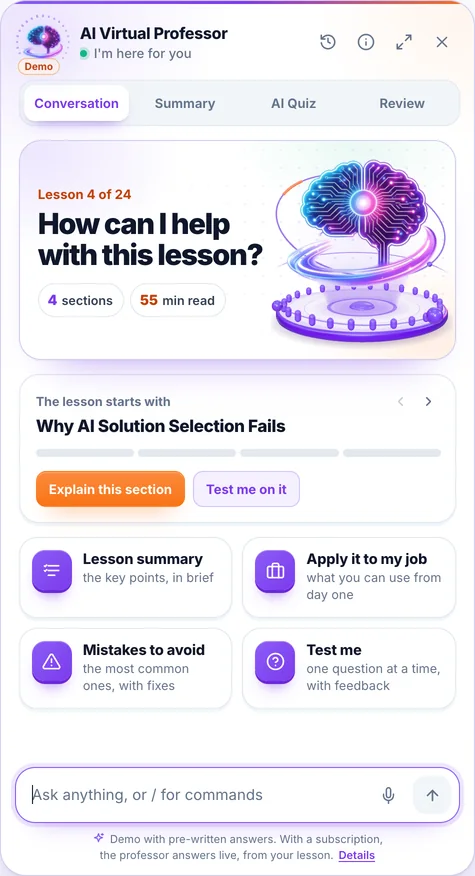
The demo opens on a lesson from the course “AI for Business Leaders”, with prepared answers; voice is off in the demo.
It is an artificial intelligence system, not a human teacher; its answers may contain errors. Details in the Terms & Conditions.
If you have ever stayed up past midnight writing lesson plans, adapting a worksheet for three different reading levels, or grading a stack of essays with your eyes half closed, this course is for you. Artificial intelligence will not teach your class — you do that, and no tool can replace the relationship you build with your students. But in 2026, AI can quietly hand back several hours of your week and help you reach learners you were struggling to reach. That is what this course is about: using AI as a well-behaved teaching assistant that drafts, adapts, and organizes, while you stay firmly in charge.
This first lesson is your map. It shows where AI genuinely helps a teacher, where it must never be trusted, the single principle that keeps you safe legally and professionally, and a practical way to decide, task by task, whether AI should touch a piece of work at all.
The one sentence that runs through this whole course
AI assists. The teacher decides.
Everything else — the prompts, the workflows, the templates — hangs off that sentence. AI is superb at producing a first draft and spotting a pattern. It is weak at final judgment and at the exception — the individual child, the sensitive situation, the professional call only you can make. Keep that distinction in mind and you will use AI well. Forget it, and you will get into trouble.
It helps to be concrete about what "assists" and "decides" mean in a school day. AI assists when it turns your rough notes into a worksheet you then edit, when it suggests three ways to explain fractions, or when it drafts a newsletter paragraph you rewrite in your own voice. You decide when you choose which explanation your class will actually understand, when you set a final grade, when you judge whether a struggling reader is ready to move on. The moment a task crosses from "produce a draft" into "make a call about a specific student," authority returns to you and stays there.
Why AI can help teachers now — a plain explanation of the mechanism
You do not need to be technical to use AI well, but a one-paragraph mental model prevents most mistakes. Modern AI assistants are large language models: systems trained on enormous amounts of text that learn to predict the most plausible next words given what came before. That single fact explains both their power and their danger. Because they have absorbed so much writing, they are extraordinarily good at producing fluent, structured, on-topic text — a lesson plan, a rubric, a parent email — in seconds. But because they predict plausible text rather than retrieve verified truth, they can state something false with the same confident fluency as something true. A model is a brilliant drafter and a poor witness. Treat every factual claim as a draft to verify, and you have the correct posture.
Where AI genuinely helps a teacher
The honest 2026 answer is that AI shines on the repetitive, first-draft, and adaptation work that eats your evenings. Here is where it delivers real value.
Planning
- Turning a topic and a year group into a first-draft lesson plan with objectives, activities, and timings.
- Building a scope and sequence for a unit so you can see the whole arc at a glance.
- Suggesting hooks, analogies, and real-world examples to explain a hard idea.
Pick up exactly where you left off
Pick the option that fits you; your account is created at checkout in under a minute:
What's next in this lesson
- Making materials
- Reaching every learner
- Assessment and feedback
- Communication and admin
- What AI cannot and must not do in teaching
- The 2026 tool landscape, briefly
- A first prompt you can use today
- The four-question filter: should AI touch this task?
Everything you'll learn in this course
1 Module 0 — AI in Education: The 2026 Landscape 3 lessons
- What Teachers Need to Know About AI in 2026 Reading now 49 min
- The Educator's AI Toolkit and How to Prompt Well 49 min
- Choosing and Setting Up AI Tools Safely 49 min
2 Module 1 — Lesson Planning and Curriculum with AI 4 lessons
- From Brief to Full Lesson Plan 49 min
- Curriculum Units, Scope and Sequence 49 min
- Learning Objectives, Standards and Backward Design 49 min
- Homework, Retrieval Practice and Spaced Review with AI 49 min
3 Module 2 — Creating Teaching Materials and Resources 4 lessons
- Worksheets, Handouts and Slide Decks 49 min
- Reading Passages, Examples and Analogies 49 min
- Visuals and Presentations with AI 49 min
- Building a Reusable Prompt and Template Library 49 min
4 Module 3 — Differentiation and Personalized Learning 3 lessons
- Differentiating for Every Learner 49 min
- Scaffolding and Tiered Materials 49 min
- Personalized Learning Paths and Student Choice 49 min
5 Module 4 — Assessment, Feedback and Grading 4 lessons
- Creating Quizzes and Assessments 49 min
- Rubrics That Actually Work 49 min
- AI-Assisted Feedback and Grading: Human in the Loop 49 min
- Making Sense of Assessment Data with AI 49 min
6 Module 5 — Inclusive Education and Special Needs 2 lessons
- Accessibility and Supporting Special Educational Needs 49 min
- Multilingual Learners and Language Support 49 min
7 Module 6 — Teaching AI Literacy to Students 2 lessons
- What AI Literacy Means and Why It Matters 49 min
- Age-Appropriate AI Lessons and Critical Thinking 49 min
8 Module 7 — Academic Integrity and Communication 4 lessons
- Academic Integrity in the AI Age 49 min
- AI Detection Tools: Why They Fail and What to Do Instead 49 min
- Designing AI-Resilient Assignments 49 min
- Parent Communication and Administrative Productivity 49 min
9 Module 8 — Responsible and Compliant AI in Education 4 lessons
- Student Data Privacy, GDPR and Protecting Minors 49 min
- Bias, Equity and the EU AI Act in Education 49 min
- Your Classroom AI Policy and Guardrails 49 min
- Building Your Personal AI Teaching Workflow 49 min
10 Final Quiz — AI for Educators and Teachers 1 lessons
- Final Assessment: AI for Educators and Teachers 33 min
Everything you need to learn effectively
Interactive quizzes
Check your knowledge at the end of every lesson with scored quizzes and feedback.
Personal notes
Save notes on every lesson, accessible anytime from your dashboard.
Scheduled reviews
Revisit lessons exactly when it matters, at the right intervals — so you remember for the long term.
Progress & Achievements
Track your progress, unlock achievements, and visualize what you've learned.
Bookmarks
Save the lessons that matter and find them instantly when you need them.
Questions & Answers
Ask questions right on the lesson and get answers from our team.
Good to know before you start
How do I get access to the course?
You can read the beginning of the first lesson for free, right on this page. For the course you create an account, pick the subscription that fits — a single course or a bundle — and get access immediately after your payment is confirmed. Everything happens 100% online.
Can I cancel my subscription anytime?
Yes. Cancel anytime, straight from your account, in just a few clicks. Your access stays active until the end of the period you have already paid for.
What does the subscription for this course include?
All 31 lessons in the course, interactive quizzes, the AI Professor built into every lesson (select a passage and choose “Explain this to me”), within a fair-use limit, personal notes, automatically saved progress, and content updates included.
Is there a fixed learning schedule?
No. You learn at your own pace, on any device. Lessons are structured step by step, and the platform saves your progress automatically, so you can pick up right where you left off — anytime.
Ready to unlock all the content?
Just this course — €99 / month, VAT included — or every Business course, with smart quizzes and the AI Professor included, in the bundle at €299 / month, VAT included.