
What Computer Vision Is and the 2026 Landscape
From the course Computer Vision with AI: From Detection to Multimodal Understanding
In every lesson
The AI Professor starts from the lesson you have open
You ask it in writing or by voice, right from the lesson, and you can listen to the answer on request. Where needed, it fills in from general knowledge. When you select a passage, a bar appears with “Explain this to me”, “Give me an example”, “Why does it matter?” and “My own question”.
Its panel has four tabs:
- Conversation: you ask, it answers starting from the lesson
- Summary: the key ideas of the lesson, point by point
- AI Quiz: 3, 5 or 10 new questions from the lesson, with explanations
- Review: flashcards made from the lesson
Included in every subscription and in single-course access, within a fair-use limit.
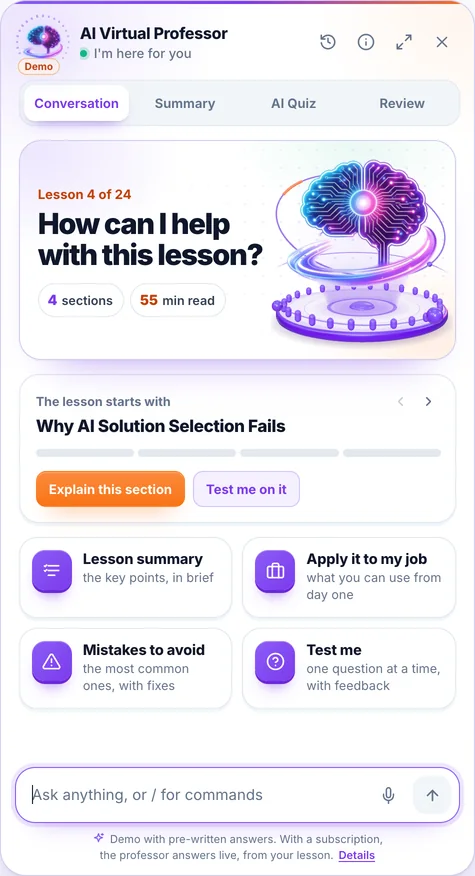
The demo opens on a lesson from the course “AI for Business Leaders”, with prepared answers; voice is off in the demo.
It is an artificial intelligence system, not a human teacher; its answers may contain errors. Details in the Terms & Conditions.
Computer vision (CV) is the engineering discipline that builds systems able to extract meaning from images and video. Where a human glances at a photo and instantly parses objects, text, faces, depth, and intent, a computer starts with nothing but a grid of numbers. The entire field is about turning that raw numeric grid into structured understanding: a class label, a set of bounding boxes, a pixel-accurate mask, a caption, a 3D pose, or a decision that drives an action. This first lesson frames the field as it stands in 2026 and hands you the map you will follow for the rest of the course.
From pixels to meaning: the core abstraction
At the lowest level, a digital image is a tensor of intensities. A grayscale image is a 2D array of shape (height, width); a standard color image is a 3D array of shape (height, width, 3) holding red, green, and blue channel values, each typically an 8-bit integer in the range 0-255. A one-minute video at 30 frames per second is simply 1,800 such tensors in sequence. Every computer vision task, no matter how sophisticated, is ultimately a function that maps this tensor to some output:
- Classification maps the tensor to one label (or a probability distribution over labels).
- Detection maps it to a list of bounding boxes, each with a label and a confidence.
- Segmentation maps it to a per-pixel label map — every pixel gets a class or an instance ID.
- Captioning / visual question answering maps it to a sequence of words.
- Pose / depth estimation maps it to keypoints or a per-pixel distance.
Keep this mental model — tensor in, structured output out — because it anchors everything that follows. When a model confuses you, ask what its input tensor is and what structure it must produce; the architecture is just the machine that connects the two.
The following table makes the mapping concrete and previews the whole course. Read it as a lookup you will return to whenever you are unsure which family of model a problem belongs to.
| Task | Input | Output structure | Typical 2026 model |
|---|---|---|---|
| Classification | One image | One label / probability vector | CNN (ResNet, ConvNeXt) or ViT |
| Object detection | One image | List of (box, class, score) | YOLO, DETR, RT-DETR |
| Semantic segmentation | One image | Per-pixel class map | DeepLab, Mask2Former, SAM |
| Instance/panoptic segmentation | One image | Per-object masks + classes | Mask2Former, YOLO-seg |
| Keypoint / pose | One image | Coordinates of joints/landmarks | YOLO-pose, ViTPose |
| Depth / 3D | One or more images | Per-pixel distance / point cloud | Depth Anything-style monocular models |
| Captioning / VQA | Image + optional text | Text answer | GPT-6 Sol, Gemini 3.1 Pro, Claude vision |
| Generation | Text (or image) prompt | New image | Diffusion models |
Notice that the input tensor is nearly always the same grid of numbers; what changes is the structure the model is asked to produce and, therefore, the head and training objective bolted onto a shared backbone. This is why a strong image backbone is reusable across so many tasks — a theme we return to with transfer learning.
The two eras of computer vision
Pick up exactly where you left off
Pick the option that fits you; your account is created at checkout in under a minute:
What's next in this lesson
- The 2026 landscape: what actually ships
- Where computer vision is deployed
- A word on responsibility from lesson one
- A worked mental exercise: framing a problem
- What the frontier can and cannot do in 2026
- How this course is structured
Everything you'll learn in this course
1 Foundations of Computer Vision in 2026 3 lessons
- What Computer Vision Is and the 2026 Landscape Reading now 48 min
- How Images Are Represented: Pixels, Channels, and Color Spaces 48 min
- The Modern CV Stack: OpenCV, PyTorch, and the Ecosystem 48 min
2 Image Preprocessing and Datasets with OpenCV 4 lessons
- Loading, Displaying, and Geometric Transformations 49 min
- Filtering, Edges, and Classical Feature Detection 49 min
- Data Augmentation and Preprocessing Pipelines 49 min
- Building, Annotating, and Auditing Vision Datasets 49 min
3 Convolutional Neural Networks for Classification 3 lessons
- Convolutional Neural Networks Explained 50 min
- Building and Training a CNN Classifier in PyTorch 50 min
- Transfer Learning and Fine-Tuning Pretrained Backbones 50 min
4 Object Detection 4 lessons
- Object Detection Fundamentals: Boxes, IoU, NMS 50 min
- YOLO in Practice 50 min
- DETR and Transformer-Based Detection 50 min
- Pose Estimation and Keypoint Detection 49 min
5 Segmentation and Segment Anything 3 lessons
- Semantic, Instance, and Panoptic Segmentation 50 min
- Segment Anything: Promptable Segmentation with SAM 3.1 50 min
- Training and Evaluating Segmentation Models 49 min
6 Vision Transformers and Multimodal Models 4 lessons
- Vision Transformers (ViT) Explained 50 min
- Vision-Language Models: CLIP to Modern VLMs 50 min
- Using Vision-Language Models in Practice 50 min
- Self-Supervised Learning and Vision Foundation Models 49 min
7 OCR, Documents, Faces, and the Law 3 lessons
- OCR and Document Understanding 50 min
- Face Detection and Recognition: Technology and Legal Duties 50 min
- Legal and Ethical Computer Vision 49 min
8 Video, Tracking, 3D, and Generative Vision 3 lessons
- Video Analysis and Object Tracking 50 min
- 3D Vision and Depth Estimation 49 min
- Generative Vision: Diffusion Models Basics 49 min
9 Evaluation, Deployment, and Production MLOps 3 lessons
- Evaluating Computer Vision Systems 49 min
- Deployment and Edge Optimization 50 min
- Monitoring, Drift, and Production MLOps for Vision 49 min
10 Final Quiz - Computer Vision with AI 1 lessons
- Final Assessment - Computer Vision with AI 45 min
Everything you need to learn effectively
Interactive quizzes
Check your knowledge at the end of every lesson with scored quizzes and feedback.
Personal notes
Save notes on every lesson, accessible anytime from your dashboard.
Scheduled reviews
Revisit lessons exactly when it matters, at the right intervals — so you remember for the long term.
Progress & Achievements
Track your progress, unlock achievements, and visualize what you've learned.
Bookmarks
Save the lessons that matter and find them instantly when you need them.
Questions & Answers
Ask questions right on the lesson and get answers from our team.
Good to know before you start
How do I get access to the course?
You can read the beginning of the first lesson for free, right on this page. For the course you create an account, pick the subscription that fits — a single course or a bundle — and get access immediately after your payment is confirmed. Everything happens 100% online.
Can I cancel my subscription anytime?
Yes. Cancel anytime, straight from your account, in just a few clicks. Your access stays active until the end of the period you have already paid for.
What does the subscription for this course include?
All 31 lessons in the course, interactive quizzes, the AI Professor built into every lesson (select a passage and choose “Explain this to me”), within a fair-use limit, personal notes, automatically saved progress, and content updates included.
Is there a fixed learning schedule?
No. You learn at your own pace, on any device. Lessons are structured step by step, and the platform saves your progress automatically, so you can pick up right where you left off — anytime.
Ready to unlock all the content?
Just this course — €99 / month, VAT included — or every IT Pro course, with smart quizzes and the AI Professor included, in the bundle at €399 / month, VAT included.