The Role of Data Engineering in AI in 2026
From the course Data Engineering for AI: Pipelines, Vector Stores and Data Quality
In every lesson
The AI Professor starts from the lesson you have open
You ask it in writing or by voice, right from the lesson, and you can listen to the answer on request. Where needed, it fills in from general knowledge. When you select a passage, a bar appears with “Explain this to me”, “Give me an example”, “Why does it matter?” and “My own question”.
Its panel has four tabs:
- Conversation: you ask, it answers starting from the lesson
- Summary: the key ideas of the lesson, point by point
- AI Quiz: 3, 5 or 10 new questions from the lesson, with explanations
- Review: flashcards made from the lesson
Included in every subscription and in single-course access, within a fair-use limit.
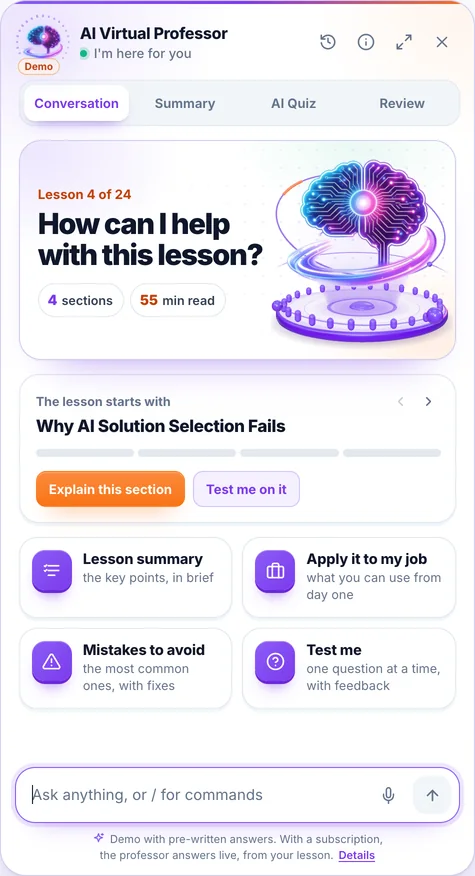
The demo opens on a lesson from the course “AI for Business Leaders”, with prepared answers; voice is off in the demo.
It is an artificial intelligence system, not a human teacher; its answers may contain errors. Details in the Terms & Conditions.
Every impressive AI system you have ever used — a support agent that answers from a company knowledge base, a code assistant grounded in a monorepo, a semantic search over millions of documents — is standing on a data pipeline. The model is the visible tip; the data engineering underneath is the iceberg. In 2026, with foundation models widely commoditized and available from many providers, the durable competitive advantage has shifted decisively from which model you call to what data you feed it and how reliably you feed it. This course is about that foundation, and this first lesson builds the mental map you will use for the next thirty lessons.
What this course is — and what it is not
It is easy to confuse two adjacent disciplines. Retrieval-augmented generation (RAG) is about the query-time loop: take a user question, retrieve relevant context, and generate an answer. That is a different course. Data engineering for AI is about everything that has to happen before retrieval is even possible, and everything that keeps it correct over time: ingesting raw data from dozens of systems, cleaning and validating it, transforming it, chunking and embedding it, loading it into a vector store, and governing it for privacy and cost. RAG consumes a vector index; this course builds and maintains the whole supply chain that produces that index.
Put bluntly: RAG changes what the model can see at query time. Data engineering determines whether what the model sees is complete, fresh, correct, legal, and affordable to maintain. A brilliant retrieval prompt over a stale, duplicated, PII-leaking, badly chunked index will still fail — and it will fail in ways that look like model problems but are actually data problems. Learning to tell the two apart is one of the most valuable skills you will build here.
The data-centric shift
The industry has internalized a lesson that early machine learning teams learned the hard way: beyond a point, you get far more improvement from better data than from a bigger model. This is the data-centric AI mindset, popularized by Andrew Ng and now standard practice. When your agent gives a wrong answer, the root cause is usually one of:
- The source document was never ingested.
- It was ingested but not re-processed after it changed.
- It was chunked so that the relevant fact was split across two chunks.
- A near-duplicate outranked the canonical version.
- The record was silently dropped by an upstream schema change.
Every one of those is a data engineering failure, not a prompting failure. The discipline of this course is to make each of those failure modes observable and preventable rather than something you discover from an angry user.
The AI data lifecycle
A production AI data platform moves data through a recognizable lifecycle. Keep this map in your head for the entire course:
- Ingestion — pull or receive data from source systems (databases, APIs, files, event streams, SaaS tools).
- Storage — land it in a lake or lakehouse using open formats (Parquet, Apache Iceberg).
- Transformation — clean, normalize, join, and model it (ELT with dbt, Spark, SQL).
- Quality and contracts — validate it against explicit expectations (Great Expectations, Pandera) and enforce schemas.
- Preprocessing — parse documents, chunk text, and prepare it for models.
- Embedding — turn text into vectors at scale, with caching and incremental updates.
- Serving — load vectors and metadata into a vector database for low-latency retrieval, and features into a feature store for models.
- Governance and operations — lineage, PII handling, retention, cost control, and monitoring across all of the above.
Pick up exactly where you left off
Pick the option that fits you; your account is created at checkout in under a minute:
What's next in this lesson
- Why AI raises the stakes for data engineering
- A concrete example: the "our AI is hallucinating" ticket
- The roles around the data-for-AI platform
- Guardrails you will carry from lesson one
- What you will be able to do by the end
- The build-vs-buy landscape in 2026
- Reliability is the product
- Key takeaways
Everything you'll learn in this course
1 The Data Foundation of AI Systems 3 lessons
- The Role of Data Engineering in AI in 2026 Reading now 50 min
- Batch vs Streaming: Choosing a Processing Paradigm 50 min
- Data Lakes, Warehouses, and the Lakehouse 50 min
2 Storage and Table Formats: Parquet and Iceberg 2 lessons
- Columnar Storage with Apache Parquet 50 min
- Apache Iceberg: Table Format, Partitioning, and Layout 50 min
3 Ingestion from Diverse Sources 3 lessons
- Ingestion Patterns: CDC, APIs, Files, and Streams 50 min
- Connectors, Schema Evolution, and Idempotent Loading 50 min
- Real-Time Streaming Ingestion with Kafka and Flink 50 min
4 ETL/ELT and Orchestration 3 lessons
- ETL vs ELT and Orchestration Fundamentals 50 min
- Orchestrating Pipelines with Apache Airflow 50 min
- Asset-Oriented Orchestration with Dagster and dbt 50 min
5 Data Quality, Validation, and Contracts 4 lessons
- Data Quality Dimensions and Great Expectations 50 min
- Data Contracts and Schema Enforcement 50 min
- Cleaning, Deduplication, and Normalization 50 min
- Testing and CI/CD for Data Pipelines (DataOps) 50 min
6 Preprocessing for LLMs and RAG 3 lessons
- Document Parsing and Text Extraction 50 min
- Chunking Strategies for LLM Pipelines 50 min
- Preparing and Enriching Chunks at Scale 50 min
7 Feature and Embedding Pipelines 3 lessons
- Building an Embeddings Pipeline 50 min
- Batch Embedding, Caching, and Incremental Updates 50 min
- Feature Stores for ML and AI Workloads 50 min
8 Vector Databases in Depth 5 lessons
- Vector Index Internals: HNSW, IVF, and Quantization 50 min
- pgvector: PostgreSQL as a Vector Store 50 min
- Dedicated Vector Databases: Pinecone, Qdrant, and Weaviate 50 min
- Hybrid Search, Metadata Filtering, and Sharding 50 min
- Evaluating Retrieval Quality and Embedding Drift 50 min
9 Governance, Lineage, PII, and Operations 4 lessons
- Metadata and Data Lineage 50 min
- Data Governance and GDPR in Pipelines 50 min
- PII Detection and Anonymization 50 min
- Cost, Performance, and Pipeline Monitoring 50 min
10 Final Quiz - Data Engineering for AI 1 lessons
- Final Assessment - Data Engineering for AI 45 min
Everything you need to learn effectively
Interactive quizzes
Check your knowledge at the end of every lesson with scored quizzes and feedback.
Personal notes
Save notes on every lesson, accessible anytime from your dashboard.
Scheduled reviews
Revisit lessons exactly when it matters, at the right intervals — so you remember for the long term.
Progress & Achievements
Track your progress, unlock achievements, and visualize what you've learned.
Bookmarks
Save the lessons that matter and find them instantly when you need them.
Questions & Answers
Ask questions right on the lesson and get answers from our team.
Good to know before you start
How do I get access to the course?
You can read the beginning of the first lesson for free, right on this page. For the course you create an account, pick the subscription that fits — a single course or a bundle — and get access immediately after your payment is confirmed. Everything happens 100% online.
Can I cancel my subscription anytime?
Yes. Cancel anytime, straight from your account, in just a few clicks. Your access stays active until the end of the period you have already paid for.
What does the subscription for this course include?
All 31 lessons in the course, interactive quizzes, the AI Professor built into every lesson (select a passage and choose “Explain this to me”), within a fair-use limit, personal notes, automatically saved progress, and content updates included.
Is there a fixed learning schedule?
No. You learn at your own pace, on any device. Lessons are structured step by step, and the platform saves your progress automatically, so you can pick up right where you left off — anytime.
Ready to unlock all the content?
Just this course — €99 / month, VAT included — or every IT Pro course, with smart quizzes and the AI Professor included, in the bundle at €399 / month, VAT included.