Why Deep Learning Still Matters in 2026
From the course Deep Learning and Neural Networks with PyTorch
In every lesson
The AI Professor starts from the lesson you have open
You ask it in writing or by voice, right from the lesson, and you can listen to the answer on request. Where needed, it fills in from general knowledge. When you select a passage, a bar appears with “Explain this to me”, “Give me an example”, “Why does it matter?” and “My own question”.
Its panel has four tabs:
- Conversation: you ask, it answers starting from the lesson
- Summary: the key ideas of the lesson, point by point
- AI Quiz: 3, 5 or 10 new questions from the lesson, with explanations
- Review: flashcards made from the lesson
Included in every subscription and in single-course access, within a fair-use limit.
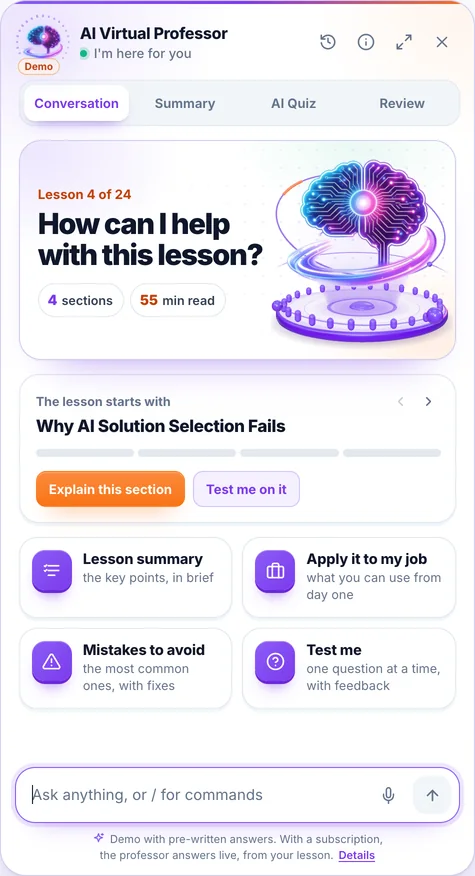
The demo opens on a lesson from the course “AI for Business Leaders”, with prepared answers; voice is off in the demo.
It is an artificial intelligence system, not a human teacher; its answers may contain errors. Details in the Terms & Conditions.
It is fair to ask, in 2026, whether you still need to understand deep learning. Powerful assistants such as Claude Opus 5.5, Claude Sonnet 5, GPT-6 Sol and Gemini 3.1 Pro can be called with a single API request, and for many product features that is genuinely the right choice. So why learn to build neural networks yourself? Because behind every one of those models is the same machinery you are about to master, and because a large and growing share of real engineering work still happens below the level of a hosted chat API: custom vision systems, tabular and time-series models, recommendation engines, embeddings, on-device models, and the fine-tuning and evaluation of open-weight models. Understanding deep learning is what turns you from a consumer of AI into someone who can diagnose, adapt, and build it.
This opening lesson sets the mental frame for the whole course. By the end of it you should be able to say, in one sentence, what deep learning is; explain why it works now when it did not two decades ago; decide when it is the right tool and when it is not; and understand why we build the entire course on PyTorch specifically. Everything technical that follows — tensors, autograd, training loops, CNNs, Transformers — is an elaboration of the ideas introduced here.
Educational note: This course is for learning. Any code you run against real data must respect data protection law (GDPR, Regulation (EU) 2016/679, in the EU), dataset licenses, and copyright. We return to these obligations throughout the course, because doing deep learning responsibly is part of doing it well. Nothing here is legal advice; when you handle personal data at work, involve your organisation's data protection function.
What "deep learning" actually means
Deep learning is a branch of machine learning that uses neural networks with many layers to learn representations directly from data. The word "deep" refers to the number of stacked layers, not to any philosophical depth. Each layer transforms its input into a slightly more useful representation, and by stacking many of them the network can model extremely complex relationships — from the edges and textures in an image to the grammar and meaning in a sentence.
The defining property is representation learning. Classical machine learning often required humans to hand-engineer features: you would decide which measurable properties of the data mattered, compute them, and feed them to a model. If you wanted to detect faces, an engineer might hand-code detectors for edges, then corners, then eye-like blobs. Deep learning largely removes that step. Given enough data and the right architecture, the network learns its own features, and — crucially — it learns them in a hierarchy: early layers of an image network discover edges and colour gradients, middle layers assemble them into textures and parts (an eye, a wheel), and later layers combine parts into whole objects. Nobody programmed that hierarchy; it emerged because it was the most useful way to reduce the training loss. This is why the same core techniques power image recognition, speech, language, protein-structure prediction, and recommendation systems: the machinery that discovers a useful hierarchy of features is domain-agnostic.
Pick up exactly where you left off
Pick the option that fits you; your account is created at checkout in under a minute:
What's next in this lesson
- Why now, and why it did not happen earlier
- Where deep learning is the right tool — and where it is not
- Why PyTorch
- Pick the best available device once and reuse it everywhere.
- A first look at the workflow you will master
- Common misconceptions to drop now
- What you will be able to do by the end
Everything you'll learn in this course
1 Foundations: Why Deep Learning in 2026 2 lessons
- Why Deep Learning Still Matters in 2026 Reading now 50 min
- Neural Networks, Intuitively 50 min
2 PyTorch Tensors and Autograd 2 lessons
- Tensors: The Core Data Structure 50 min
- Autograd: Automatic Differentiation 50 min
3 From Linear Regression to Neural Networks 4 lessons
- Linear Regression from Scratch in PyTorch 50 min
- Building a Multi-Layer Perceptron 50 min
- Activation Functions Explained 50 min
- Weight Initialization and the Vanishing/Exploding Gradient Problem 50 min
4 Backpropagation and Gradient Descent 3 lessons
- How Backpropagation Works 50 min
- Gradient Descent and Its Variants 50 min
- Learning Rate Schedules and Warmup 50 min
5 Loss Functions and Optimizers 2 lessons
- Loss Functions in PyTorch 50 min
- Optimizers: SGD, Adam and AdamW 50 min
6 Training Loops, Datasets and DataLoaders 3 lessons
- The Anatomy of a Complete Training Loop 50 min
- Datasets and DataLoaders 50 min
- Evaluating Models: Metrics, Validation and Test Discipline 50 min
7 Overfitting, Regularization and Normalization 2 lessons
- Overfitting and Regularization 50 min
- Dropout and Batch Normalization 50 min
8 Convolutional Neural Networks for Images 2 lessons
- Convolutional Neural Networks Explained 50 min
- Building a CNN Image Classifier 50 min
9 Sequence Models and the Transformer 3 lessons
- RNNs, LSTMs and Their Limits 50 min
- Embeddings and the Attention Mechanism 50 min
- The Transformer Architecture 50 min
10 Transfer Learning, GPUs and Deployment 3 lessons
- Transfer Learning and Fine-Tuning Basics 50 min
- GPU, CUDA and Mixed Precision 50 min
- From Training to Inference: Saving, Loading and ONNX 50 min
11 Practical Craft: Debugging, Reproducibility and Responsible Deep Learning 3 lessons
- Debugging Neural Networks: A Systematic Approach 50 min
- Reproducibility and Experiment Tracking 50 min
- Responsible Deep Learning: Dataset Licensing, Consent, Bias and GDPR 50 min
12 Final Quiz — Deep Learning with PyTorch 1 lessons
- Final Assessment — Deep Learning and Neural Networks with PyTorch 45 min
Everything you need to learn effectively
Interactive quizzes
Check your knowledge at the end of every lesson with scored quizzes and feedback.
Personal notes
Save notes on every lesson, accessible anytime from your dashboard.
Scheduled reviews
Revisit lessons exactly when it matters, at the right intervals — so you remember for the long term.
Progress & Achievements
Track your progress, unlock achievements, and visualize what you've learned.
Bookmarks
Save the lessons that matter and find them instantly when you need them.
Questions & Answers
Ask questions right on the lesson and get answers from our team.
Good to know before you start
How do I get access to the course?
You can read the beginning of the first lesson for free, right on this page. For the course you create an account, pick the subscription that fits — a single course or a bundle — and get access immediately after your payment is confirmed. Everything happens 100% online.
Can I cancel my subscription anytime?
Yes. Cancel anytime, straight from your account, in just a few clicks. Your access stays active until the end of the period you have already paid for.
What does the subscription for this course include?
All 30 lessons in the course, interactive quizzes, the AI Professor built into every lesson (select a passage and choose “Explain this to me”), within a fair-use limit, personal notes, automatically saved progress, and content updates included.
Is there a fixed learning schedule?
No. You learn at your own pace, on any device. Lessons are structured step by step, and the platform saves your progress automatically, so you can pick up right where you left off — anytime.
Ready to unlock all the content?
Just this course — €99 / month, VAT included — or every IT Pro course, with smart quizzes and the AI Professor included, in the bundle at €399 / month, VAT included.