
Why Edge AI Now in 2026
From the course Edge AI and On-Device Intelligence
In every lesson
The AI Professor starts from the lesson you have open
You ask it in writing or by voice, right from the lesson, and you can listen to the answer on request. Where needed, it fills in from general knowledge. When you select a passage, a bar appears with “Explain this to me”, “Give me an example”, “Why does it matter?” and “My own question”.
Its panel has four tabs:
- Conversation: you ask, it answers starting from the lesson
- Summary: the key ideas of the lesson, point by point
- AI Quiz: 3, 5 or 10 new questions from the lesson, with explanations
- Review: flashcards made from the lesson
Included in every subscription and in single-course access, within a fair-use limit.
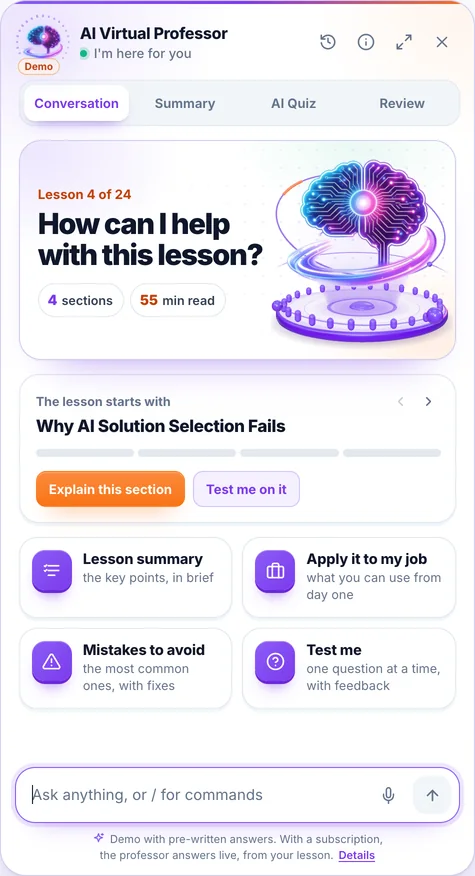
The demo opens on a lesson from the course “AI for Business Leaders”, with prepared answers; voice is off in the demo.
It is an artificial intelligence system, not a human teacher; its answers may contain errors. Details in the Terms & Conditions.
For a decade the default answer to "where does the model run" was simple: in the cloud. You collected data on a device, shipped it to a data centre, ran inference on a powerful server, and sent the answer back. In 2026 that default is breaking down. A growing and important share of machine learning now runs on the device that produced the data — the phone in your pocket, the earbuds in your ears, the camera on the factory line, the microcontroller inside a thermostat. This is Edge AI, also called on-device intelligence, and this course teaches you how to build and ship it.
Educational note: This course is for learning. Any system you build with real data must respect data-protection law (the GDPR in the EU), device security, and the rights of the people whose data you process. Edge AI has real privacy advantages, but it is not automatically compliant. We treat these obligations as engineering requirements throughout.
What "edge" actually means
The edge is simply the far end of the network, close to where data originates and where actions are taken, as opposed to the cloud, which is centralised compute in a data centre. Edge AI means running the inference — and sometimes even training or adaptation — on hardware at that far end rather than shipping raw data to a server. The device might be a flagship phone with a neural accelerator, a single-board computer like a Raspberry Pi, an industrial gateway, or a microcontroller with a few hundred kilobytes of RAM. The unifying idea is that the intelligence comes to the data, instead of the data travelling to the intelligence.
It helps to see the edge not as one place but as a spectrum of tiers, because the engineering constraints change by orders of magnitude as you descend it:
| Tier | Typical hardware | Typical memory | What realistically runs there |
|---|---|---|---|
| Near edge / on-premises | Industrial gateway, edge server | Tens of GB | Multiple mid-size models, video analytics for many cameras |
| Rich device | Flagship phone, laptop, Jetson-class board | 8–16+ GB | Vision transformers, speech models, small language models |
| Constrained device | Budget phone, wearable, Raspberry Pi | 1–4 GB | Compact CNNs, keyword spotting, compressed classifiers |
| Deep embedded (TinyML) | Microcontroller (Cortex-M class) | KB to a few MB | Tiny quantized models: wake words, anomaly detection, simple vision |
Every technique in this course — quantization, pruning, distillation, runtime selection, accelerator delegation — exists to move a capability one or two tiers further down this table than it could otherwise go. When you read a claim like "this model runs at the edge", your first question should always be: which tier? A model that is trivial on a Jetson-class board may be impossible on a microcontroller, and a design that assumes a flagship NPU may crawl on the budget phones that dominate many markets.
Pick up exactly where you left off
Pick the option that fits you; your account is created at checkout in under a minute:
What's next in this lesson
- The four forces pushing intelligence to the edge
- What changed to make this practical
- A first taste: converting a model for the edge
- A trained Keras model you already have.
- Default optimizations shrink the model (weight quantization) for the edge.
- Common misconceptions to discard on day one
- A realistic scenario to keep in mind
- What you will be able to do by the end
Everything you'll learn in this course
1 Foundations: What Edge AI Is and Why It Matters in 2026 4 lessons
- Why Edge AI Now in 2026 Reading now 50 min
- On-Device vs Cloud: The Real Tradeoffs 50 min
- Hybrid Edge–Cloud Architectures and Fallback Design 50 min
- Privacy-by-Design and the Legal Case for Edge 50 min
2 Model Compression: Making Models Fit the Edge 4 lessons
- Quantization: From FP32 to INT8 and Below 50 min
- Advanced Quantization: INT4, Mixed Precision, and QAT at Low Bits 50 min
- Pruning and Sparsity 50 min
- Knowledge Distillation 50 min
3 Edge AI Frameworks and Runtimes 3 lessons
- LiteRT and the TensorFlow Lite Lineage 50 min
- ONNX Runtime: Portable Cross-Framework Inference 50 min
- Core ML, ExecuTorch, and MediaPipe 50 min
4 Mobile AI: iOS and Android 3 lessons
- On-Device AI on Android 50 min
- On-Device AI on iOS 50 min
- Mobile AI Performance and UX Patterns 50 min
5 TinyML and Microcontrollers 3 lessons
- TinyML Fundamentals 50 min
- Deploying Models on Microcontrollers 50 min
- Embedded Vision and Audio Intelligence at the Edge 50 min
6 NPUs, Accelerators, and Edge Hardware 3 lessons
- The Edge Hardware Landscape: NPUs, Coral, and Jetson 50 min
- Optimizing Inference for Accelerators 50 min
- Benchmarking and Profiling Edge AI Workloads 50 min
7 Small Language Models On-Device 3 lessons
- Small Language Models: Gemma, Phi, and Llama on Device 50 min
- Running SLMs with llama.cpp and Quantized Formats 50 min
- On-Device LLM Inference Optimization 50 min
8 Privacy-First Design and Federated Learning 2 lessons
- Federated Learning 50 min
- Differential Privacy and On-Device Model Security 50 min
9 Deployment, OTA Updates, and Monitoring 4 lessons
- Packaging and Over-the-Air Model Updates 50 min
- Monitoring and Observability on the Edge 50 min
- Safety-Critical Edge AI: Automotive, Medical, and Industrial 50 min
- Case Studies: Mobile, IoT, and Wearables 50 min
10 Final Quiz — Edge AI and On-Device Intelligence 1 lessons
- Final Assessment — Edge AI and On-Device Intelligence 55 min
Everything you need to learn effectively
Interactive quizzes
Check your knowledge at the end of every lesson with scored quizzes and feedback.
Personal notes
Save notes on every lesson, accessible anytime from your dashboard.
Scheduled reviews
Revisit lessons exactly when it matters, at the right intervals — so you remember for the long term.
Progress & Achievements
Track your progress, unlock achievements, and visualize what you've learned.
Bookmarks
Save the lessons that matter and find them instantly when you need them.
Questions & Answers
Ask questions right on the lesson and get answers from our team.
Good to know before you start
How do I get access to the course?
You can read the beginning of the first lesson for free, right on this page. For the course you create an account, pick the subscription that fits — a single course or a bundle — and get access immediately after your payment is confirmed. Everything happens 100% online.
Can I cancel my subscription anytime?
Yes. Cancel anytime, straight from your account, in just a few clicks. Your access stays active until the end of the period you have already paid for.
What does the subscription for this course include?
All 30 lessons in the course, interactive quizzes, the AI Professor built into every lesson (select a passage and choose “Explain this to me”), within a fair-use limit, personal notes, automatically saved progress, and content updates included.
Is there a fixed learning schedule?
No. You learn at your own pace, on any device. Lessons are structured step by step, and the platform saves your progress automatically, so you can pick up right where you left off — anytime.
Ready to unlock all the content?
Just this course — €99 / month, VAT included — or every IT Pro course, with smart quizzes and the AI Professor included, in the bundle at €399 / month, VAT included.