
Why LLM Evaluation Is Hard — and Non-Negotiable
From the course LLM Evaluation and Testing: Shipping Reliable AI
In every lesson
The AI Professor starts from the lesson you have open
You ask it in writing or by voice, right from the lesson, and you can listen to the answer on request. Where needed, it fills in from general knowledge. When you select a passage, a bar appears with “Explain this to me”, “Give me an example”, “Why does it matter?” and “My own question”.
Its panel has four tabs:
- Conversation: you ask, it answers starting from the lesson
- Summary: the key ideas of the lesson, point by point
- AI Quiz: 3, 5 or 10 new questions from the lesson, with explanations
- Review: flashcards made from the lesson
Included in every subscription and in single-course access, within a fair-use limit.
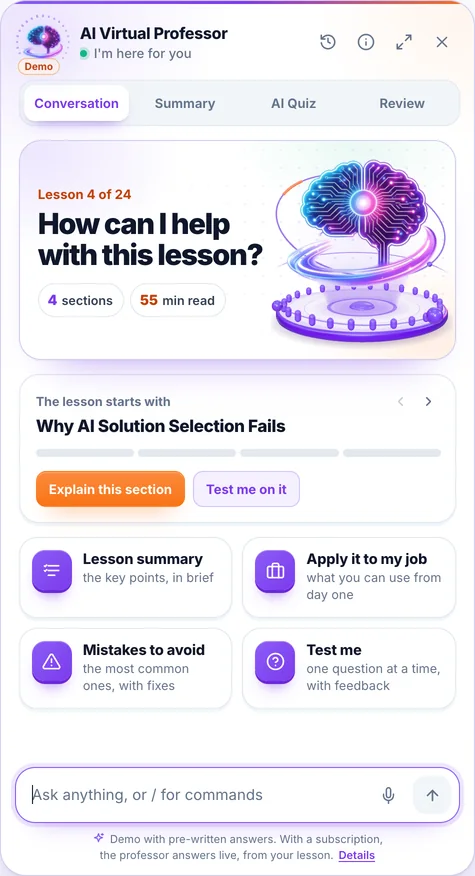
The demo opens on a lesson from the course “AI for Business Leaders”, with prepared answers; voice is off in the demo.
It is an artificial intelligence system, not a human teacher; its answers may contain errors. Details in the Terms & Conditions.
Most engineering teams can ship a web service they can reason about: the same input yields the same output, a failing assertion is unambiguous, and a green test suite means the behavior is locked in. LLM-powered systems break every one of those assumptions. The model is stochastic, the space of acceptable outputs is enormous and fuzzy, and a change that looks harmless — swapping a model version, editing one line of the system prompt, reordering few-shot examples — can silently shift quality across thousands of requests. Evaluation is the discipline that turns "it feels better" into "it is measurably better on the cases we care about, with no regression on safety." Without it you are flying blind, and in production that blindness is expensive.
This lesson frames the whole course. It explains why the familiar testing playbook collapses when the unit under test is a language model, what a real evaluation harness looks like at its core, and the maturity ladder that separates a demo from a dependable product. Everything that follows — metrics, judges, datasets, RAG and agent evals, CI and monitoring — is an elaboration of the ideas introduced here.
Why the usual testing playbook fails
Traditional software testing rests on two properties: determinism and exact correctness. A function that adds two numbers has exactly one right answer, and a unit test pins it forever. LLM outputs violate both properties at once, and they violate them in ways that are not fixable with a cleverer assertion.
- Non-determinism. With any temperature above zero the same prompt produces different completions. Even at temperature zero you cannot rely on byte-identical output: providers batch requests, floating-point reductions on GPUs are not associative, and the vendor may silently update the served checkpoint. "Reproducible" for an LLM means "statistically stable," not "identical."
- No single correct answer. For "summarize this support ticket" there are thousands of good summaries and thousands of bad ones. Correctness is a fuzzy region in output space, not a point. An exact-match assertion against one reference rejects perfectly good outputs and accepts nothing useful.
- Semantic, not lexical, equivalence. "The payment failed because the card expired" and "Charge declined: expired card" mean the same thing and share almost no tokens. Any metric that compares surface strings scores them as wildly different, which is exactly backwards.
- Emergent, high-dimensional failure modes. LLMs fail in ways ordinary functions cannot: hallucinated facts, subtle instruction-following drift, format violations, tone problems, prompt-injected content, refusal on benign requests, and sycophancy. A single pass/fail bit cannot represent this surface.
The practical consequence is blunt: you cannot assert output == expected. You need graded, multi-dimensional evaluation that tolerates paraphrase while still catching real regressions. The rest of the discipline is about building measurements that behave well under exactly these conditions.
Pick up exactly where you left off
Pick the option that fits you; your account is created at checkout in under a minute:
What's next in this lesson
- The cost of shipping without evals
- Evaluation is a first-class product surface
- A minimal harness makes the problem concrete
- naive_test.py - why exact match is the wrong default
- harness.py - the shape every eval framework generalizes
- The five properties of a healthy eval practice
- Common pitfalls before you write a single metric
- From a vibe to a number: a worked example
Everything you'll learn in this course
1 Foundations: Why LLM Evaluation Is Hard and Essential 4 lessons
- Why LLM Evaluation Is Hard — and Non-Negotiable Reading now 50 min
- The Evaluation Taxonomy: Offline vs Online, Reference-Based vs Reference-Free 50 min
- Building Your First Eval Harness with pytest 50 min
- Reading Eval Results: Variance, Significance and Confidence 50 min
2 Classic Metrics and Why They Fail on Open-Ended Text 3 lessons
- Exact Match, BLEU, ROUGE and String Metrics 50 min
- Embedding-Based Metrics: BERTScore and Semantic Similarity 50 min
- When Classic Metrics Mislead You 50 min
3 LLM-as-a-Judge: Design, Bias and Calibration 3 lessons
- Designing an LLM Judge 50 min
- Judge Biases and How to Mitigate Them 50 min
- Calibrating and Validating Your Judge Against Humans 50 min
4 Building Evaluation Datasets 3 lessons
- Golden Sets and Test Case Design 50 min
- Edge Cases, Adversarial Inputs and Slices 50 min
- Synthetic Data Generation for Evals 50 min
5 The Evaluation Tooling Landscape 3 lessons
- promptfoo: Config-Driven Evaluation and Red-Teaming 50 min
- LangSmith, Langfuse and Braintrust: Tracing and Eval Platforms 50 min
- DeepEval: Pytest-Native LLM Testing 50 min
6 Evaluating RAG Systems 3 lessons
- Retrieval Metrics: Recall, Precision, MRR and NDCG 50 min
- Generation Metrics: Faithfulness, Answer Relevancy and Ragas 50 min
- End-to-End RAG Evaluation and Failure Attribution 50 min
7 Evaluating AI Agents 3 lessons
- Task Completion and Success Metrics 50 min
- Trajectory and Tool-Call Evaluation 50 min
- Multi-Turn and Simulation-Based Agent Evaluation 50 min
8 Safety, Guardrails and Red-Teaming Evaluation 3 lessons
- Safety Evals and Guardrail Testing 50 min
- Adversarial Testing and Red-Teaming 50 min
- Eval Data Privacy, Governance and GDPR 50 min
9 Evaluation in Production: CI/CD, A/B Testing, Monitoring and Cost 4 lessons
- Regression Testing Prompts in CI/CD 50 min
- Online Evaluation and A/B Testing in Production 50 min
- Monitoring Quality Drift and Human Annotation 50 min
- The Cost of Evaluation 50 min
10 Final Quiz — LLM Evaluation and Testing 1 lessons
- Final Assessment — Shipping Reliable AI 45 min
Everything you need to learn effectively
Interactive quizzes
Check your knowledge at the end of every lesson with scored quizzes and feedback.
Personal notes
Save notes on every lesson, accessible anytime from your dashboard.
Scheduled reviews
Revisit lessons exactly when it matters, at the right intervals — so you remember for the long term.
Progress & Achievements
Track your progress, unlock achievements, and visualize what you've learned.
Bookmarks
Save the lessons that matter and find them instantly when you need them.
Questions & Answers
Ask questions right on the lesson and get answers from our team.
Good to know before you start
How do I get access to the course?
You can read the beginning of the first lesson for free, right on this page. For the course you create an account, pick the subscription that fits — a single course or a bundle — and get access immediately after your payment is confirmed. Everything happens 100% online.
Can I cancel my subscription anytime?
Yes. Cancel anytime, straight from your account, in just a few clicks. Your access stays active until the end of the period you have already paid for.
What does the subscription for this course include?
All 30 lessons in the course, interactive quizzes, the AI Professor built into every lesson (select a passage and choose “Explain this to me”), within a fair-use limit, personal notes, automatically saved progress, and content updates included.
Is there a fixed learning schedule?
No. You learn at your own pace, on any device. Lessons are structured step by step, and the platform saves your progress automatically, so you can pick up right where you left off — anytime.
Ready to unlock all the content?
Just this course — €99 / month, VAT included — or every IT Pro course, with smart quizzes and the AI Professor included, in the bundle at €399 / month, VAT included.