
What MLOps Actually Is and Why It Exists
From the course MLOps: The Machine Learning Lifecycle in Production
In every lesson
The AI Professor starts from the lesson you have open
You ask it in writing or by voice, right from the lesson, and you can listen to the answer on request. Where needed, it fills in from general knowledge. When you select a passage, a bar appears with “Explain this to me”, “Give me an example”, “Why does it matter?” and “My own question”.
Its panel has four tabs:
- Conversation: you ask, it answers starting from the lesson
- Summary: the key ideas of the lesson, point by point
- AI Quiz: 3, 5 or 10 new questions from the lesson, with explanations
- Review: flashcards made from the lesson
Included in every subscription and in single-course access, within a fair-use limit.
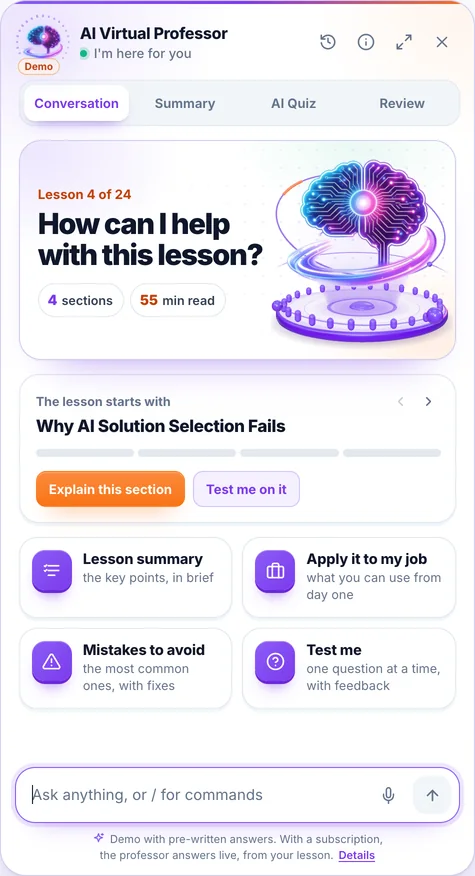
The demo opens on a lesson from the course “AI for Business Leaders”, with prepared answers; voice is off in the demo.
It is an artificial intelligence system, not a human teacher; its answers may contain errors. Details in the Terms & Conditions.
Most machine learning models never reach production, and a large share of those that do quietly degrade until they are doing more harm than good. The reason is rarely the model architecture. It is everything around the model: the data pipelines that feed it, the environments that reproduce it, the systems that serve it, and the monitoring that would tell you when it breaks. MLOps is the engineering discipline that addresses exactly this gap. It is the set of practices, tools, and cultural habits that let a team take a machine learning model from a notebook experiment to a reliable, observable, continuously improving production service — and keep it healthy over time.
A working definition
MLOps (machine learning operations) applies the proven ideas of DevOps to the machine learning lifecycle, then adds the parts that DevOps never had to deal with: data as a first-class dependency, models that decay without any code change, and training runs that are expensive and stochastic. If DevOps is about shipping and operating software reliably, MLOps is about shipping and operating learning systems reliably, where the behavior of the system depends not just on code but on data and on a trained artifact whose quality can drift the moment the world changes.
The critical mental shift is this: a model in production is not a finished deliverable. It is a living component whose accuracy is a function of how well its training distribution still matches the real world. Traditional software behaves the same on Tuesday as it did on Monday unless someone changed the code. A model can silently get worse overnight because customer behavior shifted, a data source changed format, or an upstream feature pipeline started emitting nulls. MLOps exists to make that decay visible, manageable, and reversible.
Why classic software practices are not enough
A conventional application has two moving parts you must manage: code and configuration. A machine learning system has at least three: code, data, and the trained model artifact. Each can change independently, and each can break the system.
- Code is the training scripts, feature transformations, and serving logic. This part looks familiar to any software engineer and benefits from normal version control.
- Data is the training set, the feature definitions, and the live inputs at inference time. Data has schemas, distributions, and quality that all change over time. Two identical code runs on different data produce different models.
- The model is the artifact produced by training. It has weights, hyperparameters, a training lineage, and metrics. Reproducing it requires pinning the exact code, data, and environment together.
Because all three vary, the failure modes are richer than in normal software. Your unit tests can pass, your deployment can succeed, your service can return HTTP 200 for every request — and the predictions can still be quietly wrong. This is why "it deployed successfully" is a meaningless statement of health for an ML system, and why MLOps invests so heavily in data validation and prediction monitoring rather than only in uptime.
Pick up exactly where you left off
Pick the option that fits you; your account is created at checkout in under a minute:
What's next in this lesson
- The core problems MLOps solves
- The lifecycle at a glance
- MLOps versus adjacent disciplines
- Why it matters more in 2026 than ever
- A worked scenario: how a healthy model dies quietly
- The three axes of change
- Common misconceptions that cause real damage
- The cost of skipping MLOps
Everything you'll learn in this course
1 MLOps Foundations and Maturity in 2026 3 lessons
- What MLOps Actually Is and Why It Exists Reading now 50 min
- MLOps Maturity Levels and the End-to-End Lifecycle 50 min
- Roles, Team Topologies, and the MLOps Platform 50 min
2 Experiment Tracking and Reproducibility 3 lessons
- Experiment Tracking with MLflow and Weights & Biases 50 min
- Reproducibility, Determinism, and Environments 50 min
- Data and Code Versioning with DVC and Lineage 50 min
3 Data and Feature Management 3 lessons
- Data Pipelines and Data Validation 50 min
- Feature Stores: Feast, Tecton, and Killing Skew 50 min
- Labeling, Ground Truth, and Annotation Quality 50 min
4 Training Pipelines and Orchestration 3 lessons
- Orchestration Fundamentals: Airflow, Kubeflow, Metaflow 50 min
- Building Reproducible Training Pipelines 50 min
- Distributed Training and GPU Efficiency 50 min
5 Model Registry, Versioning, and CI/CD for ML 3 lessons
- The Model Registry and Model Versioning 50 min
- CI/CD for Machine Learning 50 min
- Testing Machine Learning Systems 50 min
6 Model Serving and Deployment 4 lessons
- Serving Patterns: Batch, Online, and Streaming 50 min
- Serving Infrastructure: KServe, BentoML, and Triton 50 min
- Deployment Strategies: Canary, Shadow, and A/B Testing 50 min
- Inference Optimization: Quantization, Batching, and Caching 50 min
7 Monitoring, Drift, and Performance Decay 4 lessons
- Monitoring ML in Production: Beyond Uptime 50 min
- Data Drift and Concept Drift Detection 50 min
- Performance Decay and Feedback Loops 50 min
- Incident Response, On-Call, and Safe Rollback for ML 50 min
8 Automated Retraining and Continuous Training 2 lessons
- Automated Retraining Pipelines and Triggers 50 min
- Continuous Training and Its Guardrails 50 min
9 Governance, Cost, and LLMOps 4 lessons
- Model Governance, Model Cards, and Fairness Monitoring 50 min
- Cost, GPU Efficiency, and FinOps for ML 50 min
- LLMOps versus Classic MLOps 50 min
- Security, Secrets, and Supply-Chain Integrity for ML 50 min
10 Final Quiz — The MLOps Lifecycle in Production 1 lessons
- Final Assessment — MLOps: The Machine Learning Lifecycle in Production 50 min
Everything you need to learn effectively
Interactive quizzes
Check your knowledge at the end of every lesson with scored quizzes and feedback.
Personal notes
Save notes on every lesson, accessible anytime from your dashboard.
Scheduled reviews
Revisit lessons exactly when it matters, at the right intervals — so you remember for the long term.
Progress & Achievements
Track your progress, unlock achievements, and visualize what you've learned.
Bookmarks
Save the lessons that matter and find them instantly when you need them.
Questions & Answers
Ask questions right on the lesson and get answers from our team.
Good to know before you start
How do I get access to the course?
You can read the beginning of the first lesson for free, right on this page. For the course you create an account, pick the subscription that fits — a single course or a bundle — and get access immediately after your payment is confirmed. Everything happens 100% online.
Can I cancel my subscription anytime?
Yes. Cancel anytime, straight from your account, in just a few clicks. Your access stays active until the end of the period you have already paid for.
What does the subscription for this course include?
All 30 lessons in the course, interactive quizzes, the AI Professor built into every lesson (select a passage and choose “Explain this to me”), within a fair-use limit, personal notes, automatically saved progress, and content updates included.
Is there a fixed learning schedule?
No. You learn at your own pace, on any device. Lessons are structured step by step, and the platform saves your progress automatically, so you can pick up right where you left off — anytime.
Ready to unlock all the content?
Just this course — €99 / month, VAT included — or every IT Pro course, with smart quizzes and the AI Professor included, in the bundle at €399 / month, VAT included.