
Why Recommender Systems Matter in 2026
From the course Recommender Systems with AI: From Collaborative Filtering to Deep Learning
In every lesson
The AI Professor starts from the lesson you have open
You ask it in writing or by voice, right from the lesson, and you can listen to the answer on request. Where needed, it fills in from general knowledge. When you select a passage, a bar appears with “Explain this to me”, “Give me an example”, “Why does it matter?” and “My own question”.
Its panel has four tabs:
- Conversation: you ask, it answers starting from the lesson
- Summary: the key ideas of the lesson, point by point
- AI Quiz: 3, 5 or 10 new questions from the lesson, with explanations
- Review: flashcards made from the lesson
Included in every subscription and in single-course access, within a fair-use limit.
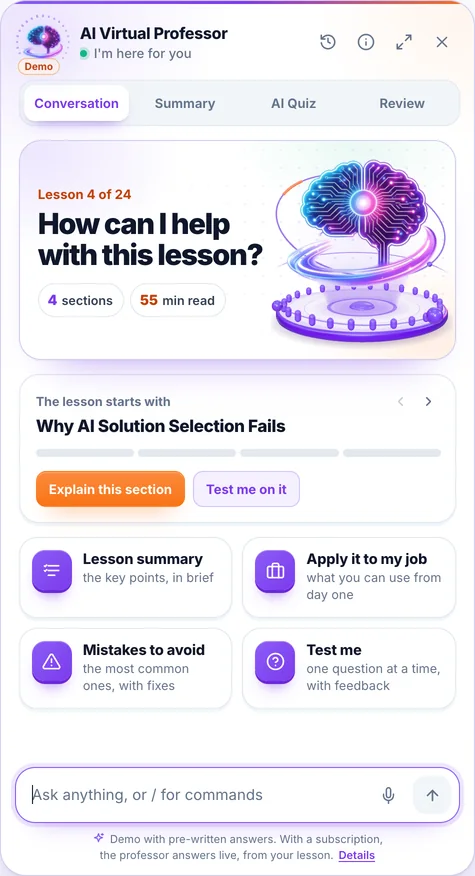
The demo opens on a lesson from the course “AI for Business Leaders”, with prepared answers; voice is off in the demo.
It is an artificial intelligence system, not a human teacher; its answers may contain errors. Details in the Terms & Conditions.
Every day, billions of people interact with recommender systems without ever naming them. The film you were nudged toward, the next track that started playing on its own, the product placed at the top of a store page, the post at the top of a feed, the code completion your editor suggested, and the document your enterprise search surfaced first — all of these are recommendations. A recommender system is any system that, from a very large set of possible items, selects a small, personalized subset to show a specific user in a specific context. That is a deceptively simple definition for one of the highest-leverage applications of machine learning in existence.
Educational note: This course is for learning. Recommender systems operate on behavioural data about real people, so they sit squarely inside data-protection law. Any system you build against real user data must respect the GDPR in the EU, including lawful basis, the rules on automated decision-making and profiling, and transparency. We return to these obligations in a dedicated module — including the Digital Services Act duties that now apply to platform recommender systems — because building recommenders responsibly is part of building them well.
Why recommendation is a distinct problem
It is tempting to treat recommendation as "just another classification or regression task", but it has properties that make it its own discipline.
First, the number of items is enormous — millions of products, hundreds of millions of videos — so you cannot simply score every item for every user in real time without careful engineering. If scoring one user-item pair costs even a tenth of a millisecond, scoring a ten-million-item catalogue for one request would take a thousand seconds. Production systems answer in tens of milliseconds, which forces an architecture (retrieval then ranking) that no ordinary classifier needs.
Second, the data is extremely sparse: any given user has interacted with a vanishingly small fraction of the catalogue, so most of the user-item matrix is unknown. A supervised learner usually has a label for every training row; a recommender must reason about a matrix in which more than ninety-nine percent of the cells were never observed at all.
Third, most of the signal is implicit — clicks, plays, dwell time, purchases — rather than explicit star ratings, and the absence of an interaction does not cleanly mean dislike. The user probably never saw the item. This asymmetry between observed positives and ambiguous blanks reshapes the loss functions, the negative sampling, and the evaluation of every model you will build.
Fourth, the system changes the very data it learns from: what you recommend is what gets clicked, which becomes tomorrow's training data. This feedback loop has no equivalent in a static classification problem and is the source of many of the field's hardest issues — exposure bias, popularity spirals, and filter bubbles all grow out of it.
Fifth, the problem is non-stationary. Catalogues change hourly, user interests drift with seasons and life events, and a model frozen for three months quietly decays. Recommendation is a lifecycle, not a one-off fit.
Finally, recommendation is multi-stakeholder. A ranking that is optimal for one user in the next ten seconds may be poor for the platform's long-term health, unfair to small item providers, or harmful at societal scale. Balancing these interests is part of the engineering job, not an afterthought.
Pick up exactly where you left off
Pick the option that fits you; your account is created at checkout in under a minute:
What's next in this lesson
- Recommendation is not search
- Why it still matters in 2026, even with powerful LLMs
- The economic weight of getting it right
- A map of the families of methods
- A first taste of the data
- Each row is a single observed interaction between a user and an item.
- The user-item matrix has n_users * n_items cells, but we only observe n_obs of them.
- Common misconceptions to discard now
Everything you'll learn in this course
1 Foundations: Why Recommendation Matters in 2026 2 lessons
- Why Recommender Systems Matter in 2026 Reading now 50 min
- Anatomy of a Recommender: Data, Feedback, and the Loop 50 min
2 Content-Based Filtering 2 lessons
- Content-Based Filtering: Representing Items and User Profiles 50 min
- TF-IDF, Embeddings, and Cosine Similarity in Practice 50 min
3 Collaborative Filtering 3 lessons
- The Collaborative Filtering Idea 50 min
- User-Based and Item-Based Neighborhood Methods 50 min
- Similarity Metrics and a Practical Implementation 50 min
4 Matrix Factorization 4 lessons
- Matrix Factorization: Latent Factors and SVD 50 min
- ALS and Implicit Feedback at Scale 50 min
- Learning to Rank with BPR and LightFM 50 min
- Factorization Machines: Feature-Aware Factorization 50 min
5 Deep Learning Recommenders 4 lessons
- Neural Collaborative Filtering and Embeddings 50 min
- The Two-Tower Architecture for Retrieval 50 min
- Feature-Rich Ranking Models 50 min
- Graph Neural Networks for Recommendation 50 min
6 Sequential and Session-Based Recommendation 2 lessons
- Sequential Recommendation: Order Matters 50 min
- Self-Attention for Recommendation: SASRec and BERT4Rec 50 min
7 Recommendation at Scale 2 lessons
- The Two-Stage Architecture: Candidate Generation and Ranking 50 min
- Serving at Scale: ANN Search, Feature Stores, and Caching 50 min
8 Cold Start and Evaluation 4 lessons
- The Cold-Start Problem 50 min
- Offline Evaluation: Precision@k, Recall@k, MAP, and NDCG 50 min
- Online Evaluation and A/B Testing 50 min
- Exploration and Bandits: Learning What You Cannot Yet Know 50 min
9 Modern Frontiers and Responsible Recommendation 4 lessons
- Large Language Models in Recommender Systems 50 min
- Diversity, Serendipity, and Fairness 50 min
- Privacy, the GDPR, and Ethical Recommendation 50 min
- Regulating the Feed: The DSA and Recommender Transparency 50 min
10 Deployment and the Production Lifecycle 2 lessons
- Deploying and Serving a Recommender in Production 50 min
- Monitoring, Retraining, and the RecSys Lifecycle 50 min
11 Final Quiz — Recommender Systems with AI 1 lessons
- Final Assessment — Recommender Systems with AI 40 min
Everything you need to learn effectively
Interactive quizzes
Check your knowledge at the end of every lesson with scored quizzes and feedback.
Personal notes
Save notes on every lesson, accessible anytime from your dashboard.
Scheduled reviews
Revisit lessons exactly when it matters, at the right intervals — so you remember for the long term.
Progress & Achievements
Track your progress, unlock achievements, and visualize what you've learned.
Bookmarks
Save the lessons that matter and find them instantly when you need them.
Questions & Answers
Ask questions right on the lesson and get answers from our team.
Good to know before you start
How do I get access to the course?
You can read the beginning of the first lesson for free, right on this page. For the course you create an account, pick the subscription that fits — a single course or a bundle — and get access immediately after your payment is confirmed. Everything happens 100% online.
Can I cancel my subscription anytime?
Yes. Cancel anytime, straight from your account, in just a few clicks. Your access stays active until the end of the period you have already paid for.
What does the subscription for this course include?
All 30 lessons in the course, interactive quizzes, the AI Professor built into every lesson (select a passage and choose “Explain this to me”), within a fair-use limit, personal notes, automatically saved progress, and content updates included.
Is there a fixed learning schedule?
No. You learn at your own pace, on any device. Lessons are structured step by step, and the platform saves your progress automatically, so you can pick up right where you left off — anytime.
Ready to unlock all the content?
Just this course — €99 / month, VAT included — or every IT Pro course, with smart quizzes and the AI Professor included, in the bundle at €399 / month, VAT included.