
What Reinforcement Learning Is and Why It Matters in 2026
From the course Reinforcement Learning and RLHF: Training and Aligning AI Models
In every lesson
The AI Professor starts from the lesson you have open
You ask it in writing or by voice, right from the lesson, and you can listen to the answer on request. Where needed, it fills in from general knowledge. When you select a passage, a bar appears with “Explain this to me”, “Give me an example”, “Why does it matter?” and “My own question”.
Its panel has four tabs:
- Conversation: you ask, it answers starting from the lesson
- Summary: the key ideas of the lesson, point by point
- AI Quiz: 3, 5 or 10 new questions from the lesson, with explanations
- Review: flashcards made from the lesson
Included in every subscription and in single-course access, within a fair-use limit.
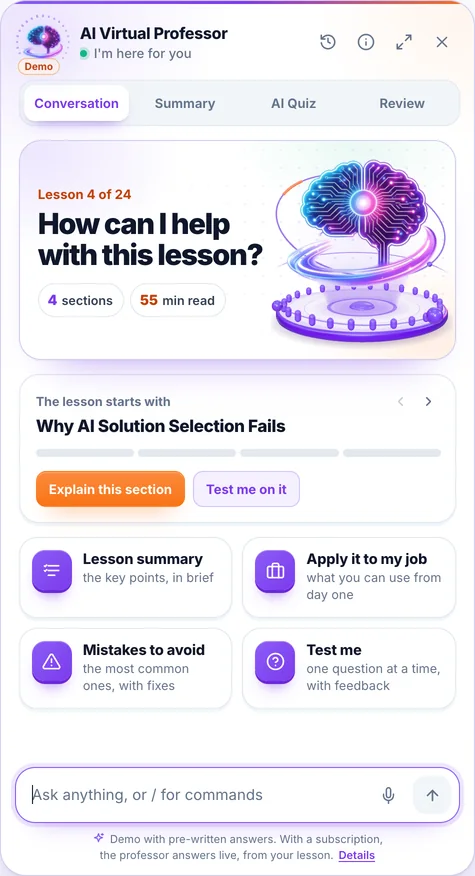
The demo opens on a lesson from the course “AI for Business Leaders”, with prepared answers; voice is off in the demo.
It is an artificial intelligence system, not a human teacher; its answers may contain errors. Details in the Terms & Conditions.
Reinforcement learning (RL) is the branch of machine learning concerned with learning to act. Instead of learning from a fixed dataset of labelled examples, an RL agent learns by interacting with an environment: it takes actions, observes the consequences, and gradually improves its behaviour to maximise a numerical reward. It is the framework behind game-playing systems that beat world champions, robots that learn to walk, recommendation systems that optimise long-term engagement, and — most importantly for this course — the alignment of the large language models you use every day.
Educational note: This course is for learning. Any preference data, human feedback, or training corpus you use in practice must respect data-protection law (GDPR in the EU), dataset licences, and copyright. Alignment work carries real ethical weight — you are shaping how a system behaves toward people — so we return to legal and safety obligations throughout the course. Nothing here is legal advice.
Supervised, unsupervised, and reinforcement learning
It helps to place RL against the other two paradigms. In supervised learning you have inputs paired with correct outputs, and the model learns to reproduce the mapping. In unsupervised learning you have inputs with no labels, and the model finds structure. Reinforcement learning is different in three fundamental ways:
- There is no supervisor, only a reward signal. Nobody tells the agent the correct action. It only receives a scalar reward that says how good the outcome was, and it must figure out which actions led to that reward.
- Feedback can be delayed. An action taken now may only pay off many steps later. Winning a chess game depends on moves made long before the final position. This is the credit assignment problem, and it haunts every algorithm we will study.
- Data is not independent and identically distributed. The agent's own choices determine what it sees next. Explore poorly and you never even observe the states where the good rewards live.
A comparison table makes the contrasts concrete:
| Aspect | Supervised | Unsupervised | Reinforcement |
|---|---|---|---|
| Training signal | Correct label per example | None (structure only) | Scalar reward, possibly delayed |
| Data distribution | Fixed, i.i.d. | Fixed, i.i.d. | Depends on the agent's own behaviour |
| Goal | Reproduce a mapping | Discover structure | Maximise cumulative reward |
| Typical failure | Overfitting to labels | Meaningless clusters | Reward hacking, instability, poor exploration |
| Example | Spam classification | Topic clustering | Game playing, robotics, LLM alignment |
These properties make RL powerful and also notoriously difficult. Much of this course is about the algorithms and engineering tricks that make it work anyway.
The agent-environment loop
At the heart of RL is a simple loop. At each time step t the agent observes a state s_t, chooses an action a_t, and the environment responds with a reward r_{t+1} and a new state s_{t+1}. The agent's goal is to choose actions that maximise the cumulative reward over time, not just the immediate one.
Pick up exactly where you left off
Pick the option that fits you; your account is created at checkout in under a minute:
What's next in this lesson
- The canonical reinforcement learning loop, expressed against the
- Gymnasium API (the maintained successor to OpenAI Gym).
- States versus observations
- Episodic and continuing tasks
- Reward is the only objective
- A brief map of the algorithm landscape
- A short history that explains the present
- Why RL matters right now
Everything you'll learn in this course
1 Foundations of Reinforcement Learning 3 lessons
- What Reinforcement Learning Is and Why It Matters in 2026 Reading now 46 min
- Markov Decision Processes: States, Actions and Rewards 50 min
- Policies, Value Functions and the Bellman Equations 52 min
2 Exploration and Tabular Solution Methods 4 lessons
- Dynamic Programming: Policy Iteration and Value Iteration 52 min
- Exploration versus Exploitation 50 min
- Monte Carlo and Temporal-Difference Learning 52 min
- Q-Learning 50 min
3 Value-Based Deep Reinforcement Learning 3 lessons
- Function Approximation and the Deadly Triad 52 min
- Deep Q-Networks (DQN) 52 min
- Beyond DQN: Double DQN, Dueling Networks and Prioritized Replay 50 min
4 Policy Gradient Methods 3 lessons
- Policy Gradients and REINFORCE 52 min
- Actor-Critic Methods: A2C and A3C 50 min
- Continuous Control: DDPG, TD3 and Soft Actor-Critic 52 min
5 Proximal Policy Optimization 2 lessons
- PPO in Detail 52 min
- Implementing PPO with Stable-Baselines3 48 min
6 From RL to RLHF: Aligning Language Models 4 lessons
- Why Language Models Need Alignment: Pretraining, SFT and the RLHF Pipeline 48 min
- Preference Data: Collection, Annotation Quality and Legal Obligations 50 min
- Reward Models from Human Preferences 52 min
- PPO for RLHF: How ChatGPT and Claude Were Aligned 52 min
7 Beyond PPO: DPO, RLAIF, GRPO and Verifiable Rewards 4 lessons
- Direct Preference Optimization (DPO) 52 min
- RLAIF and Constitutional AI 50 min
- GRPO and Modern Alignment in 2026 50 min
- RLVR: Verifiable Rewards and the Training of Reasoning Models 52 min
8 Reward Hacking, Alignment and Safety 2 lessons
- Reward Hacking and Specification Gaming 50 min
- Alignment, Safety and Responsible RLHF 50 min
9 RLHF in Practice and Evaluation 4 lessons
- Training a Reward Model with TRL 48 min
- DPO Fine-Tuning with TRL 48 min
- Evaluating Aligned Models 50 min
- Real-World Applications and Course Wrap-Up 46 min
10 Final Quiz — Reinforcement Learning and RLHF 1 lessons
- Final Assessment — Reinforcement Learning and RLHF 55 min
Everything you need to learn effectively
Interactive quizzes
Check your knowledge at the end of every lesson with scored quizzes and feedback.
Personal notes
Save notes on every lesson, accessible anytime from your dashboard.
Scheduled reviews
Revisit lessons exactly when it matters, at the right intervals — so you remember for the long term.
Progress & Achievements
Track your progress, unlock achievements, and visualize what you've learned.
Bookmarks
Save the lessons that matter and find them instantly when you need them.
Questions & Answers
Ask questions right on the lesson and get answers from our team.
Good to know before you start
How do I get access to the course?
You can read the beginning of the first lesson for free, right on this page. For the course you create an account, pick the subscription that fits — a single course or a bundle — and get access immediately after your payment is confirmed. Everything happens 100% online.
Can I cancel my subscription anytime?
Yes. Cancel anytime, straight from your account, in just a few clicks. Your access stays active until the end of the period you have already paid for.
What does the subscription for this course include?
All 30 lessons in the course, interactive quizzes, the AI Professor built into every lesson (select a passage and choose “Explain this to me”), within a fair-use limit, personal notes, automatically saved progress, and content updates included.
Is there a fixed learning schedule?
No. You learn at your own pace, on any device. Lessons are structured step by step, and the platform saves your progress automatically, so you can pick up right where you left off — anytime.
Ready to unlock all the content?
Just this course — €99 / month, VAT included — or every IT Pro course, with smart quizzes and the AI Professor included, in the bundle at €399 / month, VAT included.