
The New Era of Content Creation: Controlled Quality at AI Speed
From the course AI for Content Creation and Copywriting
In every lesson
The AI Professor starts from the lesson you have open
You ask it in writing or by voice, right from the lesson, and you can listen to the answer on request. Where needed, it fills in from general knowledge. When you select a passage, a bar appears with “Explain this to me”, “Give me an example”, “Why does it matter?” and “My own question”.
Its panel has four tabs:
- Conversation: you ask, it answers starting from the lesson
- Summary: the key ideas of the lesson, point by point
- AI Quiz: 3, 5 or 10 new questions from the lesson, with explanations
- Review: flashcards made from the lesson
Included in every subscription and in single-course access, within a fair-use limit.
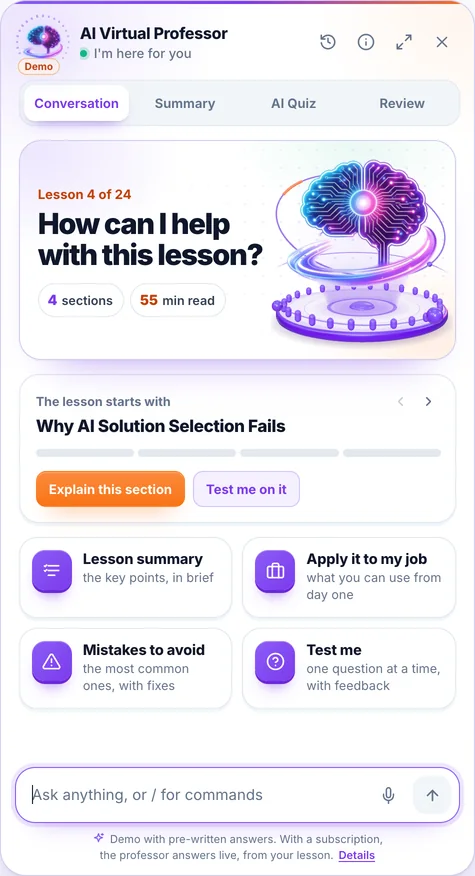
The demo opens on a lesson from the course “AI for Business Leaders”, with prepared answers; voice is off in the demo.
It is an artificial intelligence system, not a human teacher; its answers may contain errors. Details in the Terms & Conditions.
It has never been easier to produce content — and it has never been harder to stand out. Artificial Intelligence has radically transformed how content gets produced, but speed without strategy only generates noise: the internet is filling up with texts that are grammatically correct and completely interchangeable, while Google, through E-E-A-T, rewards exactly the opposite. In 2026, the winner is not whoever writes the most, but whoever builds a content engine that combines AI efficiency with human editorial rigor — the generator works at machine speed, while the editor-in-chief keeps quality under control. This course is about building exactly that engine: copywriting with proven frameworks (AIDA, PAS), SEO strategies with Surfer and Frase, video and audio production with Descript and ElevenLabs, a Quality Assurance pipeline, and a repurposing system that turns a single article into 15 formats — with real tools, prices, prompts, and step-by-step tutorials, including specific considerations for your local market.
Why Volume Alone No Longer Works
For years, the dominant strategy in content marketing was simple: publish more. More articles, more posts, more content — and the algorithms will reward you. That era has ended for good.
Google rolled out a series of updates that changed the rules of the game:
E-E-A-T (Experience, Expertise, Authoritativeness, Trustworthiness) — starting in December 2022 and reinforced through the 2024-2025 updates, Google now evaluates whether the content's author has direct experience with the subject. An article about "The best CRMs" written by an AI with no expert human input is now actively penalized.
Helpful Content Update — initially launched in August 2022 and later integrated into the core ranking system, this algorithm identifies and demotes sites that publish content created "primarily for search engines rather than people". After the major updates of 2024, numerous sites that were mass-publishing AI-generated content with no added value reported severe drops in organic traffic — in many cases losses in the tens of percent, up to the near-total disappearance of their visibility.
The practical implication: 10 generic AI-generated articles are worth less than a single well-researched article, edited and enriched with human expertise. Controlled quality at high speed — this is the new winning formula.
The "Hallucination" Phenomenon — What It Is and Why It Matters
One of the most dangerous aspects of using AI in content creation is hallucination — the tendency of language models to generate information that sounds convincing but is completely false.
Pick up exactly where you left off
Pick the option that fits you; your account is created at checkout in under a minute:
What's next in this lesson
- Real Examples of Costly Errors
- Why Hallucination Happens
- Separating the Roles: AI = Generator, Human = Editor-in-Chief
- The Operational Workflow in 5 Steps
- Step 1: Brief (15-20 minutes)
- Step 2: AI Draft (5-15 minutes)
- Step 3: Intent-Based Editing (20-40 minutes)
- Step 4: Fact-Check (10-20 minutes)
Everything you'll learn in this course
1 Content AI Fundamentals 3 lessons
- The New Era of Content Creation: Controlled Quality at AI Speed Reading now 65 min
- Mapping the Impact: Where AI Delivers the Fastest Content ROI 60 min
- The Content Creator's Arsenal: Real AI Tools with Pricing 65 min
2 Editorial Strategy and Research with AI 3 lessons
- The Anatomy of the Audience: Buyer Personas and Research with AI 60 min
- The Architecture of Authority: Topic Clusters, SEO, and Content Strategy with AI 60 min
- The Art of the Brief: How to Order Quality Content from AI 55 min
3 Text Production and Copywriting with AI 4 lessons
- From Prompt to High-Performing Copy: Engineering Commercial Text with AI 65 min
- Attention Engineering: Headlines, Hooks, and Scroll-Stoppers That Convert 55 min
- Long-Form Masterclass: SEO Articles, Whitepapers, and Guides that Educate and Sell 65 min
- Email Marketing with AI: Smart Sequences that Turn Subscribers into Customers 65 min
4 Multi-Format: Social Media, Video and Audio with AI 3 lessons
- The Social Content Factory: A Multi-Platform Production System with AI 65 min
- Video Content with AI: Scripts, Captions, Editing, and Avatars 65 min
- Audio Content: Podcasts, Voiceovers, and Premium Text-to-Speech 60 min
5 Quality, Brand Voice and Compliance 4 lessons
- The Identity Guardian: How to Keep Your Brand Voice Consistent with AI 60 min
- The Fact Detective: Fact-Checking and Source Verification in AI Content 55 min
- The Red Line: Copyright, GDPR, and Legal Aspects in AI Content 60 min
- The QA Pipeline: Complete Quality Assurance for AI Content 60 min
6 Operations, KPIs and Scaling 4 lessons
- Content Operations: Roles, SLAs, and Batch Production 60 min
- Metrics That Matter: From Vanity to Business Impact 55 min
- The ROI of Content AI: How to Convince Stakeholders 60 min
- The 30-90-180 Day Roadmap for Successful Content AI 65 min
7 Final Quiz — Content AI 1 lessons
- Final Assessment: Content Creation and Copywriting with AI 80 min
8 Hands-On Tutorials: Content AI in Action 3 lessons
- Complete Tutorial: How to Write a 2,000-Word SEO Article in 45 Minutes 65 min
- Tutorial: How to Create a 3-Month Editorial Calendar with AI 55 min
- Tutorial: Repurposing Masterclass — 1 Article → 15 Formats in 60 Minutes 60 min
9 Content AI for Smaller European Markets 4 lessons
- Content Marketing in Smaller European Markets: Platforms, Audiences and Local Specifics 60 min
- AI Copywriting in Romanian: Challenges, Solutions, and Optimized Prompts 60 min
- Transparency and AI Content Labeling: What the Law Requires in 2026 (EU AI Act Art. 50 + C2PA) 45 min
- Official Resources, 2026 Updates, and Learning Paths 35 min
Everything you need to learn effectively
Interactive quizzes
Check your knowledge at the end of every lesson with scored quizzes and feedback.
Personal notes
Save notes on every lesson, accessible anytime from your dashboard.
Scheduled reviews
Revisit lessons exactly when it matters, at the right intervals — so you remember for the long term.
Progress & Achievements
Track your progress, unlock achievements, and visualize what you've learned.
Bookmarks
Save the lessons that matter and find them instantly when you need them.
Questions & Answers
Ask questions right on the lesson and get answers from our team.
Good to know before you start
How do I get access to the course?
You can read the beginning of the first lesson for free, right on this page. For the course you create an account, pick the subscription that fits — a single course or a bundle — and get access immediately after your payment is confirmed. Everything happens 100% online.
Can I cancel my subscription anytime?
Yes. Cancel anytime, straight from your account, in just a few clicks. Your access stays active until the end of the period you have already paid for.
What does the subscription for this course include?
All 29 lessons in the course, interactive quizzes, the AI Professor built into every lesson (select a passage and choose “Explain this to me”), within a fair-use limit, personal notes, automatically saved progress, and content updates included.
Is there a fixed learning schedule?
No. You learn at your own pace, on any device. Lessons are structured step by step, and the platform saves your progress automatically, so you can pick up right where you left off — anytime.
Ready to unlock all the content?
Just this course — €99 / month, VAT included — or every Business course, with smart quizzes and the AI Professor included, in the bundle at €299 / month, VAT included.