
What E-commerce and Retail Teams Need to Know About AI in 2026
From the course AI for E-commerce and Retail
In every lesson
The AI Professor starts from the lesson you have open
You ask it in writing or by voice, right from the lesson, and you can listen to the answer on request. Where needed, it fills in from general knowledge. When you select a passage, a bar appears with “Explain this to me”, “Give me an example”, “Why does it matter?” and “My own question”.
Its panel has four tabs:
- Conversation: you ask, it answers starting from the lesson
- Summary: the key ideas of the lesson, point by point
- AI Quiz: 3, 5 or 10 new questions from the lesson, with explanations
- Review: flashcards made from the lesson
Included in every subscription and in single-course access, within a fair-use limit.
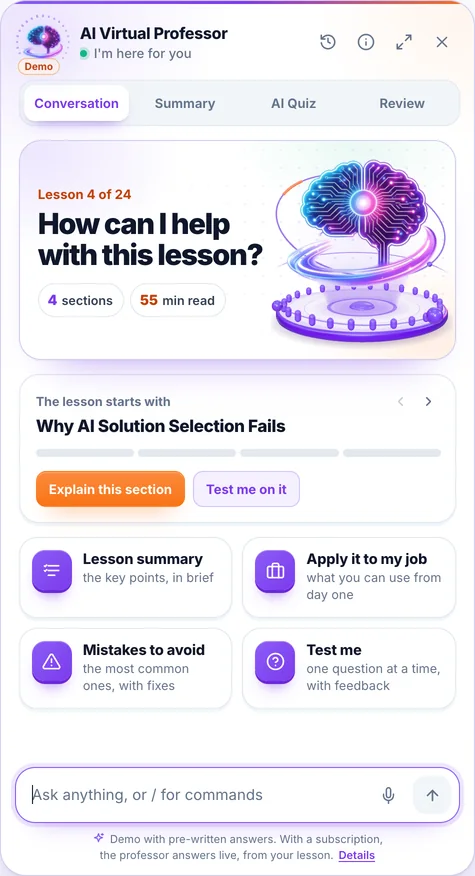
The demo opens on a lesson from the course “AI for Business Leaders”, with prepared answers; voice is off in the demo.
It is an artificial intelligence system, not a human teacher; its answers may contain errors. Details in the Terms & Conditions.
By 2026, artificial intelligence is no longer a novelty bolted onto an online store — it runs quietly inside the tools most retailers already use every day. It writes the first draft of a product description, cleans up a product photo, decides which four products to show a returning shopper, answers a "where is my order" message at 2 a.m., and flags a suspicious transaction before it ships. The gap in the market is no longer access to AI; it is knowing where AI genuinely earns its place in a store and where it quietly creates risk.
This course is about that judgment, applied specifically to e-commerce and retail operations. It is not a general digital-marketing course. We are focused on the mechanics of running a store: catalog, imagery, search, merchandising, pricing, inventory, reviews, service, marketplaces, returns and conversion — and the legal guardrails that sit under each one in the EU.
The one principle to carry through the whole course
AI scales the store. Humans stay accountable for what customers see, pay, and trust.
Every module hangs off that sentence. AI can generate a thousand product descriptions in an afternoon — but if one of them overstates what a product does, you have a consumer-protection problem, not a productivity win. AI can set a price dynamically — but if that price adjusts based on the wrong signal, you can create a legal and reputational mess. The skill this course teaches is using AI aggressively where it is safe and cheap to be wrong, and keeping a human firmly in the loop where a mistake reaches a customer as a claim, a price, or a decision.
Hold that principle up against any AI idea you hear this year and it will sort itself instantly into "ship it" or "gate it behind human review".
Where AI genuinely helps a store
The honest 2026 picture: AI is excellent at the first draft, the pattern, and the tireless repetitive task, and weaker at final judgment and the exception. Across the shopper journey, that maps to:
- Catalog and content: drafting product titles, descriptions, bullet points, size guides, and FAQs from structured attributes — at a scale no copywriter could match manually.
- Imagery: removing backgrounds, generating lifestyle scenes, upscaling, standardising angles, and producing consistent on-model or in-context shots.
- Discovery: semantic and visual site search that understands "warm jacket for a rainy hike" rather than only matching exact keywords.
- Personalization: product recommendations, "complete the look", and re-ordering category pages per shopper.
- Operations: demand forecasting, inventory allocation, reorder suggestions, and returns triage.
- Trust and service: review summarization, moderation, fraud scoring, and tier-one customer support.
- Conversion: on-site shopping assistants, A/B test idea generation, and analytics narratives that a manager can act on.
Pick up exactly where you left off
Pick the option that fits you; your account is created at checkout in under a minute:
What's next in this lesson
- Where AI must not be left alone
- The 2026 tool and model landscape, briefly
- A worked example: sorting one week of AI ideas
- How to read the rest of this course
- Common mistakes this course prevents
- The economics: cost savings versus revenue moves
- A maturity model for AI in retail
- In practice
Everything you'll learn in this course
1 Module 0 — The AI E-commerce and Retail Landscape in 2026 2 lessons
- What E-commerce and Retail Teams Need to Know About AI in 2026 Reading now 50 min
- The AI Retail Tech Stack: Tools and Where They Fit 50 min
2 Module 1 — Product Content and Listings at Scale 4 lessons
- Writing Product Descriptions and Listings with AI 52 min
- Product Data Quality: Taxonomy, Attributes and Catalog Enrichment 50 min
- SEO Product Content and Structured Data with AI 50 min
- Legal Guardrails: Accurate Product Claims 52 min
3 Module 2 — Product Photography and Visual Content with AI 2 lessons
- AI Product Photography and Image Enhancement 50 min
- Generated Models, Lifestyle Scenes and Disclosure 50 min
4 Module 3 — Personalization and Recommendations 4 lessons
- How Recommendation Engines Work for Retail 50 min
- Personalization at Scale Across the Journey 50 min
- Testing and Measuring Personalization: Experiments and Uplift 50 min
- GDPR and Consent for Personalization 52 min
5 Module 4 — AI Site Search and Merchandising 2 lessons
- AI Site Search: Semantic and Visual Discovery 50 min
- AI Merchandising and Category Management 50 min
6 Module 5 — Pricing, Inventory, Demand and Retail Operations 4 lessons
- Dynamic Pricing with AI — Done Legally 52 min
- Demand Forecasting and Inventory with AI 50 min
- AI for Returns Reduction and Reverse Logistics 50 min
- In-Store and Omnichannel AI for Retail 50 min
7 Module 6 — Conversational Commerce, Service and Email 4 lessons
- Shopping Assistants and Conversational Commerce 50 min
- Agentic Commerce: AI Shopping Agents and Getting Your Store Ready 50 min
- AI Customer Service for Retail 50 min
- Email, SMS and Retargeting with AI 50 min
8 Module 7 — Reviews, UGC, Loyalty and Marketplaces 3 lessons
- Customer Reviews and UGC with AI 50 min
- Loyalty and Retention with AI 50 min
- Marketplace Optimization: Amazon and Beyond 52 min
9 Module 8 — Fraud, Analytics, CRO and Your Roadmap 4 lessons
- Fraud Detection and Trust in Retail 50 min
- Analytics and Conversion Rate Optimization with AI 50 min
- Building an AI Governance Framework for Your Retail Operation 50 min
- Your AI Retail Roadmap and Operating Model 50 min
10 Final Quiz — AI for E-commerce and Retail 1 lessons
- Final Assessment: AI for E-commerce and Retail 30 min
Everything you need to learn effectively
Interactive quizzes
Check your knowledge at the end of every lesson with scored quizzes and feedback.
Personal notes
Save notes on every lesson, accessible anytime from your dashboard.
Scheduled reviews
Revisit lessons exactly when it matters, at the right intervals — so you remember for the long term.
Progress & Achievements
Track your progress, unlock achievements, and visualize what you've learned.
Bookmarks
Save the lessons that matter and find them instantly when you need them.
Questions & Answers
Ask questions right on the lesson and get answers from our team.
Good to know before you start
How do I get access to the course?
You can read the beginning of the first lesson for free, right on this page. For the course you create an account, pick the subscription that fits — a single course or a bundle — and get access immediately after your payment is confirmed. Everything happens 100% online.
Can I cancel my subscription anytime?
Yes. Cancel anytime, straight from your account, in just a few clicks. Your access stays active until the end of the period you have already paid for.
What does the subscription for this course include?
All 30 lessons in the course, interactive quizzes, the AI Professor built into every lesson (select a passage and choose “Explain this to me”), within a fair-use limit, personal notes, automatically saved progress, and content updates included.
Is there a fixed learning schedule?
No. You learn at your own pace, on any device. Lessons are structured step by step, and the platform saves your progress automatically, so you can pick up right where you left off — anytime.
Ready to unlock all the content?
Just this course — €99 / month, VAT included — or every Business course, with smart quizzes and the AI Professor included, in the bundle at €299 / month, VAT included.