
AI-First Entrepreneurship in 2026: What It Means and Why It Matters
From the course AI for Entrepreneurs and Startups: The Complete Guide
In every lesson
The AI Professor starts from the lesson you have open
You ask it in writing or by voice, right from the lesson, and you can listen to the answer on request. Where needed, it fills in from general knowledge. When you select a passage, a bar appears with “Explain this to me”, “Give me an example”, “Why does it matter?” and “My own question”.
Its panel has four tabs:
- Conversation: you ask, it answers starting from the lesson
- Summary: the key ideas of the lesson, point by point
- AI Quiz: 3, 5 or 10 new questions from the lesson, with explanations
- Review: flashcards made from the lesson
Included in every subscription and in single-course access, within a fair-use limit.
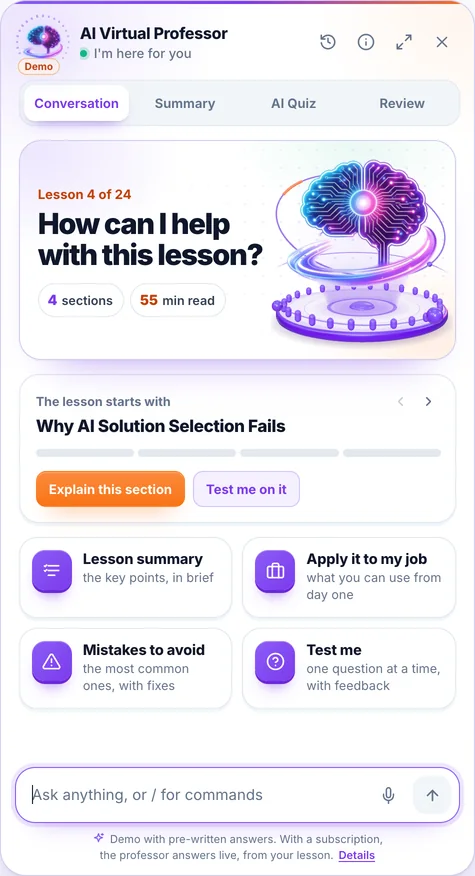
The demo opens on a lesson from the course “AI for Business Leaders”, with prepared answers; voice is off in the demo.
It is an artificial intelligence system, not a human teacher; its answers may contain errors. Details in the Terms & Conditions.
Five years ago, launching a digital product required a team of 10 developers and a budget of 200,000 EUR. Today you need a real problem, sound judgment, and the ability to use AI as a virtual co-founder. That is the shift 2026 lays at the feet of every entrepreneur: AI tools have become affordable, no-code platforms have matured, and markets across Europe are going through an unprecedented wave of digitalization. If you are reading this course, you probably already have an idea — or at least the intuition that artificial intelligence can radically transform the way businesses are built. You are right. And in the pages ahead you will apply AI exactly the way the most successful entrepreneurs in the global ecosystem use it, step by step, from validating your idea all the way to scaling. Let's begin.
AI-First vs. AI-Assisted: The Fundamental Difference
The first thing you need to understand is the distinction between an AI-first company and an AI-assisted one. It is not just a semantic nuance — it is a difference in architecture, culture, and competitive advantage.
AI-assisted means a traditional company that adds a layer of AI on top of existing processes. Think of an online store that uses ChatGPT to generate product descriptions. Valuable? Yes. Transformative? Not really. If you remove the AI, the company keeps functioning — slower and more expensively, but it functions.
AI-first means artificial intelligence is the core of the product or service. Without AI, the company does not exist in its current form. Think of Midjourney: without the generative image model, there is no product. Or Harvey AI (legaltech): without the LLM trained on legal documents, there is no service.
The key differences:
- Decision-making: AI-assisted makes decisions the traditional way and uses AI for execution; AI-first uses AI to inform and even make decisions
- Scaling: AI-assisted scales linearly (more people = more work); AI-first scales exponentially (one model serves millions of users)
- Differentiation: AI-assisted has temporary differentiation (anyone can add ChatGPT); AI-first has structural differentiation (proprietary data, fine-tuned models)
- Marginal cost: AI-assisted cuts costs by 20-40%; AI-first pushes marginal cost close to zero
As an entrepreneur in 2026, you do not necessarily have to build the next OpenAI. But you do have to think AI-first: what would your business look like if every process — from customer support to content generation, from financial analysis to product development — were built around artificial intelligence from day one?
Why 2026 Is the Perfect Moment
This is not a motivational slogan — there is concrete data behind the claim.
AI costs have dropped dramatically. In 2023, an API call to GPT-4 cost roughly $0.06 per 1K output tokens. In 2026, comparable or superior models (GPT-6 Sol, Claude Opus 5.5, Gemini 3.8 Flash / Gemini 3.1 Pro) are priced far lower: on the order of $0.004/$0.020 per 1K input/output tokens for Claude Opus 5.5 (released September 22, 2026) and $0.002/$0.010 for GPT-6 Sol (released September 22, 2026). For high volumes there are even cheaper models (Gemini 3.8 Flash, GPT-6 Luna, Claude Haiku 4.5). A startup can run tens of thousands of AI calls per month on a budget under 100 EUR.
Pick up exactly where you left off
Pick the option that fits you; your account is created at checkout in under a minute:
What's next in this lesson
- What AI Can Do for an Entrepreneur
- What AI Cannot Do (and Will Not Anytime Soon)
- The Entrepreneurial Ecosystem in an Emerging EU Market: Romania in 2026
- The 3 Phases: Validation → Launch → Scaling
- Practical Exercise: AI-Readiness Self-Assessment
- Conclusion: The AI-First Manifesto
Everything you'll learn in this course
1 Fundamentals: AI-First Entrepreneurship 3 lessons
- AI-First Entrepreneurship in 2026: What It Means and Why It Matters Reading now 65 min
- The Opportunity Map: How to Identify Viable Business Ideas with AI 60 min
- The AI Entrepreneur's Toolkit: Tools and Pricing for Every Phase 65 min
2 Validation and Product-Market Fit with AI 3 lessons
- Idea Validation: Interviews, Market Signals, and Rapid Testing with AI 60 min
- Market Research with AI: Competition, Trends, and Market Size 60 min
- MVP Strategy: Build the Minimum to Learn the Maximum 65 min
3 Product, Experience and Delivery with AI 3 lessons
- No-Code + AI: How to Launch Fast Without a Technical Team 65 min
- Customer Journey: From First Interaction to Loyal Customer with AI 60 min
- Prompt Operations: How to Standardize AI Quality in Your Business 60 min
4 Go-To-Market and Growth with AI 4 lessons
- The Commercial Offer: Pricing, Positioning, and Differentiation with AI 60 min
- Lead Generation with AI: Controlled Volume, High Quality 65 min
- Sales with AI: Discovery, Proposal, Negotiation, and Closing 60 min
- Hybrid Customer Support: AI + Human for Speed and Trust 60 min
5 Finance, Operations and Efficiency with AI 3 lessons
- Unit Economics: CAC, LTV, Margin, and Burn Rate with AI 65 min
- Cash Flow Management: How to Avoid Financial Bottlenecks 60 min
- Operational Automation: The Processes That Deserve AI First 65 min
6 Risk, Legal and Governance with AI 3 lessons
- AI Risks for Entrepreneurs: Hallucinations, Bias, and Over-Reliance 55 min
- Legal and Compliance: Company Formation, GDPR, and Contracts for Startups 65 min
- Governance and Decision-Making with AI 55 min
7 Scaling and Maturing 3 lessons
- Scaling the Team: First Hires and Culture Building with AI 60 min
- KPIs and Metrics: What to Measure for Healthy Growth 60 min
- A 30-90-180 Day Roadmap for an AI-First Startup 65 min
8 Final Quiz — AI for Entrepreneurs 1 lessons
- Final Assessment: AI for Entrepreneurs and Startups 80 min
9 Hands-On Tutorials: Entrepreneurial AI in Action 3 lessons
- Tutorial: How to Validate a Business Idea with AI in 48 Hours 65 min
- Tutorial: How to Launch a SaaS MVP with No-Code + AI in 14 Days 65 min
- Tutorial: How to Create a Content Marketing Engine with AI in 7 Days 60 min
10 AI Entrepreneurship in Emerging European Markets: Ecosystem and Opportunities 2 lessons
- The Startup Ecosystem in an Emerging European Market: Funding, Accelerators and Communities 60 min
- Tax and Legal Specifics for Startups in an Emerging EU Market: The Romanian Case 60 min
11 Official Resources, 2026 Updates and Learning Paths 2 lessons
- Official Resources, 2026 Updates and Learning Paths 32 min
- Quiz: Resources, 2026 Updates and Recap 8 min
Everything you need to learn effectively
Interactive quizzes
Check your knowledge at the end of every lesson with scored quizzes and feedback.
Personal notes
Save notes on every lesson, accessible anytime from your dashboard.
Scheduled reviews
Revisit lessons exactly when it matters, at the right intervals — so you remember for the long term.
Progress & Achievements
Track your progress, unlock achievements, and visualize what you've learned.
Bookmarks
Save the lessons that matter and find them instantly when you need them.
Questions & Answers
Ask questions right on the lesson and get answers from our team.
Good to know before you start
How do I get access to the course?
You can read the beginning of the first lesson for free, right on this page. For the course you create an account, pick the subscription that fits — a single course or a bundle — and get access immediately after your payment is confirmed. Everything happens 100% online.
Can I cancel my subscription anytime?
Yes. Cancel anytime, straight from your account, in just a few clicks. Your access stays active until the end of the period you have already paid for.
What does the subscription for this course include?
All 30 lessons in the course, interactive quizzes, the AI Professor built into every lesson (select a passage and choose “Explain this to me”), within a fair-use limit, personal notes, automatically saved progress, and content updates included.
Is there a fixed learning schedule?
No. You learn at your own pace, on any device. Lessons are structured step by step, and the platform saves your progress automatically, so you can pick up right where you left off — anytime.
Ready to unlock all the content?
Just this course — €99 / month, VAT included — or every Business course, with smart quizzes and the AI Professor included, in the bundle at €299 / month, VAT included.