
What Project and Product Managers Need to Know About AI in 2026
From the course AI for Project and Product Management
In every lesson
The AI Professor starts from the lesson you have open
You ask it in writing or by voice, right from the lesson, and you can listen to the answer on request. Where needed, it fills in from general knowledge. When you select a passage, a bar appears with “Explain this to me”, “Give me an example”, “Why does it matter?” and “My own question”.
Its panel has four tabs:
- Conversation: you ask, it answers starting from the lesson
- Summary: the key ideas of the lesson, point by point
- AI Quiz: 3, 5 or 10 new questions from the lesson, with explanations
- Review: flashcards made from the lesson
Included in every subscription and in single-course access, within a fair-use limit.
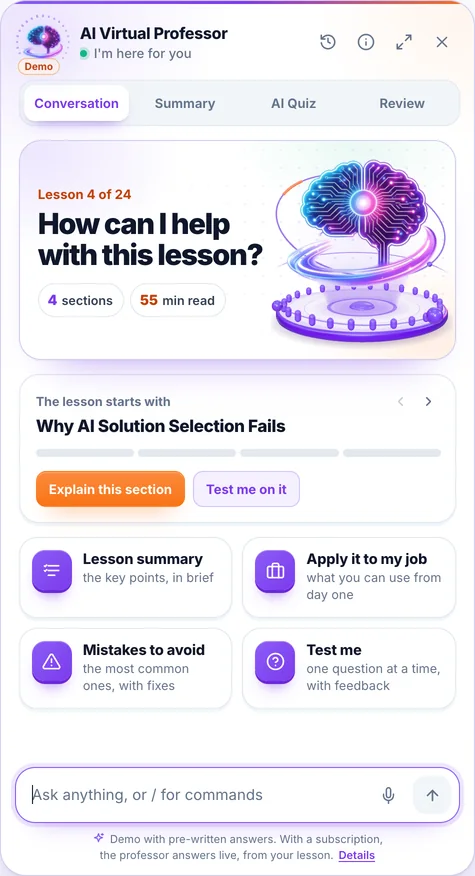
The demo opens on a lesson from the course “AI for Business Leaders”, with prepared answers; voice is off in the demo.
It is an artificial intelligence system, not a human teacher; its answers may contain errors. Details in the Terms & Conditions.
By 2026, artificial intelligence has stopped being a novelty for project and product managers and become part of the plumbing. It is inside the tools you already use — Jira, Linear, Notion, Confluence, Amplitude, Mixpanel, Slack, your calendar and your inbox — and it is available as general-purpose assistants such as Claude (Opus 5.5, Sonnet 5, Fable 5.1), GPT-6 Sol, Gemini 3.1 Pro and Microsoft 365 Copilot. The question is no longer whether to use AI. It is where it genuinely helps, where it quietly hurts, and how to stay accountable for decisions a machine can draft but must never own.
This lesson gives you the mental model the rest of the course builds on. Read it as the operating system for everything that follows.
The core framing: AI is a co-pilot, not the pilot
Throughout this course we treat AI as a co-pilot: it drafts, summarizes, structures, translates, reformats and surfaces patterns at a speed no human can match. But strategy, trade-offs, prioritization calls, estimates you commit to, and the accountable decision remain human. A pilot who lets the autopilot fly is still the person the airline holds responsible for the landing. The same is true for you: when a roadmap slips, when a launch date is missed, when a feature ships with a privacy flaw, "the AI wrote it" is not a defense your stakeholders, your customers, or a regulator will accept.
This framing matters because modern models are fluent. They produce confident, well-structured, executive-ready prose even when the underlying claim is wrong. Fluency is not accuracy. The single most expensive mistake a PM can make in 2026 is to mistake a polished paragraph for a verified truth.
What AI is genuinely good at for PMs
- Drafting from a blank page. First drafts of PRDs, user stories, status updates, release notes, retro summaries, stakeholder emails. Turning a blank document into an 80% draft you edit.
- Summarizing volume. Compressing 20 interview transcripts, a 400-comment feedback thread, a quarter of support tickets, or a two-hour recorded workshop into themes and quotes.
- Restructuring and reformatting. Turning messy notes into a structured spec; converting a spec into a set of user stories; converting stories into a test-case checklist.
- Surfacing patterns and gaps. "What themes recur across these interviews?" "What edge cases are missing from these acceptance criteria?" "What risks does this plan not mention?"
- Translation and tone. Rewriting a technical update for executives, translating a doc for an international team, softening or sharpening a difficult message.
What AI is bad at — and must not own
- Judgment under ambiguity. Which of three good bets to make with limited engineers this quarter.
- Weighing invisible context. The quiet promise your VP made to a strategic customer; the political reason a project cannot be cut; the real story behind last quarter's miss. AI does not know what it was not told.
- Committing to numbers. An estimate, a date, or a forecast the business will plan around. AI can help you reason about these; a human owns them.
- Declaring outcomes. "The A/B test won." "This is the right strategy." "This risk is acceptable." These are accountable decisions.
- Being right about facts by default. Models fabricate statistics, citations, competitor claims and features with total confidence. Every fact that reaches a stakeholder must be verified against a real source.
Pick up exactly where you left off
Pick the option that fits you; your account is created at checkout in under a minute:
What's next in this lesson
- Why "AI does not know what it was not told"
- The 2026 model landscape, accurately
- The "Should AI touch this task?" filter
- Where AI now lives in the PM workflow
- A worked example: the Monday morning update
- Common pitfalls to avoid from day one
- Decision rights: who owns what
- A short scenario: the confident competitor number
Everything you'll learn in this course
1 Module 0 — AI in Project and Product Management: The 2026 Landscape 3 lessons
- What Project and Product Managers Need to Know About AI in 2026 Reading now 50 min
- The 2026 AI Tool Stack for Project and Product Managers 50 min
- Guardrails from Day One: Confidentiality, GDPR and Human Decisions 50 min
2 Module 1 — Discovery and Customer Research with AI 3 lessons
- AI-Assisted Customer Discovery and Interviews 50 min
- Synthesizing Research: Themes, Insights and Jobs to Be Done 50 min
- Surveys, Feedback and Voice of Customer at Scale 50 min
3 Module 2 — PRDs, Specs and Product Documentation with AI 4 lessons
- Writing PRDs with AI 50 min
- Technical Specs, One-Pagers and Design Briefs 50 min
- Keeping Documentation Alive with Notion and Confluence 50 min
- Prototyping and Vibe-Coding: PMs Building Clickable Prototypes with AI 50 min
4 Module 3 — Prioritization and Roadmapping with AI 3 lessons
- AI-Assisted Prioritization: RICE, MoSCoW and Kano 50 min
- Roadmapping and Communicating the Plan 50 min
- OKRs, Goals and Outcome-Based Roadmaps with AI 50 min
5 Module 4 — User Stories and Backlog Grooming with AI 2 lessons
- Writing User Stories and Acceptance Criteria with AI 50 min
- Backlog Grooming and Refinement with AI 50 min
6 Module 5 — Project Planning, Estimation and Risk with AI 3 lessons
- Project Planning and Work Breakdown with AI 50 min
- Estimation and Scheduling with AI 50 min
- Risk Identification and Mitigation with AI 50 min
7 Module 6 — Communication, Status Reports and Stakeholders 3 lessons
- Status Reports and Stakeholder Updates with AI 50 min
- Meeting Notes, Action Items and Follow-ups 50 min
- Difficult Communications and Executive Summaries 50 min
8 Module 7 — Agile Delivery with AI 2 lessons
- Sprints, Standups and Ceremonies with AI 50 min
- Sprint Retrospectives and Continuous Improvement 50 min
9 Module 8 — Product Analytics, Experiments and Competitive Intelligence 3 lessons
- Product Analytics and Insights with Amplitude and Mixpanel 50 min
- A/B Testing and Experiment Design with AI 50 min
- Competitive Analysis and Market Research 50 min
10 Module 9 — Judgment, Guardrails and Measuring Impact 3 lessons
- Project Managers vs Product Managers: Where AI Fits Each Role 50 min
- Guardrails, Human Decisions and Verifying Output 50 min
- Measuring the Impact of AI on Your Team 50 min
11 Final Quiz — AI for Project and Product Management 1 lessons
- Final Assessment: AI for Project and Product Management 30 min
Everything you need to learn effectively
Interactive quizzes
Check your knowledge at the end of every lesson with scored quizzes and feedback.
Personal notes
Save notes on every lesson, accessible anytime from your dashboard.
Scheduled reviews
Revisit lessons exactly when it matters, at the right intervals — so you remember for the long term.
Progress & Achievements
Track your progress, unlock achievements, and visualize what you've learned.
Bookmarks
Save the lessons that matter and find them instantly when you need them.
Questions & Answers
Ask questions right on the lesson and get answers from our team.
Good to know before you start
How do I get access to the course?
You can read the beginning of the first lesson for free, right on this page. For the course you create an account, pick the subscription that fits — a single course or a bundle — and get access immediately after your payment is confirmed. Everything happens 100% online.
Can I cancel my subscription anytime?
Yes. Cancel anytime, straight from your account, in just a few clicks. Your access stays active until the end of the period you have already paid for.
What does the subscription for this course include?
All 30 lessons in the course, interactive quizzes, the AI Professor built into every lesson (select a passage and choose “Explain this to me”), within a fair-use limit, personal notes, automatically saved progress, and content updates included.
Is there a fixed learning schedule?
No. You learn at your own pace, on any device. Lessons are structured step by step, and the platform saves your progress automatically, so you can pick up right where you left off — anytime.
Ready to unlock all the content?
Just this course — €99 / month, VAT included — or every Business course, with smart quizzes and the AI Professor included, in the bundle at €299 / month, VAT included.