
The Knowledge Worker's AI Reality in 2026
From the course The AI Productivity Masterclass for Knowledge Workers
In every lesson
The AI Professor starts from the lesson you have open
You ask it in writing or by voice, right from the lesson, and you can listen to the answer on request. Where needed, it fills in from general knowledge. When you select a passage, a bar appears with “Explain this to me”, “Give me an example”, “Why does it matter?” and “My own question”.
Its panel has four tabs:
- Conversation: you ask, it answers starting from the lesson
- Summary: the key ideas of the lesson, point by point
- AI Quiz: 3, 5 or 10 new questions from the lesson, with explanations
- Review: flashcards made from the lesson
Included in every subscription and in single-course access, within a fair-use limit.
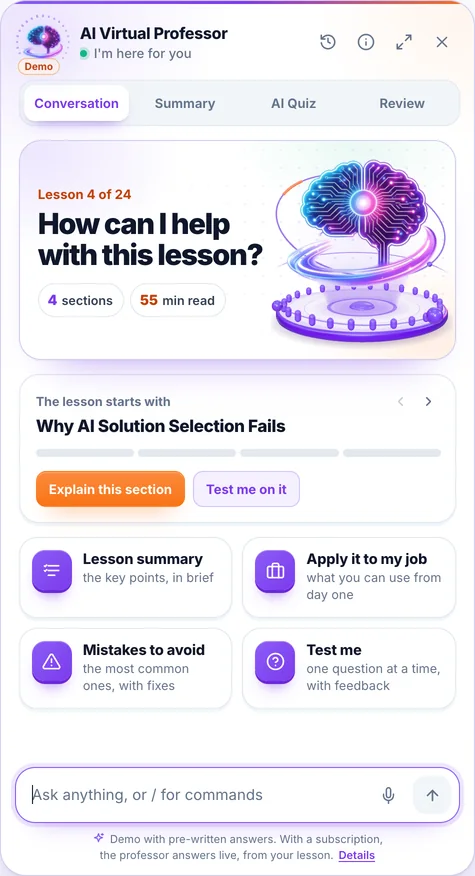
The demo opens on a lesson from the course “AI for Business Leaders”, with prepared answers; voice is off in the demo.
It is an artificial intelligence system, not a human teacher; its answers may contain errors. Details in the Terms & Conditions.
If your job is mostly reading, writing, analysing, planning, communicating and deciding — you are a knowledge worker, and this course was built for you. Not for engineers, not for data scientists. For the analyst who lives in spreadsheets and slide decks, the marketer juggling campaigns, the HR partner writing policies, the operations lead chasing status updates, the consultant turning messy notes into clean recommendations. In 2026, general-purpose AI assistants have become a normal part of that work, the way email and search once did. This lesson gives you an honest map of what that means, so you can use these tools with confidence instead of hype or fear.
What Actually Changed
The core shift is simple: you can now hold a natural-language conversation with a capable assistant that reads, writes and reasons across almost any topic. Tools like ChatGPT (OpenAI), Claude (Anthropic) and Gemini (Google) can draft an email in your tone, summarise a 40-page report into a one-page brief, turn rough bullet points into a structured proposal, or help you think through a tricky decision — in seconds, not hours.
What changed is not that machines became "smart" in a human sense. What changed is the cost of a first draft. A blank page — the empty email, the empty document, the empty analysis — used to be the most expensive part of knowledge work. AI collapses that cost to near zero. Your job shifts from producing the first version to directing, editing and verifying it. That is a different skill, and it is learnable.
This Course Is Vendor-Agnostic on Purpose
You might use ChatGPT at home, Gemini inside Google Workspace at work, or Claude through a company account. You might switch next quarter when your employer changes contracts. If this course taught you the buttons of one specific product, it would be outdated the moment your organisation changed suppliers.
So instead, you will learn a durable method: how to think about AI, how to write prompts that work in any tool, and how to build repeatable workflows for the tasks you actually do. The method transfers. Whether you type into ChatGPT, Claude or Gemini, the same principles apply. Where a specific tool has a genuinely distinctive strength, we will name it — but the goal is competence you keep, not loyalty to one brand.
Note: This course is not about Microsoft 365 Copilot specifically — that suite has its own dedicated course. Here we focus on the standalone assistants any professional can open in a browser.
The Three Assistants You'll Hear About
You do not need technical detail to choose well. Here is the plain-language picture as of September 2026:
- ChatGPT (GPT-6 Sol, OpenAI) — a strong all-rounder for drafting, brainstorming and creative work, and the ChatGPT app handles text, images and audio together in one place. Widely available with free and paid tiers.
- Claude (Opus 5.5 and Sonnet 5, Anthropic) — the Claude family is known for careful writing, following detailed instructions, and working through long documents without losing the thread. A favourite for analysis, editing and anything where accuracy and tone matter.
- Gemini (Gemini 3.1 Pro, Google) — strong at multimodal reasoning and tightly integrated with Google Workspace (Docs, Sheets, Gmail), so it feels natural if your day lives in Google tools.
You will go much deeper on choosing between them in Module 2. For now, remember the headline: there is no single "best" tool — there is the right tool for the task in front of you.
Three Myths Worth Dropping Today
Myth 1: "AI will do my job for me." It will not. It produces drafts and options; you still supply judgement, context and accountability. The professionals who win are not the ones who hand over their work — they are the ones who direct the tool well and check its output.
Myth 2: "AI is always right." It is not. These systems can produce fluent, confident text that is simply wrong — this is called a hallucination. It has improved a great deal, but it has not disappeared. Never treat an AI answer as a verified fact, especially before a decision. We dedicate a full lesson to verification later.
Pick up exactly where you left off
Pick the option that fits you; your account is created at checkout in under a minute:
What's next in this lesson
- A Realistic Picture of the Benefit
- How We Got Here: A Very Short History
- A Mental Model That Actually Works: The Brilliant New Hire
- The Four Failure Modes to Recognise
- Worked Micro-Example: The Same Task, Two Ways
- Your First-Week Experiment
- A Field Guide to the 2026 Assistant Experience
- Common Beginner Questions, Answered
Everything you'll learn in this course
1 The AI Mindset for Knowledge Workers 3 lessons
- The Knowledge Worker's AI Reality in 2026 Reading now 50 min
- Where AI Actually Helps — and Where It Doesn't 50 min
- Augmentation, Not Automation: Your New Operating Model 50 min
2 Choosing the Right Tool: ChatGPT vs Claude vs Gemini 3 lessons
- The 2026 AI Tool Landscape for Everyday Work 50 min
- Real Strengths: Matching the Tool to the Task 50 min
- Free vs Paid, Privacy Tiers, and Building Your Toolkit 50 min
3 Practical Prompting for Non-Technical People 3 lessons
- The Anatomy of a Great Prompt 50 min
- Six Prompt Patterns You'll Use Every Day 50 min
- Iterating, Refining, and Building Reusable Templates 50 min
4 Email & Everyday Communication 3 lessons
- Drafting, Replying, and Controlling Tone 50 min
- Difficult Messages and Cross-Cultural Communication 50 min
- Building Your Personal Communication Playbook 50 min
5 Documents, Reports & Summarization 3 lessons
- Summarizing Long Documents Reliably 50 min
- Writing Reports, Briefs, and Proposals 50 min
- Editing, Proofreading, and Formatting 50 min
6 Research & Synthesis (with Source Verification) 3 lessons
- Using AI for Research the Right Way 50 min
- Verifying Facts and Avoiding Hallucinations 50 min
- Synthesizing Multiple Sources Into Insight 50 min
7 Meetings, Notes, Tasks & Problem-Solving 3 lessons
- Meeting Prep, Notes, and Action Items 50 min
- Planning Your Day and Managing Tasks with AI 50 min
- Brainstorming and Problem-Solving with AI 50 min
8 Automations, Second Brain & Sustainable Habits 4 lessons
- Simple No-Code Automations for Everyday Work 50 min
- Building a Second Brain and Knowledge Management 50 min
- Reusable Custom Assistants: Projects, Custom GPTs and Gems 50 min
- Sustainable AI Habits and Routines 50 min
9 Privacy, Confidentiality & Responsible Use 4 lessons
- What Not to Paste: Privacy and Confidentiality 50 min
- GDPR, Company Policy, and Data Governance 50 min
- Intellectual Property and Ownership of AI Output 50 min
- Verifying Output and Using AI Responsibly 50 min
10 Final Quiz 1 lessons
- Final Assessment: The AI Productivity Masterclass 50 min
Everything you need to learn effectively
Interactive quizzes
Check your knowledge at the end of every lesson with scored quizzes and feedback.
Personal notes
Save notes on every lesson, accessible anytime from your dashboard.
Scheduled reviews
Revisit lessons exactly when it matters, at the right intervals — so you remember for the long term.
Progress & Achievements
Track your progress, unlock achievements, and visualize what you've learned.
Bookmarks
Save the lessons that matter and find them instantly when you need them.
Questions & Answers
Ask questions right on the lesson and get answers from our team.
Good to know before you start
How do I get access to the course?
You can read the beginning of the first lesson for free, right on this page. For the course you create an account, pick the subscription that fits — a single course or a bundle — and get access immediately after your payment is confirmed. Everything happens 100% online.
Can I cancel my subscription anytime?
Yes. Cancel anytime, straight from your account, in just a few clicks. Your access stays active until the end of the period you have already paid for.
What does the subscription for this course include?
All 30 lessons in the course, interactive quizzes, the AI Professor built into every lesson (select a passage and choose “Explain this to me”), within a fair-use limit, personal notes, automatically saved progress, and content updates included.
Is there a fixed learning schedule?
No. You learn at your own pace, on any device. Lessons are structured step by step, and the platform saves your progress automatically, so you can pick up right where you left off — anytime.
Ready to unlock all the content?
Just this course — €99 / month, VAT included — or every Business course, with smart quizzes and the AI Professor included, in the bundle at €299 / month, VAT included.